When a contractor does not deduct CIS from a subcontractor’s payment, HMRC raises the full liability against the contractor directly. This includes cases of CIS deductions not paid to HMRC or failure to deduct CIS tax entirely. The amount that was never deducted becomes the contractor’s debt to HMRC and remains so until HMRC decides otherwise.
Penalties begin from day one, interest accumulates from the date each payment was originally due and HMRC can investigate multiple years depending on why the failure occurred. The earlier this is addressed, the more options remain available.
Key takeaways
- Failing to verify a subcontractor can result in higher CIS liabilities and no reasonable excuse defence.
- CIS late filing penalties escalate over time and can quickly exceed the original £100 charge.
- Missing CIS deductions can create immediate PAYE cash flow issues for limited company subcontractors.
- Regulation 9 relief is time-sensitive and becomes harder to secure once HMRC takes formal action.
- From April 2026, HMRC will have stronger powers to remove Gross Payment Status for businesses linked to fraudulent CIS activity.
Immediate steps to take when CIS Deductions have been missed
If CIS deductions are missing or applied incorrectly, early action helps reduce penalties, limit interest and improve the compliance position before HMRC intervention.
- Review all subcontractor payments and identify affected periods
- Check subcontractor verification status with HMRC
- Identify whether deductions were not made or not paid over
- File any missing CIS monthly returns
- Calculate correct deduction amounts for each payment
- Pay outstanding liabilities to HMRC as soon as possible
- Check eligibility for Regulation 9 relief
- Ensure all supporting records are complete before HMRC contact or enquiry
This step is about stopping the issue from getting worse. Once that is done, the focus shifts to understanding how the failure happened and how HMRC will treat it.
Two ways CIS Failure occurs
CIS non-compliance takes two distinct forms. The first is a complete failure to deduct the subcontractor receives their full gross payment and nothing is reported to HMRC.
The second is where a deduction is made correctly but not paid to HMRC. In this case, the subcontractor receives less than their gross invoice but gains no credit on their record.
Both create serious consequences, but the impact on the subcontractor and the route to resolution differs between them.
Nothing was deducted at all
When a contractor does not deduct anything from a subcontractor’s payment, the subcontractor receives their full gross amount. At the point the subcontractor files their Self-Assessment return, there is no CIS credit on their HMRC record to reduce their tax bill. They owe the full income tax and National Insurance on that income as though no scheme arrangement existed.
For the contractor, HMRC raises the full liability through a determination assessment covering every payment where the deduction was missed, plus interest from each original payment date. A single month of missed deductions across several subcontractors can produce a significant assessment figure once interest is added.
CIS deducted but not paid to HMRC
When the contractor removes the correct amount from the subcontractor’s payment but never passes it to HMRC, the subcontractor has received less than their gross invoice shows but has no corresponding credit on their HMRC record.
The subcontractor should contact HMRC directly, provide copies of their invoices and bank statements showing the net amounts actually received and ask HMRC to investigate the contractor’s return record. The contractor’s liability to HMRC remains in full regardless of what was removed from the subcontractor’s payment.
How far back HMRC can assess and what determines the period?
Once HMRC identifies missed deductions, it can issue a determination assessment for the full amount that should have been deducted, with interest accumulating from the original due date of each payment.
The investigation period depends entirely on the nature of the failure as confirmed in HMRC Compliance Handbook CH52100 and CH56100:
| Reason for Failure | HMRC Investigation Period |
|---|---|
| Honest mistake, reasonable care taken | 4 years |
| Careless behaviour by contractor or agent | 6 years |
| Deliberate non-compliance | 20 years |
In practice, HMRC regularly challenges claims of reasonable care, particularly where verification procedures were not followed. The 4-year limit exists in legislation but rarely applies. Six years is the standard outcome for careless errors and twenty years where the failure was deliberate.
From 6 April 2026, HMRC can immediately withdraw Gross Payment Status where a business knew or should have known that a transaction was connected to fraudulent tax evasion. The reapplication restriction period in such cases increases from one year to five years.
The CIS Penalty Structure
Penalties are charged per return, not per period of non-compliance. When three consecutive monthly returns are missed, three separate penalty sequences run at the same time, each escalating independently.
| How late? | Penalty |
|---|---|
| 1 day late | £100 automatic fixed penalty |
| 2 months late | Additional £200 penalty |
| 6 months late | Additional £300 or 5% of CIS deductions due, whichever is higher |
| 12 months late | Additional £300 or 5% of CIS deductions due, whichever is higher |
| Deliberate non-compliance | Up to £3,000 or 100% of CIS deductions due, whichever is higher |
As confirmed by HMRC’s guidance on interest on late payment of PAYE and CIS, interest on late PAYE and CIS payments is charged from the original due date.
For cheque payments, this is generally the 19th of the month following the tax period. For electronic payments, it is generally the 22nd of the month following the tax period. Interest is calculated on a daily basis until the amount is paid in full.
From 6 April 2026, CIS contractors are required to submit a monthly return even where no subcontractors have been paid. This is known as a nil return.
Contractors who do not file a nil return must notify HMRC in advance that no payments will be made that month. Failure to do either attracts the same penalty sequence above.
Knowing what the penalties are is one part of the picture. Understanding how HMRC identifies these failures in the first place is what helps contractors assess their real exposure.
How HMRC identifies missed CIS Deductions?
HMRC does not rely on contractors self-reporting errors. It uses several methods to identify compliance failures and construction businesses face checks more frequently than most other sectors.
- Data matching is HMRC’s primary method. HMRC cross-references contractor monthly returns against subcontractor Self Assessment and Corporation Tax records. Where a subcontractor has declared income that no contractor has reported under CIS, HMRC flags the discrepancy for review.
- Risk-based compliance checks focus on contractors whose filing patterns show irregularities. These include returns that stop suddenly, figures inconsistent with the contractor’s reported turnover and businesses registered under CIS that have never filed a return.
- Random compliance checks also happen even when no issue is identified. These checks cover verification records, payment details, deduction calculations and monthly return accuracy.
- Third-party referrals also lead to investigations. A subcontractor who contacts HMRC about missing deduction statements or absent credits on their account can prompt a formal check on the contractor’s records.
Once a check is opened, HMRC requests payment records, subcontractor verification evidence, bank statements and monthly return submissions. The scope of the check depends on what the initial review reveals.
The Impact on Limited Company Subcontractors
A sole trader claims CIS deductions through their annual Self-Assessment return. A limited company works differently and the impact of missed deductions is felt immediately, not at year end.
Each month, a limited company reduces the amount it pays HMRC by the CIS deductions it has suffered, reporting this through its Employer Payment Summary against PAYE, National Insurance and other employer liabilities due.
For example: A limited company has £2,800 in employer liabilities due in a given month and has suffered £3,200 in CIS deductions from its contractors. It reduces its payment by £2,800, pays nothing to HMRC that month and moves the remaining £400 to the following month.
Where the contractor has not made those deductions, the monthly reduction is not available. The company owes HMRC £2,800 with no credit to reduce it. Across several months, that accumulates into a significant liability.
At year end, unused CIS deductions can be refunded or set against Corporation Tax. Where deductions were never made, there is nothing to reclaim.
How to avoid CIS Deduction failures?
Most CIS failures repeat the same three oversights. Verifying subcontractors, using the right tools and checking returns before submission removes most of the risk before HMRC gets involved.
- Always verify subcontractors before the first payment: Confirm every subcontractor’s status with HMRC before any payment is made. The result determines the correct deduction rate. No verification means no defence.
- Use CIS software or work with a specialist accountant: CIS software applies correct rates, tracks subcontractor statuses and sends return deadline reminders. A specialist accountant ensures the scheme is applied correctly from the start.
- Reconcile monthly returns with payments before filing: Check every return against invoices, bank payments and deduction figures before submitting. Errors found before filing are simple to correct. Errors found by HMRC during an assessment are not.
If the failure has already occurred, prevention is no longer the priority. What matters at that point is how quickly the position is corrected and what steps are taken before HMRC moves further.
How to correct missed CIS Deductions?
Every week without action increases penalty exposure and reduces available options. These steps should ideally be taken before HMRC makes contact.
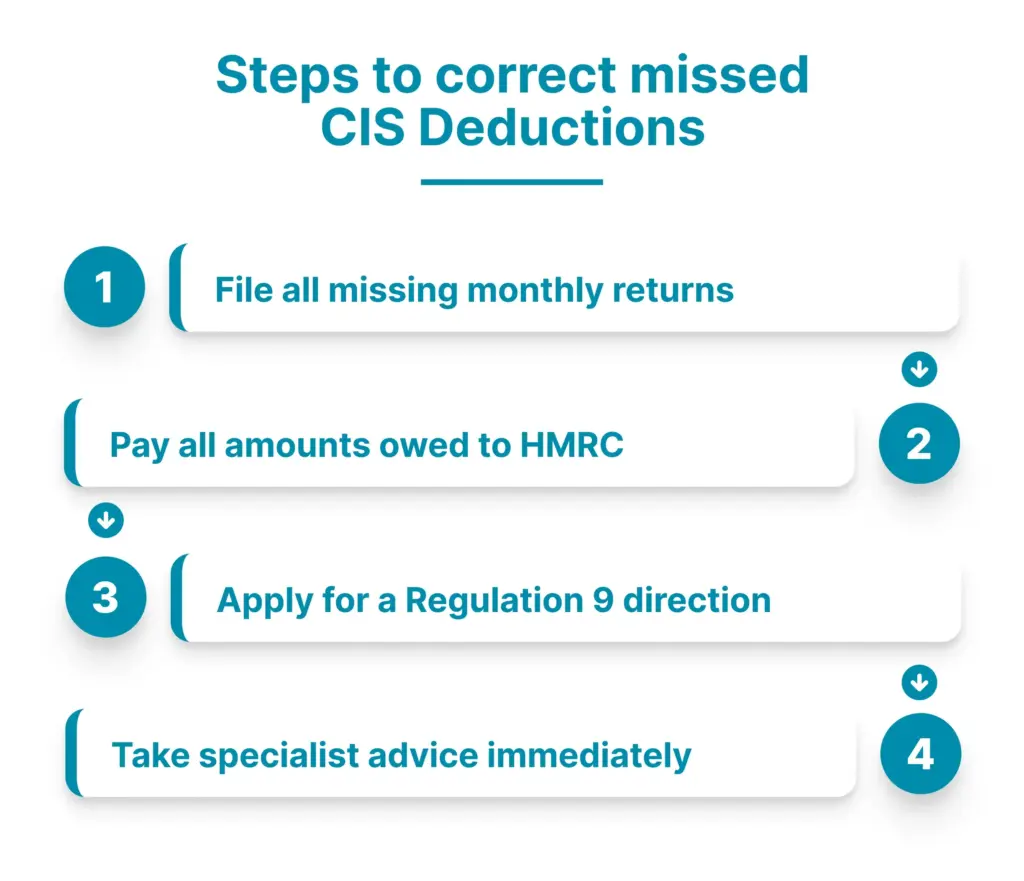
Step 1: File all missing returns
Submit every overdue monthly return through HMRC’s CIS online service. Apply the correct deduction rate for each subcontractor: 0% for gross payment status, 20% for registered subcontractors and 30% for unregistered or unverified subcontractors. Where verification was never completed, complete it before filing.
An incorrect rate caused by skipped verification is not a reasonable excuse and the full liability for any shortfall remains with the contractor.
Step 2: Pay the amounts owed
Calculate every amount owed across all affected periods and pay HMRC as soon as possible. The deadline for electronic payment is the 22nd of the month and by cheque it is the 19th.
Where full payment cannot be made immediately, contact HMRC’s CIS helpline and request a Time to Pay arrangement. Doing this before the next penalty escalation point demonstrates willingness to comply and can influence how HMRC approaches the case.
Step 3: Apply for a Regulation 9 direction
Under Regulation 9 of the Income Tax (Construction Industry Scheme) Regulations 2005, a contractor’s liability can be reduced or removed entirely where one of two conditions is met.
Condition A applies where the contractor took reasonable care and the failure was a genuine mistake in good faith.
Condition B applies where the subcontractor has already declared the relevant payments in their own return and paid the tax due.
This application must be made before HMRC issues a Regulation 13 direction. Once that letter arrives, the application becomes a formal ground of appeal and the position becomes considerably harder to argue.
Step: 4 Take specialist advice
The Regulation 9 process has specific evidence requirements and the timing is critical. Contractors who proceed without professional support at this stage are the most likely to lose access to the relief that would have resolved their position.
Common mistakes to avoid
Once HMRC opens a compliance check, how a contractor responds in the weeks that follow shapes the extent of the damage. These are the errors that consistently make the position worse.
- Not responding to HMRC’s initial notice: HMRC gives the contractor an opportunity to provide information before a formal assessment is raised. Contractors who do not respond lose the right to contest the figures and the assessment becomes the basis for recovery.
- Assuming the subcontractor’s tax payment resolves the contractor’s liability: HMRC assesses both liabilities independently. The subcontractor’s payment has no effect on the contractor’s account unless a Regulation 9 direction has been granted.
- Paying subcontractors without verifying their CIS status first: Verification is mandatory before the first payment is made. Applying the wrong rate because this step was skipped is not accepted as a reasonable excuse and the full liability remains with the contractor.
- Waiting too long to apply for Regulation 9: Once HMRC issues a Regulation 13 direction, a proactive Regulation 9 application is no longer possible. The only option at that point is a formal appeal, which is a significantly harder position to argue.
Conclusion
For most contractors who have missed CIS deductions, the position is recoverable when it is addressed without delay. The penalty structure escalates quickly, the investigation periods are long and the 2026 enforcement changes have added new consequences for businesses with supply chain exposure.
The right steps taken early filing the returns, paying what is owed and applying for Regulation 9 before HMRC moves further make a real difference to the final outcome.
We work with contractors and subcontractors across the UK who are at exactly this point. Visit DNS CloudCo or get in touch today to discuss your situation.
FAQs
Can a subcontractor take direct action against a contractor who failed to deduct CIS?
Yes, a subcontractor can report the discrepancy to HMRC directly, supported by invoices and bank statements. HMRC will then examine the contractor’s records. Civil action through the courts is also available where financial loss can be demonstrated.
What records should a subcontractor keep for a CIS dispute?
Every deduction statement received from the contractor, all invoices showing gross and net amounts and bank statements confirming what was actually received. These three are what HMRC requires to examine the contractor’s record.
What happens if the contractor who failed to deduct CIS has since become insolvent?
The liability does not transfer to the subcontractor. Contact HMRC directly, provide your evidence and request that your account be credited based on income declared in your Self-Assessment return.
Can a contractor appeal a CIS determination assessment?
Yes, within 30 days of the assessment being issued. Regulation 9 relief can also be raised as part of the appeal if it was not applied for previously.
How does a contractor’s compliance history affect future HMRC checks?
A poor compliance record increases the likelihood of risk-based checks in subsequent years. A consistent record of accurate returns and timely payments reduces that likelihood considerably.
What is the penalty for failure to deduct CIS tax?
Penalties start at £100 for one day late, rising to £200 at two months, from six and twelve months the penalty becomes £300 or 5% of deductions due, whichever is higher.
Can HMRC recover CIS from subcontractors instead?
No, HMRC holds the contractor fully liable for missed deductions in all cases, the subcontractor’s tax position is assessed separately and does not reduce what the contractor owes.
How quickly should CIS errors be corrected?
Immediately, penalties escalate monthly, interest runs from the original payment date and Regulation 9 relief becomes unavailable once HMRC issues a Regulation 13 direction.

Divyanshi is a subject matter expert in the UK accounting space, creating clear and easy-to-read content for accountants and businesses. She covers topics such as VAT returns, Self-assessment tax, bookkeeping, business planning and Year-end accounts. By understanding the common challenges faced by accountants and business owners, she focuses on writing content that answers real questions and simplifies complex topics. Her approach keeps information clear, relevant and useful for everyday business needs.