
Under the Construction Industry Scheme (CIS), contractors deduct tax before paying subcontractors. The rate is 20% if registered and 30% if not. Over time, these deductions can be higher than what is actually owed to HMRC. When that happens, the extra amount can be claimed back as a CIS refund.
Sole traders claim this through their Self-Assessment tax return. Limited companies recover CIS through payroll, not through Corporation Tax.
This guide explains both methods, what needs to be prepared and the common mistakes that can delay a claim.
Key Takeaways:
- Sole traders claim CIS refunds by reporting deductions in their Self-Assessment tax return
- Limited companies recover CIS through payroll using a Full Payment Submission and an Employer Payment Summary
- Claims must be made within four years from the end of the tax year
- Recording all allowable expenses properly can reduce tax and increase the refund amount
Note : This blog was last updated & republished on 30 April 2026. It covers the latest HMRC guidance on CIS deduction rates, Self-Assessment, Employer Payment Summary reporting and the GOV.UK portal.
Understanding how the CIS Refund System works?
CIS deductions are taken as advance payments towards tax and National Insurance. Contractors deduct 20% if a subcontractor is registered and 30% if not. If total deductions exceed your actual tax liability, HMRC issues a repayment.
The method used for a CIS reclaim depends entirely on your business structure.
How business structure affects your claim:
| Business Type | Method to Claim | Reporting Channel |
|---|---|---|
| Sole trader | Self-Assessment return | GOV.UK portal |
| Partnership | Individual partner returns | Self-Assessment |
| Limited company | Offset against PAYE | Employer Payment Summary (EPS) |
| Simple case | Direct reclaim | CIS reclaim form (R38) |
Most subcontractors claim CIS refund online through their Government Gateway account.
How to claim CIS Refund as a Sole Trader?
If you are self-employed, the main route to submit a CIS refund claim is through your annual Self-Assessment tax return.
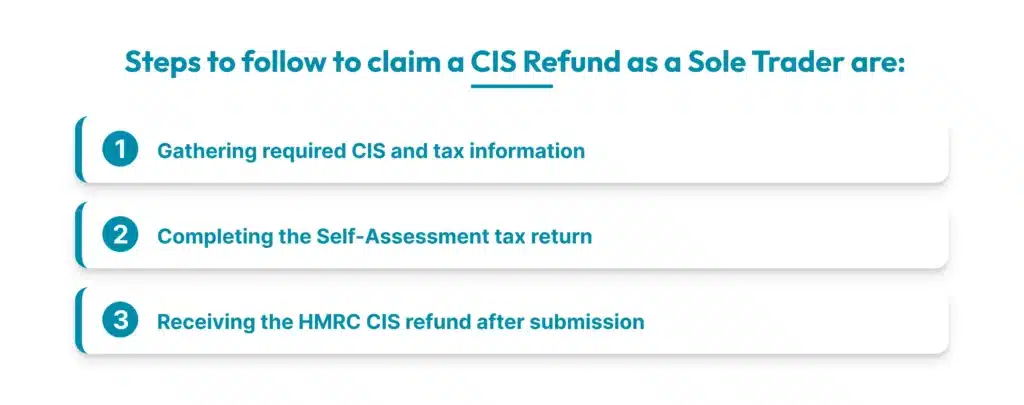
Step 1: Gathering required CIS and tax information
Before starting your CIS claim online, ensure you have:
- Government Gateway User ID
- Unique Taxpayer Reference (UTR)
- Monthly CIS deduction statements
- Income records
- Allowable expense records
Contractors must provide deduction statements. These confirm how much CIS has been withheld.
Step 2: Completing the Self-Assessment tax return
When completing the return:
- Enter total construction income
- Record all CIS deductions suffered (SA103S box 56)
- Include allowable business expenses
HMRC then calculates your final tax liability.
Step 3: Receiving the HMRC CIS refund after submission
If deductions exceed your tax due, the balance becomes your HMRC CIS refund. Most repayments are issued within 2-4 weeks for online filings, up to 8 weeks with verification.
Allowable Expenses that increase your CIS Reclaim
Accurately claiming CIS deductions from HMRC depends on correctly identifying and recording all allowable expenses in line with current guidelines.
Common Allowable Costs
- Tools and small equipment
- Protective clothing
- Travel between job sites
- Materials not reimbursed
- Professional fees
Under-reporting expenses reduces your repayment and weakens your CIS refund claim.
How to claim back CIS suffered Limited Company?
A limited company claims back CIS suffered by reporting it through payroll using an Employer Payment Summary (EPS), where the deductions are offset against PAYE and National Insurance.
For UK limited companies, the process is different from sole traders, as CIS suffered cannot be reclaimed through Corporation Tax and must be handled through payroll reporting.
Using Employer Payment Summary (EPS)
To claim CIS refund for limited company, you must:
- Submit an Employer Payment Summary (EPS)
- Declare CIS suffered in payroll reporting
- Offset deductions against PAYE and National Insurance
If deductions exceed payroll liabilities, the surplus may be:
- Carried forward
- Reclaimed from HMRC at year end via Gateway or post to PAYE Employer Office (BX9 1BX)
This is the correct method for limited companies to recover CIS deductions.
What not to do?
Do not try to claim CIS deductions through a personal Self-Assessment return or informal forms. For limited companies, recovery must be completed through the payroll (PAYE) system.
When to use a CIS Reclaim Form?
A CIS reclaim form, typically Form R38, applies only in limited and simple circumstances.
Suitable situations
- You are not required to submit Self-Assessment
- The claim is small
- You are not trading as a limited company
For most active subcontractors, Self-Assessment remains the primary method.
CIS refund deadlines and processing times
CIS refunds must be claimed within specific time limits and processing times can vary depending on how and when the claim is submitted.
Understanding these timelines helps ensure claims are made on time and allows for better planning around when refunds are likely to be received.
Four-year claim deadline
You have four years from the end of the relevant tax year to claim.
For example:
- Tax year ending 5 April 2026
- Deadline to submit claim: 5 April 2030
Missing this deadline prevents recovery.
HMRC CIS refund process timeline
Once submitted:
- Standard processing time: 2-4 weeks online (Self-Assessment), 4-8 weeks EPS/R38
- Longer if discrepancies arise
Delays often occur due to mismatched contractor submissions or incorrect payroll data.
For Example:
Consider a sole trader with:
- Income: £60,000
- CIS deducted: £12,000
- Allowable expenses: £18,000
After tax calculation, suppose liability equals £8,000.
CIS deducted (£12,000) minus tax due (£8,000) results in a £4,000 HMRC CIS refund.
This highlights why accurate expense reporting is essential when understanding how to claim a CIS refund efficiently.
Common errors in CIS claim online submissions
Avoid these issues during the HMRC CIS claim process:
- Entering incorrect deduction figures
- Claiming through Corporation Tax instead of EPS
- Missing CIS statements
- Submitting outside the four-year window
- Incorrect PAYE reporting
Accuracy speeds up repayment and reduces compliance risk.
Should you use a CIS refund specialist?
Some subcontractors appoint agents to manage a CIS reclaim. Fees typically range from 15% to 25% of the refund.
Before engaging a specialist:
- Confirm HMRC authorisation
- Review fee structure
- Compare against accountancy support
Straightforward cases are often managed directly through GOV.UK.
Conclusion
Claiming a CIS refund comes down to using the right route for your business. Sole traders go through Self-Assessment, limited companies offset CIS deductions against PAYE through FPS and EPS submissions and in both cases accurate records and timely submission are what determine how quickly HMRC processes the repayment.
If you want to make sure your claim is done correctly, speak to a specialist UK accountant at DNS CloudCo. Call us on 01908 886755 or email info@dnscloudco.co.uk
Frequently Asked Questions
How do I claim a CIS refund?
Sole traders claim through Self-Assessment, while limited companies offset CIS deductions against PAYE by submitting an FPS and an Employer Payment Summary.
How do I claim CIS deductions from HMRC?
Sole traders record CIS deductions in their Self-Assessment return, while limited companies report them through payroll and offset against PAYE and National Insurance.
How does a limited company claim back CIS suffered?
Submit a Full Payment Submission and an Employer Payment Summary through your payroll software, HMRC will then offset the CIS deductions against your PAYE liability and any remaining balance carries forward or is repaid at year end.
Can I claim a CIS refund online?
Yes, sole traders submit through the HMRC Government Gateway via Self-Assessment, while limited companies submit through payroll software using FPS and EPS.
How long does an HMRC tax refund take?
Online Self-Assessment claims are usually processed within 2 to 4 weeks, while EPS submissions can take 4 to 8 weeks and if HMRC needs to check anything, it takes longer.
Does HMRC automatically refund overpaid tax?
No, you need to submit a claim through Self-Assessment or payroll reporting, as HMRC will not issue a CIS refund without one.
How can I check if my tax return has been processed by HMRC?
Sign in to your Government Gateway account on GOV.UK, where your Self-Assessment account will show whether the return has been processed and if a repayment is due.
How to speed up a tax refund from HMRC?
File online rather than by post, make sure your CIS deduction figures match what your contractor has reported and check that your bank details on your HMRC account are correct, as this is one of the most common reasons refunds are delayed.
What documents do I need for a CIS refund claim?
You need your UTR, CIS deduction statements from your contractor, a record of your income, your allowable expense records and access to the HMRC Government Gateway.
What is a CIS I form?
There is no official HMRC document called a CIS I form and CIS refunds are claimed through Self-Assessment or payroll reporting depending on your business structure.

Divyanshi is a subject matter expert in the UK accounting space, creating clear and easy-to-read content for accountants and businesses. She covers topics such as VAT returns, Self-assessment tax, bookkeeping, business planning and Year-end accounts. By understanding the common challenges faced by accountants and business owners, she focuses on writing content that answers real questions and simplifies complex topics. Her approach keeps information clear, relevant and useful for everyday business needs.