Most employers facing a PAYE and NIC inspection are not worried about the records they kept properly. They are worried about the figure that looks slightly off, the one they noticed once and never went back to check.
By itself, that doubt is rarely an issue. The real difference lies in what happens next. Disclosing it before HMRC identifies it often means no penalty, while waiting until HMRC finds it can prove far more costly.
This guide explains how the inspection actually runs, what HMRC expects at each stage, and where the real risk exists, using HMRC’s own compliance check guidance throughout.
Key takeaways
- HMRC normally gives at least 7 days of notice before an arranged visit to inspect PAYE and NIC records.
- Payroll records must be kept for 3 years legally (from the end of the tax year), but 6 years is best practice since HMRC can investigate up to 6 years back.
- Refusing an inspection allows HMRC to seek tribunal approval. If approved and you still refuse, a £300 penalty applies.
- Penalties for inaccuracies range from 0% to 100% of the tax involved, based on behaviour and disclosure timing.
- Employers can appoint a representative and ask HMRC to deal with them directly.
Why HMRC opens a PAYE and NIC Check?
A compliance check is not an accusation. Most checks are routine, HMRC opens them to confirm tax is paid correctly, and most close with nothing owed by either party.
Routine Checks vs Risk-Based Selection
Some checks are simply part of HMRC’s regular programme of work, with no specific concern behind them. Others are opened because something in the data caught attention.
What tends to catch HMRC’s attention:
Inconsistent RTI (Real Time Information) payroll submissions and repeated late filing are common reasons for HMRC to review PAYE records more closely. Figures that differ significantly from what HMRC expects for similar businesses may also trigger further enquiries.
For businesses engaging contractors, HMRC often examines whether worker status has been assessed correctly and whether IR35 obligations have been met.
The reason a check has opened matters less than what HMRC will expect to see once records and submissions come under review.
What HMRC expects to see before you even speak to them?
Preparing records before HMRC requests them reduces delays, limits the need to reconstruct historical data under pressure and shows that payroll obligations have been managed consistently.
Some records are more important because they support PAYE deductions, worker status decisions, and figures already reported to HMRC.
The retention period most employers get wrong
.Payroll records must be kept for 3 years from the end of the tax year to which they relate. This includes pay and deduction records, submissions made to HMRC, payments made to HMRC, leave and sickness records, tax code notices, and details of taxable expenses or benefits. Keeping these records complete and accessible helps employers respond promptly if HMRC requests information during a compliance check.
Incomplete records and their cost
If payroll records are incomplete, HMRC may estimate the amount due using the information available and charge a penalty of up to £3,000. Where records have been lost because of events such as theft or fire, employers should inform HMRC and take reasonable steps to recreate the missing information wherever possible.
Contractors and worker status evidence
Where a business engages contractors, HMRC examines closely whether employment status has been assessed correctly and whether IR35 rules have been applied properly. A documented status assessment using HMRC’s CEST tool provides evidence that working practices match the status given.
While CEST provides a useful starting point and HMRC will stand by its results where information entered is accurate, the tool is unable to return a determination in approximately 1 in 5 cases. It also does not account for Mutuality of Obligation, a key factor in employment status decisions. In complex or borderline cases, independent legal or tax advice is recommended alongside any CEST result
Preparing records is only one aspect of getting ready for a PAYE check. Employers also benefit from understanding how inspections are carried out, as notice periods, rights of access, and the people HMRC may need to speak with can differ depending on how a visit is arranged.
First Steps after receiving a Compliance Letter
Receiving a compliance letter does not mean HMRC has found an error. In many cases, it simply means HMRC wants to check that PAYE and NIC obligations have been met correctly.
Review the letter carefully
Check what HMRC is asking for, the period under review and any deadlines for responding. The letter should also indicate whether HMRC plans to visit the business, review records remotely or request information by post or email.
Gather and review payroll records
Before sending documents to HMRC, compare payroll records with RTI submissions, payment records and supporting documents. Identifying inconsistencies early makes it easier to explain them and avoids having to reconstruct information under pressure.
Disclosing known errors promptly
If an error is discovered while reviewing records, informing HMRC before they identify it themselves may reduce or eliminate a penalty, depending on the circumstances. Delaying disclosure can limit the reductions available.
Choosing a representative
Employers can appoint an accountant, payroll adviser or other representative to handle correspondence and discuss the check with HMRC. Where additional time is genuinely needed to gather records, HMRC may agree to an extension if told promptly.
Being prepared before HMRC starts reviewing records can reduce delays and uncertainty. It also helps employers understand how inspections are conducted, including the notice given, the access HMRC can request and the people it may need to speak with.
What actually happens when the Inspection takes place?
HMRC may inspect PAYE and NIC records through an arranged visit or, in some circumstances, without prior notice. How the inspection begins affects the notice an employer receives, the rights available, and how access to records is requested.
Visits arranged in advance
Most visits are arranged ahead of time. HMRC contacts the employer by phone or letter to set a date and time, normally giving at least 7 days’ notice. A date that does not work can be rescheduled.
Visits without notice
In some cases HMRC visits without notice. The officer must show identification and provide a notice of inspection, a legal document authorising the visit.
Declining access
Refusing an inspection allows HMRC to seek tribunal approval. If approved and access is still refused, a £300 penalty applies, plus up to £60 a day until the inspection proceeds. A reasonable excuse, such as serious illness or a bereavement, removes the penalty if reported straightaway.
Visit length and who gets involved
A visit can last from a few hours to several days, depending on the size of the business and the complexity of what is being checked. HMRC does not usually need to speak with general staff, only those who maintain payroll and finance records, unless employment status is under review.
Discovering an issue during a visit does not automatically lead to a fixed financial consequence. HMRC assesses how the error arose, whether reasonable care was taken, and whether the employer acted before or after HMRC identified the problem.
What does it cost when HMRC finds an error?
Errors identified during a PAYE and NIC check do not automatically lead to the same financial outcome. The amount payable depends on how the error arose, whether reasonable care was taken, and whether HMRC was informed before or after it became aware of the issue.
How HMRC assesses errors:
HMRC sorts inaccuracies into four behavioural categories. Reasonable care, where a genuine effort was made and an error still occurred, results in no penalty. Careless means reasonable care was not taken. Deliberate means the business knew the figures were wrong. Deliberate and concealed means active steps were taken to hide the error, such as creating a false document.
How Penalty ranges differ:
| Behaviour | Unprompted Disclosure | Prompted Disclosure |
|---|---|---|
| Reasonable care | No penalty | No penalty |
| Careless | 0% to 30% | 15% to 30% |
| Deliberate | 20% to 70% | 35% to 70% |
| Deliberate and concealed | 30% to 100% | 50% to 100% |
These penalty ranges for inaccurate returns depend on whether the disclosure was unprompted or prompted. An unprompted disclosure means telling HMRC before there is any reason to think they have found, or are about to find, the error. Anything after that point counts as prompted, and the minimum penalty rises.
How Cooperation can reduce a penalty:
HMRC reduces penalties based on telling (up to 30% reduction), helping (up to 40%), and giving access to records (up to 30%). Taking three years or more to disclose an error restricts the maximum reduction available, regardless of how cooperative the disclosure itself is.
Suspended penalties
For careless inaccuracies only, HMRC can suspend a penalty for up to 2 years if conditions are set to help avoid the same mistake recurring. Deliberate or concealed inaccuracies are never eligible.
Even where additional tax or a penalty arises, employers retain several procedural rights during the check. Understanding those rights affects how quickly disagreements get resolved and whether communication with HMRC stays manageable.
What Employers are entitled to throughout the Process?
A compliance check is not a one-way process. HMRC sets out specific rights an employer can rely on at every stage.
Representation
A representative, such as an accountant, can be appointed to deal with HMRC directly for the check. HMRC may still need to contact the employer directly on some matters, but will copy the representative on correspondence.
Requesting more time
HMRC allows extra time where there is a good reason, such as serious illness or a recent bereavement. Telling the officer dealing with the check as soon as the issue arises gives the best chance of a reasonable extension.
Disagreeing with the Outcome
Where the outcome is disputed, there are usually three options for resolving the disagreement. New information can be sent to the officer dealing with the check, the case can be reviewed by a different HMRC officer, or the matter can go to an independent tribunal. This must happen within 30 days of the decision letter.
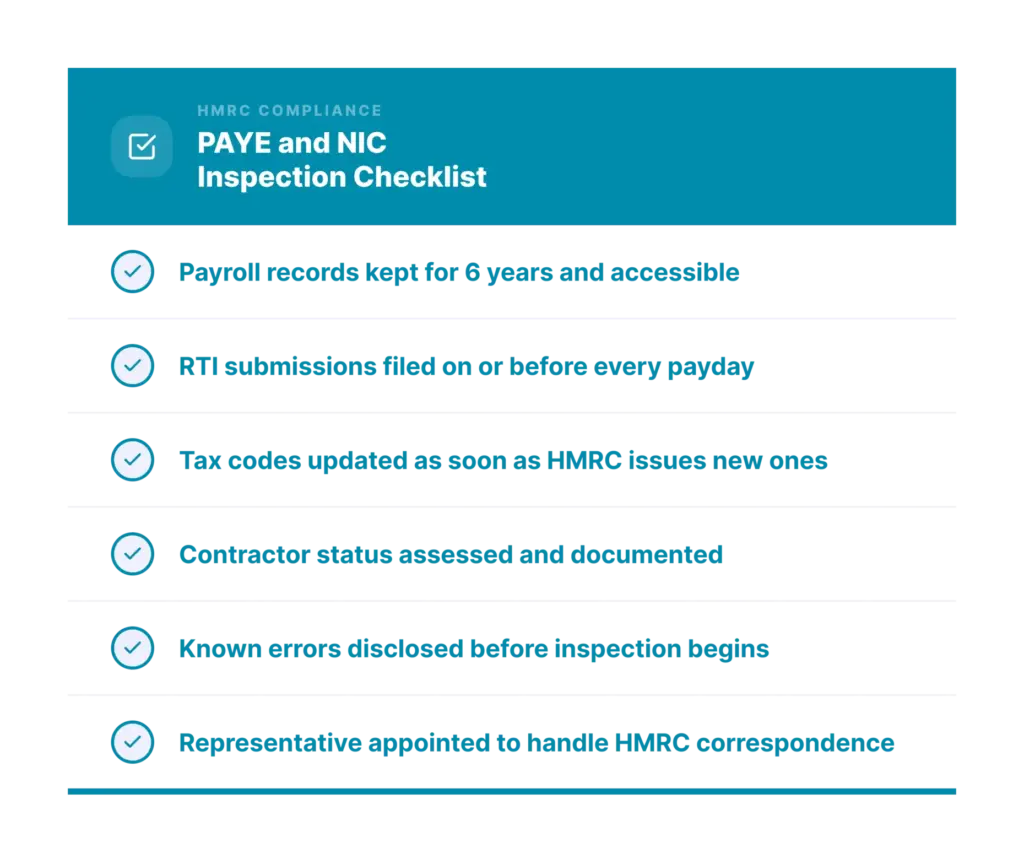
PAYE and NIC Inspection Checklist
Before and during an inspection, confirm the following:
FAQs
How long does a PAYE and NIC inspection typically last?
Can HMRC inspect my PAYE records remotely without visiting?
What happens if payroll was outsourced when the error occurred?
What if I discover an error after HMRC has already started the inspection?
Does using payroll software protect me from penalties?
What is the difference between a careless and a deliberate inaccuracy?
Can a penalty be reduced if I report an error myself?
Do I need a status assessment if I use contractors?

Divyanshi is a subject matter expert in the UK accounting space, creating clear and easy-to-read content for accountants and businesses. She covers topics such as VAT returns, Self-assessment tax, bookkeeping, business planning and Year-end accounts. By understanding the common challenges faced by accountants and business owners, she focuses on writing content that answers real questions and simplifies complex topics. Her approach keeps information clear, relevant and useful for everyday business needs.