Registering as a sole trader is one of the easiest ways to work for yourself in the UK. You register as self-employed with HMRC, keep records of your income and expenses and file a self-assessment tax return each year. There is no company to register and fewer formal filing requirements than a limited company.
But that simplicity comes with risks that are easy to miss when a business is new. As a sole trader, you and your business are treated as the same person in UK law.
Every debt your business incurs becomes your personal liability. From April 2026, Making Tax Digital (MTD) for Income Tax introduces mandatory quarterly reporting for sole traders earning above £50,000
This guide covers the key disadvantages of being a sole trader in the UK, including what each one means in practice.
Key takeaways
- Personal liability is one of the biggest risks of operating as a sole trader, as business debts can directly affect your personal finances
- As profits increase, sole trader taxation can become less efficient than operating through a limited company
- From April 2026, Making Tax Digital for Income Tax will introduce more frequent reporting requirements for many sole traders
- Irregular income and limited financial history can make it harder to secure a mortgage or business finance
- Sole trader status can become harder to manage over time, particularly when business continuity and long-term planning become priorities
Sole Trader vs Limited Company: Key Differences
Before covering the disadvantages in detail, this comparison shows how the two structures differ across the areas that matter most.
| Area | Sole Trader | Limited Company |
|---|---|---|
| Legal liability | Personally liable for all business debts | Liability usually limited to company assets |
| Tax on profits | Income Tax at 20%, 40% or 45% | Corporation Tax is charged at 19% to 25% with marginal relief applying to profits b/w £50,000 & £250,000. |
| Tax flexibility | All profits taxed as personal income | Income can be taken as salary and dividends |
| Sick pay | No entitlement to SSP | May qualify for SSP if eligible |
| Pension options | Personal contributions only | Employer pension contributions available |
| Holiday pay | No statutory holiday pay | No statutory holiday pay for directors |
| Public disclosure | No public accounts | Accounts filed at Companies House |
| Business sale | Usually sale of assets | Shares or the company can be sold |
| MTD requirements | MTD for Income Tax from April 2026 if qualifying income exceeds £50,000 | No confirmed MTD for Corporation Tax timetable |
| Administration | Simple HMRC registration | Companies House registration and ongoing compliance |
Major Drawbacks and Risks of being a Sole Trader in the UK
Drawbacks of being a sole trader include personal financial risk, higher administrative pressure and fewer options when it comes to tax planning and long-term business stability.
Understanding these can help you decide whether this structure is still right for you.
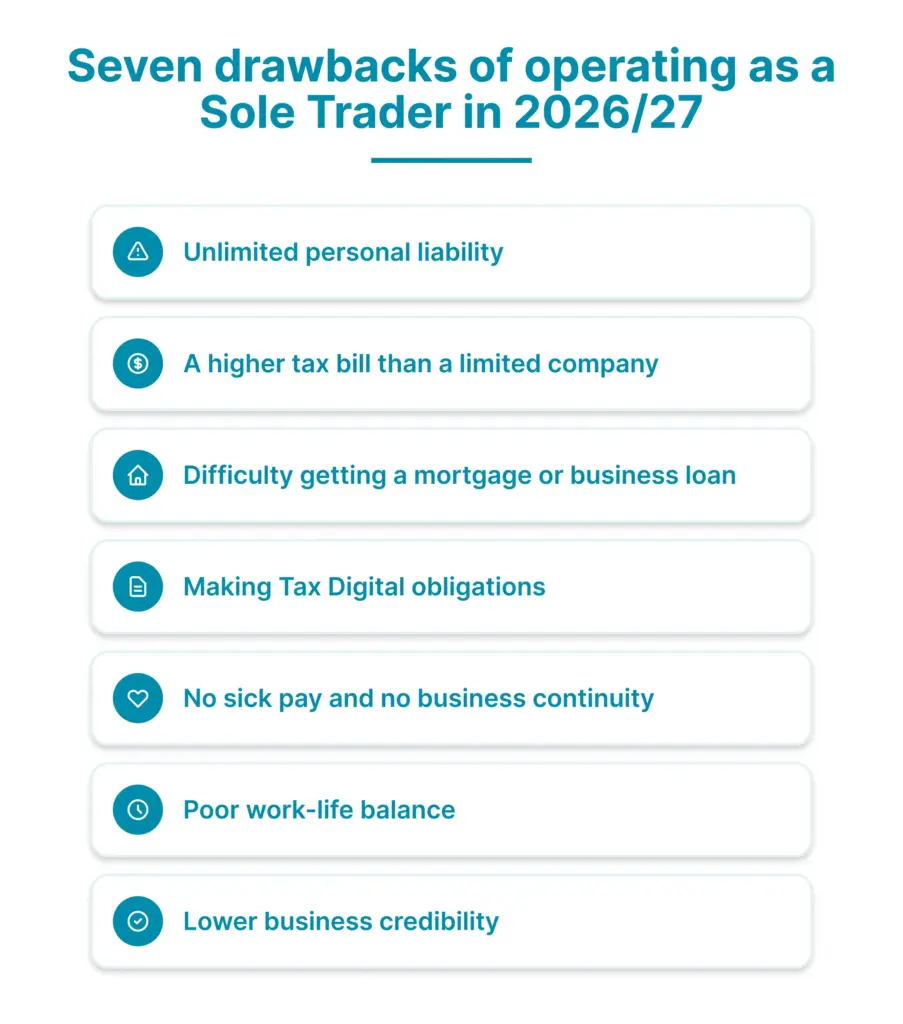
Unlimited personal liability
There is no legal separation between you and your business as a sole trader. Any debts or claims linked to the business become your personal responsibility.
If the business cannot meet what it owes, creditors may take legal action against your personal assets including savings, a vehicle, or your home.
Example: An IT contractor facing a client claim over a financial dispute may be personally responsible for any amount not covered by insurance or available business funds.
A limited company is a separate legal entity, meaning the company is responsible for its own debts rather than the director personally.
Insurance can reduce but not remove this risk. Sole traders should consider:
- Public liability insurance covers claims from third parties for injury or property damage caused by your business
- Professional indemnity insurance covers client claims arising from errors, omissions, or professional advice
- Income protection insurance replaces a portion of income if illness or injury stops you from working
These policies reduce exposure, but they do not eliminate personal liability. Any claim or debt outside their scope remains your personal responsibility.
A higher tax bill than a Limited Company
Sole traders pay income tax on all taxable profits. In 2026/27, the rates for England, Wales and Northern Ireland are as follows, according to HMRC:
| Profit Band | Rate |
|---|---|
| Up to £12,570 | 0% |
| £12,571 to £50,270 | 20% |
| £50,271 to £125,140 | 40% |
| Above £125,140 | 45% |
Class 4 National Insurance also applies at 6% on profits between £12,570 and £50,270, and 2% above that. (Rates based on current HMRC guidance and subject to change).
A limited company pays corporation tax instead 19% on profits up to £50,000 and 25% above £250,000. Directors can draw income through a mix of salary and dividends, which can reduce the overall tax bill compared to sole trader taxation.
Whether incorporation is more tax-efficient depends on your profit level, how you take income, and the additional responsibilities involved in running a company. As profits grow, the difference becomes more significant.
Difficulty getting a mortgage or business loan
Mortgage lenders and banks usually ask sole traders for more financial evidence because self-employed income can change from year to year. Most lenders require at least two to three years of self-assessment tax returns before approving a mortgage application.
Affordability is normally assessed using average profits across multiple years rather than the most recent figure.
For example, a sole trader who reported profits of £30,000 one year and £50,000 the next may be assessed on the average of both rather than the higher amount.
This makes borrowing harder for sole traders with fluctuating income or a shorter trading history. Keeping accurate financial records matters more as HMRC moves towards regular digital reporting throughout the year.
Making Tax Digital for Income Tax
From 6 April 2026, sole traders with qualifying income over £50,000 are required to use Making Tax Digital for Income Tax, as confirmed on GOV.UK. HMRC determines whether you are in scope based on your 2024/25 self-assessment return.
Digital record-keeping is mandatory, so sole traders must keep income and expense records in compatible software. In some cases, spreadsheets may only be used if they connect through bridging software that can send the data to HMRC.
Once in scope, the single annual return is replaced with:
- Four quarterly digital updates
- A final year-end declaration
- All submissions through HMRC-approved software
The threshold reduces to £30,000 from April 2027 and £20,000 from April 2028. More sole traders will need to keep records updated throughout the year rather than dealing with most reporting in one go.
For a full explanation, see our Making Tax Digital for sole traders guide.
No sick pay and no business continuity
Most sole trader businesses depend entirely on one person for client work, invoices, administration, and communication.
There is no Statutory Sick Pay for the self-employed. If illness or injury prevents you from working, income stops immediately while fixed business costs continue.
There is no system in place to keep the business running in your absence. Client work pauses, deadlines can be missed, and communication slows until you return.
This also affects long-term planning. When the business is built entirely around one person, stepping away, retiring, or transferring ownership becomes difficult. Succession planning, something a limited company handles through share transfers or directorship changes is far more complicated for a sole trader.
Poor work-life balance
In a sole trader business, one person is typically responsible for delivering client work and running every operational aspect of the business at the same time.
Client communication, invoicing, follow-ups and administration extend beyond planned working hours because there is no separate support to manage these tasks. Even small queries require the owner’s direct attention.
In practice, this often looks like:
- Evenings and weekends used for admin and invoicing
- Difficulty taking time off without work falling behind
- Constant awareness of pending tasks even during personal time
- No clear separation between work and rest
Over time, this overlap between personal and business time can affect health, relationships and productivity. Without deliberate boundaries, sole trader work tends to expand to fill all available time.
Lower business credibility
Some larger businesses and public sector organisations prefer working with limited companies. Certain supplier policies also require a registered company before a contract is considered.
Sole traders do not file accounts at Companies House, so there is less public financial information available for clients, suppliers and lenders to look at. A potential client cannot check your accounts before deciding whether to work with you.
This can affect trust, contract opportunities and the credit terms suppliers are willing to offer. Sole traders also face challenges when trying to scale or sell the business, as there is no separate legal entity to transfer.
Conclusion
Sole trader status works best when the business is simple, early stage, or low in ongoing commitments. It offers ease of setup and full control, which is why many people start here.
However, as the business becomes more active and expectations from clients, lenders and reporting requirements increase, the structure starts to show clear limits in how much it can support long-term stability and planning.
That is why the decision is not only about starting a business, but about whether the structure still matches how the work is being run.
As risks of being a sole trader grow, it’s worth considering whether a different structure would work better.
If you are unsure whether remaining a sole trader still fits your situation, DNS CloudCo can help you review your position and understand the next steps. Call us on 01908886755 or email info@dnscloudco.co.uk.
Frequently Asked Questions
At what point should a sole trader consider switching to a limited company?
Many sole traders think about changing to a limited company when their profits increase, personal risk becomes a concern, or the tax and legal benefits start becoming more useful than the extra admin.
Can a sole trader protect personal assets without becoming a limited company?
Not fully, as personal liability is part of being a sole trader. Insurance, well-written contracts, and keeping personal and business finances separate can reduce risk, but they cannot remove it completely.
Can a sole trader hire employees and still remain a sole trader?
Yes, hiring employees does not change your business structure. You can still operate as a sole trader, but you will have extra responsibilities like payroll reporting and workplace pension duties.
Does professional indemnity insurance remove personal liability for a sole trader?
No, professional indemnity insurance can cover certain client claims, but you are still personally responsible for any debts or liabilities that are not covered by the policy.
Can a sole trader sell their business in the future?
A sole trader can sell business assets, client relationships, and goodwill, but not the business itself as a separate legal entity. This can make selling or handing over the business more difficult.
Does Making Tax Digital mean sole traders need accounting software?
In most cases, yes, sole traders affected by Making Tax Digital for Income Tax will need HMRC-approved software to keep digital records and send quarterly updates.
Can a sole trader get financial support if they cannot work due to illness?
It depends on the situation. Some state benefits may be available. Beyond that, income protection insurance or personal savings are usually what sole traders fall back on.
When does sole trader status still make sense?
For new businesses, short-term projects or anyone who wants to keep admin simple, it is often the right starting point. As profits grow or risks increase, it is worth looking at whether a different structure would work better.
Is being a sole trader risky in the UK?
Yes, mainly due to unlimited personal liability and income variability. The level of risk depends on the nature and scale of the business.
What is the biggest disadvantage of being a sole trader?
Unlimited personal liability is generally considered the biggest drawback, as personal assets may be at risk if the business cannot pay its debts.

Divyanshi is a subject matter expert in the UK accounting space, creating clear and easy-to-read content for accountants and businesses. She covers topics such as VAT returns, Self-assessment tax, bookkeeping, business planning and Year-end accounts. By understanding the common challenges faced by accountants and business owners, she focuses on writing content that answers real questions and simplifies complex topics. Her approach keeps information clear, relevant and useful for everyday business needs.