Many UK business owners hesitate when registering with HMRC because the terms self-employed and sole trader appear interchangeable. This uncertainty often leads to incorrect assumptions about tax, liability and compliance. For freelancers, consultants, contractors and even Ltd company directors reviewing their structure, misunderstanding the sole trader vs self-employed distinction can create avoidable risk.
The consequences are practical. The wrong structural choice may affect personal asset protection, National Insurance obligations, administrative burden and long-term tax efficiency. A clear understanding of the difference between self-employed and sole trader ensures accurate registration and better business planning.
Key Takeaways
- The precise meaning behind sole trader vs self-employed in the UK
- How employment status differs from legal structure
- Tax and liability implications in each case
- When operating as a sole trader is appropriate
Note : This article was updated and republished on 28 February 2026 to reflect the latest HMRC Self-Assessment requirements, 2026 National Insurance thresholds, Corporation Tax rates, VAT registration limits and Making Tax Digital for Income Tax updates applicable to sole traders and self-employed individuals in the UK.
The Core Distinction: Employment Status vs Legal Structure
Before analysing tax or liability, it is important to clarify the foundation of the discussion. The confusion in the sole trader vs self-employed in the UK debate arises because one term describes how you work, while the other defines how your business is legally organised.
What “Self-Employed” Actually Means?
Self-employed refers to employment status. It means an individual works for themselves rather than being paid under PAYE.
A self-employed person:
- Finds and contracts with their own clients
- Invoices directly
- Manages their own tax affairs
- Submits Self-Assessment returns where required
However, self-employment does not define the legal form of the business. That is where structure becomes relevant.
What “Sole Trader” Specifically Refers To?
A sole trader is a defined legal structure. Under this model:
- The individual and the business are legally the same
- There is no separate legal entity
- All profits belong to the owner
- All debts belong to the owner
This structural definition sits at the heart of the difference between self-employed and sole trader.
To answer a common search query directly: is a sole trader self-employed? Yes, but not all self-employed individuals operate as sole traders.
Sole Trader vs Self-Employed: Structural Comparison
Understanding the distinction becomes clearer when comparing status and structure side by side. The following breakdown reinforces how the two terms interact within the UK regulatory framework.
Comparison Overview
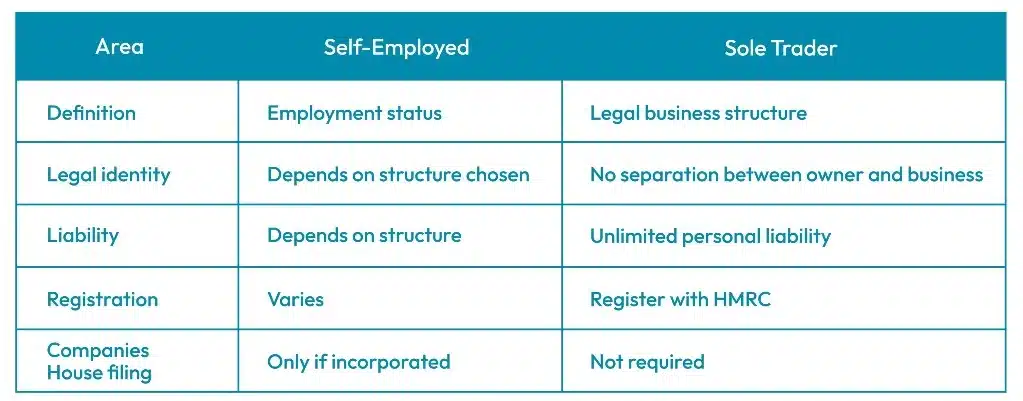
This table demonstrates that sole trader is one subset within the wider self-employed category. The sole trader vs self-employed discussion is therefore about scope versus form.
Liability Implications: Where Structure Matters Most
Once the structural difference is understood, the next logical consideration is liability. This is often the most significant practical consequence in the sole trader vs self-employed in the UK.
Unlimited Liability as a Sole Trader
Under sole trader status:
- Personal savings may be used to repay business debts
- Legal claims are directed at the individual
- There is no legal barrier between personal and business assets
This exposure is manageable for low-risk service providers but may be concerning in higher-risk industries.
Limited Liability Under Other Self-Employed Structures
If a self-employed individual incorporates a limited company:
- The company becomes a separate legal entity
- Liability is generally limited to the company’s assets
- Personal asset protection improves
This contrast highlights why the question sole trader or self-employed must be considered carefully when evaluating business risk.
Tax and National Insurance Treatment
After liability, taxation is the next key area where the difference between self-employed and sole trader becomes operationally relevant.
Tax Position of a Sole Trader
A sole trader:
- Pays Income Tax on business profits
- Pays Class 4 National Insurance based on profit thresholds
- May pay Class 2 contributions depending on income level
- Submits an annual Self-Assessment return
Tax is calculated directly on profit, not salary.
Tax Position of Self-Employed Individuals via Limited Companies
Where a self-employed individual operates through a company:
- The company pays Corporation Tax
- The director may receive a salary and dividends
- Dividend tax rules apply
- Reporting obligations increase
The tax system therefore responds to structure rather than employment status alone. This is a critical component of the sole trader vs self-employed comparison in the UK.
The £1,000 Trading Allowance
To deepen understanding, it is important to consider entry-level trading rules that affect early-stage entrepreneurs.
How the Trading Allowance Works?
HMRC allows individuals to earn up to £1,000 per tax year from trading without registering as self-employed.
If income exceeds £1,000:
- Registration for Self-Assessment becomes mandatory
- Income must be declared
- Either actual expenses or the £1,000 allowance may be claimed
This rule often influences those testing business ideas and is frequently overlooked in discussions around the sole trader vs self-employed distinction.
Registration Process for Sole Traders
Where a decision is made in favour of sole trader status, the administrative process is relatively straightforward.
Step-by-Step Registration
- Create a Government Gateway account
- Register for Self-Assessment
- Notify HMRC by 5 October following the end of the tax year trading began
- Maintain accurate digital records
Although simple, late registration can result in penalties. Clear understanding avoids compliance errors within the broader sole trader vs self-employed UK framework.
When Sole Trader Status May No Longer Be Suitable?
Business growth often changes structural suitability. The difference between self-employed and sole trader becomes more significant as profits and risk exposure increase.
Indicators for Structural Review
A sole trader may consider incorporation when:
- Profits increase consistently
- Business risk expands
- External investment is sought
- Tax planning flexibility becomes important
Structure should align with scale and risk profile, not simply convenience.
Common Misunderstandings to Avoid
Despite its simplicity, the sole trader vs self-employed topic generates recurring misconceptions.
Frequent Errors
- Assuming both terms mean the same thing
- Believing registration as self-employed automatically defines structure
- Ignoring personal liability implications
- Failing to reassess structure as profits grow
Clear definitions prevent long-term compliance complications.
Practical Examples
To bring alignment to the theory, consider the following example.
An IT consultant registers with HMRC as a sole trader and files Self-Assessment annually. Another IT consultant forms a limited company but works independently.
Both individuals are self-employed. Only the first operates as a sole trader.
This practical example reinforces the structural nature of the sole trader vs self-employed in the UK distinction.
Conclusion
The sole trader vs self-employed discussion centres on one essential principle: employment status is not the same as legal structure.
Self-employed describes how an individual works. Sole trader defines how the business is organised legally.
Understanding the difference between self-employed and sole trader directly influences liability exposure, tax treatment, compliance obligations and long-term planning decisions.
For UK business owners, directors and accountants, clarity on this distinction ensures accurate HMRC registration and informed structural choices. The terms are closely related, but they are not interchangeable.
Frequently Asked Questions
Is a sole trader self-employed?
Yes, every sole trader is self-employed by definition, as they work independently without PAYE employment.
What is the difference between self-employed and sole trader?
Self-employed describes employment status (working for yourself), while sole trader is a specific legal business structure with no separation between owner and business.
Is sole trader and self-employed taxed the same way?
Sole traders pay Income Tax and National Insurance directly on profits through Self-Assessment. Self-employed individuals using limited companies pay Corporation Tax plus personal tax on salary/dividends.
Can you be self-employed without being a sole trader?
Yes, you can be self-employed as a partner in a partnership, member of an LLP, or director of a limited company.
Does sole trader status mean unlimited liability?
Yes, sole traders have unlimited liability, meaning personal assets can be used to settle business debts since there’s no legal separation.
Which is easier to set up: sole trader or self-employed?
Sole trader is simpler, requiring only HMRC Self-Assessment registration no Companies House filing needed.
Does the £1,000 trading allowance apply to sole traders?
Yes, sole traders (and other traders) can earn up to £1,000 tax-free per year before needing to register for Self-Assessment.
When should a sole trader consider incorporating in 2026?
Consider incorporation when profits exceed £50,000 regularly, you approach the VAT threshold (£90,000 dropping to £60-70k), or MTD for Income Tax compliance becomes mandatory.

Divyanshi is a subject matter expert in the UK accounting space, creating clear and easy-to-read content for accountants and businesses. She covers topics such as VAT returns, Self-assessment tax, bookkeeping, business planning and Year-end accounts. By understanding the common challenges faced by accountants and business owners, she focuses on writing content that answers real questions and simplifies complex topics. Her approach keeps information clear, relevant and useful for everyday business needs.