Tax planning for high-net-worth individuals requires strategic thinking and careful execution. Wealthy UK individuals face unique challenges when managing substantial assets.
This guide explores proven strategies to protect wealth, reduce tax liabilities and ensure long-term financial security.
Key Takeaways
Maximise ISA, pension, and CGT allowances annually unused allowances are forfeited.
Employ lifetime gifting and trusts to reduce inheritance tax exposure.
Business owners should optimise salary-dividend ratios and pension contributions.
Cross-border wealth requires specialist international tax planning advice.
Tax mitigation is legal; tax evasion is not maintain.
Seek professional guidance for complex situations including trusts and offshore assets.
Understanding High Net Worth Individuals in the UK
What is a high net worth individual? The UK definition has evolved over recent years.
Her Majesty’s Revenue and Customs (HMRC) changed the threshold in 2016. Previously, the cut-off was £20 million in assets.
Currently, anyone with assets exceeding £10 million qualifies as a high net worth individual. Ultra high net worth individuals typically possess investable assets of at least $30 million (£24m+ approx)
These classifications exclude primary residences and personal belongings. The focus is on liquid, investable assets.
Core Principles of Tax Planning
Effective tax planning strategies follow several fundamental principles. These approaches help high earners reduce their tax burden legally.
The primary goal involves using all available tax allowances annually. Families should maximise exemptions across all members where possible.
Asset structuring plays a crucial role in tax mitigation. Proper arrangement of investments minimises unnecessary tax exposure.
Tax optimisation means placing income-generating investments in the most tax-efficient accounts. Tax-deferred vehicles offer significant advantages for certain asset types.
Regular reviews ensure strategies remain aligned with changing regulations. Professional tax planning advice becomes essential for complex portfolios.
Tax-Efficient Investment Structures
Individual Savings Accounts (ISAs)
Individual savings accounts represent the most recognised tax-efficient investment wrapper. Adult UK residents can contribute £20,000 annually to ISAs.
These funds may go into cash ISAs, stocks and shares ISAs, or combinations. Investment returns from ISAs face no income tax or capital gains tax.
Junior ISAs provide similar benefits for children with a £9,000 annual limit. These accounts automatically convert to adult ISAs at age 18.
Pensions for Tax Relief
Pension contributions are a highly effective way for high earners to reduce their tax liability, offering immediate tax relief while building retirement savings. Personal contributions receive income tax relief at marginal rates.
The maximum contribution equals the higher of £3,600 or relevant UK earnings. Total annual allowance reaches £60,000 including employer contributions (2024/25).
High earners must watch the tapered annual allowance carefully. Adjusted income exceeding £260,000 reduces allowances by £1 for every £2 (2024/25).
The minimum annual allowance drops to £10,000 with a maximum reduction of £50,000. Threshold income must exceed £200,000 for taper to apply.
Unused allowances from the previous three tax years can be carried forward. This strategy increases current year contribution capacity under specific conditions.
Investment Accounts and Allowances
General investment accounts become relevant after maximising ISA and pension allowances. These accounts face taxation on capital gains, interest and dividends.
Several annual reliefs help offset these taxes effectively:
Personal savings allowance 2024/25:
- Basic rate taxpayers: £1,000
- Higher rate taxpayers: £500
- Additional rate taxpayers: £0
Dividend allowance 2024/25: £500 annually across all tax bands.
Capital gains tax annual exemption 2024/25: £3,000.
Capital gains tax rates vary by income level:
- Basic rate: 10% (residential property 18%)
- Higher and additional rate: 20% (residential property 24%)
Previous capital losses can offset future gains indefinitely. Claims must occur within four tax years of the loss.
Business Tax Planning Strategies
Limited Company Tax Loopholes
Business owners access unique tax planning opportunities through company structures. Drawing income efficiently requires careful consideration of various methods.
Salary and dividend combinations often prove most tax-efficient. The dividend allowance provides £500 of tax-free income annually (2024/25).
Entrepreneurs can invest business profits to avoid taxes through various vehicles. Pension contributions from companies offer immediate corporation tax relief.
Research and development tax credits reduce taxable profits substantially. Legitimate business expenses lower overall tax obligations when properly documented.
How to Reduce Tax Bill for Self Employed?
Self-employed individuals face different challenges in tax planning for businesses. Maximising allowable deductions becomes the primary strategy.
Home office expenses, equipment and travel costs all qualify as deductions. Professional subscriptions and training expenses reduce taxable income further.
Pension contributions from business profits provide dual benefits. They lower current year tax while building retirement savings.
Timing of income and expenses affects annual tax liabilities significantly. Strategic invoice timing can shift income between tax years.
Wealth Management Tax Planning Approaches
Asset Location Strategy
Tax-efficient investing requires matching assets with appropriate investment vehicles. Different account types receive different tax treatments.
Unwrapped unit trusts and general investment accounts suit capital growth assets. Pensions and bonds work better for income-generating investments.
ISAs, Junior ISAs, VCTs and EIS investments provide maximum tax efficiency. All returns grow completely tax-free within these wrappers.
Retirement Planning for High Income Earners
High earner tax management requires special attention to retirement income withdrawal. Sequencing withdrawals from different accounts maximises tax efficiency.
Traditional advice suggests drawing from taxable accounts first. More sophisticated strategies can increase lifetime spending power significantly.
Offshore and onshore bond withdrawals don’t always register as taxable income. ISA distributions provide tax-free retirement income streams.
Combining different withdrawal sources optimises overall tax position. Professional financial planning business owners particularly benefit from this approach.
Estate Planning and Inheritance Tax
Understanding Inheritance Tax Basics
UK inheritance tax (IHT) impacts estates exceeding certain thresholds. The current nil-rate band stands at £325,000 per individual.
An additional residence nil-rate band of £175,000 applies to main homes. This allowance applies when passing property to direct descendants.
Estates above £2,000,000 see the residence nil-rate band reduced. Beyond these allowances, estates face 40% inheritance tax.
Transfers between spouses and civil partners remain IHT exempt. Nil-rate bands also transfer to surviving spouses upon death.
Tax Tips for Income Over 100k UK
Earnings exceeding £100,000 trigger personal allowance tapering. The allowance reduces by £1 for every £2 over this threshold.
Strategic pension contributions can keep adjusted net income below £100,000. This preserves the full personal allowance and reduces effective tax rates.
Salary sacrifice arrangements offer additional planning opportunities. Exchange of salary for employer pension contributions lowers taxable income.
Investment income timing becomes crucial around the £100,000 threshold. Deferring dividends or interest may prevent allowance loss.
Lifetime Gifting Strategies
Lifetime gifts reduce estate values and potential inheritance tax liabilities. The seven-year rule remains the primary gifting consideration.
Gifts made more than seven years before death completely escape IHT. Earlier gifts may face tapered tax if death occurs within seven years.
Annual exemptions allow £3,000 in tax-free gifts each year. Unused exemptions carry forward one year only for additional flexibility.
Small gifts of £250 per recipient face no restrictions or limits. Wedding and civil partnership gifts receive special allowances up to £5,000.
Regular gifts from surplus income avoid IHT entirely under specific conditions. These must not affect the donor’s standard of living.
Transfer of Tax Free Allowance to Spouse
Marriage allowance enables transfer of unused personal allowance between spouses. Basic rate taxpayers can transfer £1,260 to higher-earning partners.
This reduces the recipient’s tax bill by up to £252 annually. The transferor must have income below their personal allowance.
Transferring assets between spouses avoids immediate capital gains tax. Both partners can then use their full CGT exemptions annually.
Income-producing assets transferred to lower-earning spouses reduce overall family tax. This strategy proves particularly effective for dividend income.
How to Avoid Paying Higher Rate Tax in the UK?
Staying below the higher rate threshold requires careful income management. The higher rate begins at £50,270 for most taxpayers.
Pension contributions effectively reduce taxable income below this threshold. Every £1 contributed saves 40p for higher rate taxpayers.
Salary sacrifice schemes exchange income for non-taxable benefits. Childcare vouchers and cycle-to-work schemes provide tax-free value.
Timing capital gains realisation avoids pushing income into higher bands. Spreading asset sales across multiple tax years maintains basic rate status.
Personal Tax Planning Techniques
Personal circumstances significantly influence optimal tax strategies. Family structures, business ownership and investment types all matter.
Couples should review their combined income and asset positions annually. Redistributing income-producing assets between partners often yields savings.
Children’s allowances provide additional planning opportunities for families. Junior ISAs and bare trusts utilise children’s tax-free allowances.
Charitable donations receive generous tax treatment in the UK. Gift aid extends basic rate relief to charities automatically.
Higher and additional rate taxpayers claim extra relief through tax returns. Donations in wills can reduce inheritance tax on estates.
Trust Structures and Wealth Preservation
Role of Trusts in Tax Planning
Trusts provide control over wealth distribution while offering tax advantages. Various trust types serve different planning objectives and family circumstances.
Bare trusts allow grandparents to fund grandchildren’s education tax-efficiently. Assets belong to children for tax purposes immediately.
This utilises children’s personal allowances and capital gains exemptions. Income from trust assets faces lower or zero tax rates.
Discretionary trusts offer flexibility in distributing assets over time. Trustees control when and how beneficiaries receive funds.
Interest in possession trusts provide income to beneficiaries while preserving capital. Remaindermen eventually receive the trust capital upon specified events.
Family Investment Companies
Family investment companies represent an alternative to traditional trust structures. These vehicles suit larger estates due to setup and maintenance costs.
Shares can be structured to maintain parental control over assets. Different share classes attribute future growth to younger generations.
This separates asset appreciation from the parent’s estates for IHT purposes. Control shares retain voting rights while growth shares capture value increases.
Companies face ongoing compliance requirements and administrative expenses. Professional advice ensures structures remain compliant and tax-efficient.
Property and Capital Gains Tax Planning
Selling a Company Tax Considerations
Business sales trigger significant capital gains tax liabilities without planning. Business Asset Disposal Relief (formerly Entrepreneurs’ Relief) reduces CGT to 10% on qualifying disposals.
Lifetime limits of £1 million apply to entrepreneurs’ relief claims. Qualifying conditions include ownership period and business activity requirements.
Spreading disposals across multiple tax years utilises annual exemptions repeatedly. This reduces overall CGT on large business sales substantially.
Employee ownership trusts offer complete CGT exemption on qualifying sales. Strict requirements govern these arrangements and ongoing operations.
How to Invest Business Profits to Avoid Taxes?
Reinvesting business profits through the company structure defers personal taxation. Corporate tax rates remain lower than higher personal income tax rates.
Extracting funds as pension contributions provides immediate tax relief. Company pension schemes offer flexible contribution options for directors.
Business asset disposal relief applies when selling trading companies. Qualifying assets receive preferential CGT treatment upon eventual sale.
Enterprise investment schemes (EIS) and venture capital trusts (VCTs) offer substantial reliefs. These high-risk investments require specialist advice before commitment.
How to Reduce Taxable Income UK Strategies?
Multiple approaches exist for legally reducing taxable income levels. Pension contributions remain the most effective tool for most individuals.
Employer pension contributions don’t count as taxable income initially. Maximum contribution limits allow significant annual tax savings.
Salary sacrifice arrangements convert taxable salary into non-taxable benefits. Careful planning ensures these arrangements remain HMRC compliant.
Investment bonds provide tax-deferred growth over extended periods. No annual tax arises on growth within insurance-based bonds.
Offshore bonds offer additional flexibility for international investors. UK residents still face eventual taxation on withdrawals and gains.
Advanced Tax Mitigation Techniques
Business Tax Advice for Complex Situations
Complex business structures require specialist tax planning advice. Multi-entity groups need coordination across different legal entities.
Holding companies can receive dividends from subsidiaries tax-efficiently. Group relief allows losses to offset profits within corporate groups.
International businesses face additional tax treaty considerations. Transfer pricing rules require arm’s length pricing between related entities.
VAT planning affects cash flow and pricing strategies significantly. Understanding partial exemption rules optimises VAT recovery positions.
How to Avoid Paying 40 Tax Strategies?
The 40% higher rate threshold presents a significant tax cliff. Strategic planning can keep income just below this critical level.
Pension contributions receive full tax relief at marginal rates. Higher rate taxpayers gain 40% relief on qualifying contributions.
Charitable donations extend the basic rate band correspondingly. This pushes more income into the basic 20% tax bracket.
Marriage allowance transfers never push recipients into higher rates. The transfer amount itself carries basic rate tax treatment only.
How to Reduce Income Tax in the UK Legally?
Legal tax reduction requires understanding all available reliefs and allowances. Combining multiple strategies amplifies overall tax savings.
Tax-efficient investing using ISAs eliminates tax on investment returns. Maximum contributions should be made each tax year consistently.
Pension planning provides both immediate tax relief and long-term savings. Annual contribution limits should be fully utilised where possible.
Income splitting between family members reduces the overall family tax burden. Assets can be transferred between spouses without triggering immediate taxes.
Risk Management and Wealth Protection
Insurance in Tax Planning
Life insurance policies provide tax-efficient wealth protection and liquidity. Policies written in trust pass outside estates for IHT purposes.
Death benefits from trust-held policies provide immediate funds for IHT bills. This prevents forced asset sales to meet HMRC payment deadlines.
Income protection insurance replaces lost earnings without tax implications. Monthly benefits typically arrive tax-free to policyholders.
Key person insurance protects businesses from unexpected leadership losses. Proceeds can be structured for optimal tax treatment.
Lasting Power of Attorney Considerations
Mental capacity loss can derail even the best tax planning strategies. Lasting powers of attorney (LPA) enable continued financial management.
Property and financial affairs LPAs allow attorneys to handle tax matters. These must be registered before they become necessary.
Health and welfare LPAs cover medical and care decisions separately. Both types work together to provide comprehensive protection.
Professional Guidance Importance
Tax regulations change frequently and require constant monitoring. Professional tax planning advice ensures compliance with current rules.
Chartered accountants and tax specialists provide essential expertise. Complex situations demand professionals with relevant qualifications and experience.
Financial planning business owners need coordinated advice across multiple disciplines. Accountants, solicitors and financial advisers should work together.
Independent financial advisers offer unbiased product recommendations. Restricted advisers may have limited product ranges affecting advice quality.
Practical Steps to Stay Tax Efficient in the UK?
Annual Tax Planning Checklist
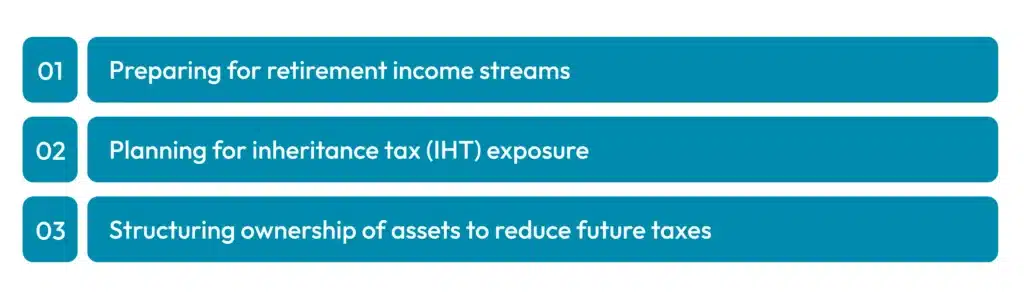
Tax efficiency requires proactive annual planning and regular reviews. Key dates and deadlines should be diarised well in advance.
Common Tax Planning Mistakes
Several errors frequently undermine otherwise sound tax planning strategies. Awareness helps avoid these costly pitfalls.
Timing Errors:
Receiving income or realising gains in the wrong tax year increases bills unnecessarily. Strategic timing can save substantial amounts.
Unused Allowances:
Failing to use annual exemptions means losing them permanently. These cannot carry forward to future years.
Documentation Failures:
Insufficient records cause problems during HMRC enquiries. Comprehensive documentation supports all tax positions taken.
Ignoring Spouse Planning:
Married couples should always plan jointly for maximum efficiency. Individual planning often misses significant savings opportunities.
Long-Term Wealth Preservation
Sustainable wealth requires balancing current needs with future security. Short-term tax savings shouldn’t compromise long-term objectives.
Diversification across asset classes protects against market volatility. Geographic diversification provides additional risk management benefits.
Regular rebalancing maintains desired asset allocation percentages. Tax-loss harvesting during rebalancing can offset capital gains.
Estate planning should begin early and be reviewed regularly. Legislative changes may require strategy adjustments over time.
Working with Professional Advisers
Selecting the Right Tax Adviser
Choosing appropriate professional advisers significantly impacts planning success. Qualifications, experience and approach all matter substantially.
Chartered tax advisers (CTA) possess specialist taxation expertise. Chartered certified accountants (ACCA) offer broader financial knowledge.
Experience with high-net-worth individuals proves essential for complex situations. General practitioners may lack necessary specialist knowledge.
Fee structures should be transparent and understood upfront. Fixed fees, hourly rates, or percentage-based charges each have advantages.
Coordinating Multiple Advisers
Complex wealth management often requires multiple professional relationships. Accountants, solicitors and financial advisers must work together.
Regular coordination meetings ensure all advisers understand current strategies. This prevents conflicting advice and missed opportunities.
Clear communication channels between advisers improve efficiency significantly. Client permission enables direct professional-to-professional discussions.
One lead adviser can coordinate other professionals effectively. This central point of contact simplifies complex planning exercises.
Conclusion
Tax planning for high-net-worth individuals requires comprehensive strategies and expert guidance. Wealthy UK individuals face complex challenges that demand proactive management.
Successful tax mitigation balances current savings with long-term wealth preservation. Multiple planning tools work together to create optimal outcomes.
Regular reviews and professional advice ensure strategies remain compliant and effective. Early planning and consistent execution deliver the greatest long-term benefits.
FAQs
What qualifies as a high net worth individual in the UK?
HMRC defines high net worth individuals as those with assets exceeding £10 million, excluding primary residences and personal possessions.
How can I reduce tax on income over £100,000?
Make pension contributions to keep adjusted net income below £100,000, preserving your full personal allowance and reducing effective tax rates significantly.
What is the seven-year rule for inheritance tax?
Gifts made more than seven years before death escape inheritance tax completely; gifts within seven years may face tapered taxation.
How do I avoid paying higher rate tax?
Keep taxable income below £50,270 through pension contributions, salary sacrifice schemes, ISA investments and strategic timing of capital gains.
What tax reliefs can I claim for pension contributions as a high-net-worth individual?
Personal pension contributions receive income tax relief at your marginal rate (20%, 40%, or 45%), with an annual allowance of £60,000 (2024/25), subject to tapering for high earners.
How can I minimise my inheritance tax liability in the UK?
Use lifetime gifting strategies, establish trusts, make use of annual exemptions (£3,000) and consider life insurance policies written in trust to cover IHT bills.
Are there legal ways to pay less tax?
Yes, maximise ISAs, pension contributions, capital gains exemptions, gift allowances, spousal transfers and charitable donations within legal frameworks.
What is tax mitigation for wealthy individuals?
Tax mitigation involves legally reducing tax liabilities through planning strategies like trusts, family investment companies, offshore bonds and asset location optimisation.
How can I reduce my tax bill when self-employed?
Maximise allowable business expense deductions (home office, equipment, travel), make pension contributions and strategically time income and expenses between tax years.
What are the main tax planning strategies for business owners?
Balance salary and dividends efficiently, make company pension contributions, claim R&D tax credits and utilise business asset disposal relief on qualifying sales.
How do trusts help with tax planning?
Trusts separate legal ownership from beneficial enjoyment, utilise children’s tax allowances, offer flexible asset distribution and can reduce inheritance tax on estates.
What is the best way to plan tax for wealth transfer?
Start early with lifetime gifting using annual exemptions, utilise the seven-year rule, establish trusts and use life insurance policies written in trust.
How often should I review my tax planning strategy?
Conduct annual reviews as a minimum, with quarterly check-ins to track progress and immediate reviews after major life events or legislative changes.
Is tax mitigation legal in the UK?
Yes, tax mitigation uses legal reliefs and allowances within the law, unlike tax evasion which is illegal.
When should high earners seek professional tax advice?
Seek advice when income exceeds £100,000, when establishing trusts, during business exits, or when managing offshore assets and cross-border interests.
Can business owners combine personal and business tax planning?
Yes, coordinated planning across salary, dividends, pensions and investments is highly effective and often yields the greatest overall tax savings.

Divyanshi is a subject matter expert in the UK accounting space, creating clear and easy-to-read content for accountants and businesses. She covers topics such as VAT returns, Self-assessment tax, bookkeeping, business planning and Year-end accounts. By understanding the common challenges faced by accountants and business owners, she focuses on writing content that answers real questions and simplifies complex topics. Her approach keeps information clear, relevant and useful for everyday business needs.