
The SA800 Partnership Tax Return is the official HMRC form that UK partnerships must submit annually to report their income, expenses, and profit and loss figures to HM Revenue and Customs. Unlike sole trader returns, the SA800 captures the partnership’s financial activity as a whole, including how profits and losses are allocated between individual partners.
Completing an accurate HMRC partnership return is a legal obligation under HMRC’s self-assessment framework. Partnerships must report all sources of partnership income tax return obligations accurately, allocate profits to each partner in line with the partnership agreement, and ensure every submission meets HMRC’s requirements. Errors or late filings can result in automatic penalties that apply to the partnership and its nominated partner.
This partnership tax return guide explains everything you need to know about filing the SA800, from form requirements to step-by-step online submission.
Key Takeaways
Who must file a partnership tax return in the UK and when
How to complete the SA800 partnership tax return form correctly
Key SA800 filing requirements and HMRC deadlines
How digital tools simplify partnership self assessment obligations
Who Needs to File a Partnership Tax Return in the UK?
Understanding partnership tax return filing requirements starts with identifying which business structures are legally obligated to submit. Not every business type falls under this obligation, so it is important to confirm whether your partnership structure requires an SA800 before the tax year ends. HMRC requires an SA800 tax return from the following:
- Ordinary partnerships: two or more individuals running a business together
- Limited liability partnerships (LLPs): including professional practices such as law firms, accountancy firms, and medical partnerships
- Mixed partnerships: involving both individual and corporate partners
A partnership must register for Self-Assessment with HMRC before it can file. The nominated partner registers the partnership and is responsible for submitting the HMRC partnership return each tax year.
Each individual partner must also register separately and complete their own SA100 return, declaring their allocated share of partnership income.
How to File the SA800 Partnership Tax Return?
Knowing where to file a partnership tax return and how to complete it correctly is essential for every UK partnership.
The process involves several distinct stages, from initial registration through to online submission, and each step must be completed accurately to avoid errors or delays.
Below is a step-by-step partnership tax return guide HMRC recommends following.
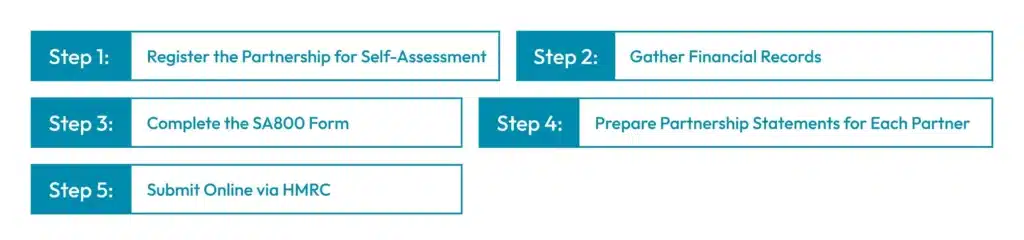
Step 1: Register the Partnership for Self-Assessment
The nominated partner must register the partnership with HMRC using form SA400. Each partner registers individually using form SA1.
Step 2: Gather Financial Records
Compile all records for the accounting period including income, expenses, bank statements, invoices, and records of capital purchases. Thorough record-keeping is the foundation of an accurate partnership income tax return.
Step 3: Complete the SA800 Form
Work through each section of the SA800 partnership tax return form, including any supplementary pages for property income or foreign income where applicable. The SA800 notes published by HMRC provide line-by-line guidance on how to complete each section correctly.
Step 4: Prepare Partnership Statements for Each Partner
Complete a Partnership Statement (short or full) showing each partner’s allocated profit or loss. This document is essential as each partner relies on it to complete their own SA100 return accurately.
Step 5: Submit Online via HMRC
File the partnership tax return online through HMRC’s Self-Assessment service. Filing partnership tax return online is the recommended method as it provides instant confirmation of receipt and reduces the risk of postal delays.
Here is how you can do it:
- Sign in to your HMRC online account at GOV.UK using the nominated partner’s Government Gateway credentials
- Select the partnership UTR to access the correct Self-Assessment record
- Navigate to the SA800 and complete each section in order partnership details, income and expenses, capital allowances, and the partnership statement
- Attach supplementary pages if the partnership has property income, foreign income, or other additional sources
- Review all entries and check partner details including NI numbers and profit allocations before proceeding
- Submit the return and save the confirmation receipt as proof of filing
Key Components of the SA800 Form
Understanding the SA800 form structure helps partnerships avoid errors during completion. The form is divided into several sections, each capturing a specific aspect of the partnership’s financial activity for the year. The main sections include the following.
Partnership details
This section records the partnership’s core information, including:
- partnership name and address
- Unique Taxpayer Reference (UTR)
- details of the nominated partner responsible for filing the return
Income and expenses
The partnership income tax return must report:
- trading income generated by the partnership
- additional business income
- allowable operating expenses
These figures determine the partnership’s total profit or loss for the year.
Capital allowances
Capital allowances allow partnerships to claim deductions for certain business assets such as equipment, machinery, or vehicles.
Profit allocation to partners
The partnership statement included in the SA800 tax return confirms how profits or losses are divided among partners. Each partner receives a statement that must be used when completing their individual self-assessment return.
A practical partnership tax return example would be a three-partner consulting firm dividing net profit equally.
Each partner’s third share is recorded on the Partnership Statement and carried into their individual SA100 return.
Filing Deadlines and HMRC Requirements
Meeting partnership tax return HMRC deadlines is critical to avoiding financial penalties. HMRC sets different deadlines depending on whether the return is submitted on paper or online, and partnerships should plan their filing well in advance of these dates.
| Submission Method | Deadline |
|---|---|
| Paper SA800 | 31 October following the end of the tax year |
| Online SA800 | 31 January following the end of the tax year |
Late Filing Penalties
Missing the deadline triggers automatic HMRC penalties that escalate the longer the return remains outstanding:
- Immediate: £100 penalty the day after the deadline
- 3 months late: Daily penalties of £10 per day, up to a maximum of £900
- 6 months late: An additional penalty of 5% of the tax due or £300, whichever is greater
- 12 months late: A further 5% or £300 charge, with potential for higher penalties in cases of deliberate non-compliance
The nominated partner is personally liable for these penalties, making timely submission essential for the whole partnership.
Incomplete Partner Details
Submitting the SA800 with missing or inaccurate partner information is one of the most common causes of HMRC queries and delayed processing. Ensure the following are correct for every partner before filing:
- National Insurance numbers: missing NI numbers can delay allocation of income to individual partners
- Current addresses: outdated addresses prevent HMRC from issuing correspondence correctly
- New or departing partners: any changes in partnership membership during the tax year must be reflected in the return, including the dates each partner joined or left and their share of profit for the relevant period
SA800 vs SA100: Key Differences
Both forms sit within HMRC’s Self-Assessment system but serve entirely different purposes. Understanding which form applies to the partnership and which applies to individual partners is essential to avoid misfiling or missing a submission deadline entirely.
| Feature | SA800 | SA100 |
|---|---|---|
| Who files it | The partnership (via nominated partner) | Individual taxpayer or partner |
| Purpose | Reports partnership income and profit allocation | Reports personal income including partnership share |
| Tax liability | No tax due from the partnership itself | Individual Income Tax payable by each partner |
| Submission requirement | Mandatory for all UK partnerships | Required for each partner with partnership income |
How the Partnership Tax Return System Works?
The SA800 operates as a two-layer system. The partnership files one SA800 reporting total income, expenses, and profit. Each partner then uses their allocated share, shown on the Partnership Statement, to complete their own SA100 Self Assessment return and pay tax individually.
The nominated partner is responsible for submitting the partnership self assessment return and liaising with HMRC on the partnership’s behalf. They are also liable for any penalties if the return is late or incorrect.
Best Software for Partnership Tax Returns
Many accountants and partnerships use HMRC-recognised partnership tax return software to file SA800 returns digitally. Choosing the right software can significantly reduce the time spent on compliance and minimise the risk of errors that could trigger an HMRC inquiry. The key benefits include the following.
- Automated calculations that reduce the risk of arithmetic errors
- Pre-validated submissions that check for common errors before filing partnership tax return online
- Integrated partnership statements that automatically generate each partner’s profit allocation
- Cloud-based access allowing accountants and partners to collaborate remotely
The best software for partnership tax return filing combines HMRC-compliant submission with real-time bookkeeping, reducing the administrative burden across the entire partnership self assessment process.
Conclusion
Filing the SA800 partnership tax return accurately and on time is a fundamental compliance requirement for every UK partnership. From registering with HMRC and gathering financial records, to completing the SA800 tax return form and submitting online before the 31 January deadline, every step in the process matters.
Partnerships that understand their HMRC partnership return obligations, maintain accurate records, and allocate profits correctly to each partner will avoid penalties and stay compliant year after year.
Professional accounting tools and digital tax solutions can help partnerships manage their partnership self-assessment obligations more efficiently.
FAQ
Who needs to complete the SA800 partnership tax return?
Any UK partnership including ordinary partnerships, LLPs, and professional partnerships must file. The nominated partner submits it on behalf of all partners.
How do I file a partnership tax return online?
Log in to HMRC’s Self-Assessment portal, select the partnership UTR, complete the SA800, and submit by 31 January.
What is the difference between SA100 and SA800?
The SA800 is filed by the partnership to report collective income and profit allocation; the SA100 is filed by each partner to declare their personal share and pay Income Tax.
What happens if a partnership does not file its tax return?
HMRC issues an automatic £100 penalty, with escalating daily and further penalties at three, six, and twelve months.
How do I complete the SA800 partnership tax return?
Work through partnership details, income and expenses, capital allowances, and the Partnership Statement, using HMRC’s SA800 notes for guidance.
What information is required in the SA800 form?
Partnership details, income and expenses, capital allowances, and a partnership statement showing each partner’s profit allocation.
Does a partnership pay tax through the SA800?
No, profits are allocated to individual partners, who each pay Income Tax and National Insurance on their share via their SA100.
When must a partnership register for Self-Assessment?
By 5 October following the end of the first tax year in which the partnership was active.
Do I need to file a partnership tax return if profits are low?
Yes, filing is mandatory regardless of profit level. The SA800 must be submitted as long as the partnership is active, even if it made a loss.
What is the best software for partnership tax return?
HMRC-recognised software that automates calculations, validates submissions, and generates partnership statements is the most reliable option for accurate, compliant filing.

Divyanshi is a subject matter expert in the UK accounting space, creating clear and easy-to-read content for accountants and businesses. She covers topics such as VAT returns, Self-assessment tax, bookkeeping, business planning and Year-end accounts. By understanding the common challenges faced by accountants and business owners, she focuses on writing content that answers real questions and simplifies complex topics. Her approach keeps information clear, relevant and useful for everyday business needs.