
Most people start as a sole trader as it is the simplest way to run a business in the UK. It is quick to set up, easy to manage and often the right choice in the early stages.
The question of moving from sole trader to limited company usually comes up when profits grow, tax bills increase or the business starts becoming more complex.
There is no fixed point where every sole trader should switch. The right time depends on whether the current setup is still working for you or not. This guide explains the key financial thresholds and common signs that can help you decide when becoming a limited company makes sense for your business.
Key takeaways
- There is no single profit figure that tells every sole trader when to switch. The decision relies on the full picture not one number.
- A limited company is more tax efficient when the business retains some profit instead of fully withdrawing them each month. This is the point where sole trader and limited company tax rates start to differ.
- If you have employment income alongside your business, switching from sole trader to limited company can make sense at a lower profit level due to combined income tax and national insurance impact.
- Protecting personal assets such as property or savings is a valid reason to incorporate a business, especially for personal liability protection.
- It is easier to set up the right structure early than to convert sole trader to limited company after growth.
The answer depends on your situation, not just your profit
The most common question sole traders ask is: at what income should I switch?
Profit alone does not give a clear answer.
Two people running a sole trading business and earning the same amount can need completely different structures. One has a salary on top. One may own a home or savings they want to protect. One can leave money in the business, while the other needs to take it all out in order to cover the monthly expenses.
When you start looking at sole trader vs limited company, what actually decides it is the combination of what you earn, what you keep, what you own and where the business is heading.
The signs below help make the decision easier to judge in real situations.
Sign 1: Your profits are crossing £50,000
This is where the tax difference between a sole trader and a limited company starts to matter in real terms.
As a sole trader, your profit is your personal income. Once it crosses £50,270 in 2026/27, every additional pound is taxed at 40% Income Tax plus 2% National Insurance. That is 42 pence from every £1 above this level goes to HMRC.
When you become a limited company, the business pays Corporation Tax on its profits. The sole trader tax rates and limited company tax rates for 2026/27 are:
| Company Annual Profit | Corporation Tax Rate |
|---|---|
| Up to £50,000 | 19% |
| £50,001 to £250,000 | Between 19% and 25% via marginal relief |
| Above £250,000 | 25% |
That gap between 42% and 19% is significant. But here is what most people miss.
The lower tax only applies to profit that stays inside the company.
Once money is taken out as a salary or dividends, personal tax still applies. So, if everything is withdrawn each month, the overall benefit reduces.
The real benefit comes when a part of profit is left inside the company. It is taxed once at the lower corporate rate and can be taken out later when personal tax is lower. This is what makes a limited company a genuinely tax-efficient way to trade as your profits grow.
So, the right question is not just whether you are earning over £50,000. It is whether you can afford to leave a meaningful amount inside the company each year. If yes, the case for converting is strong at this level.
Sign 2: You earn a salary and run a business at the same time
This changes the calculation more than most people expect and it is one of the clearest situations where switching from sole trader to limited company makes sense earlier than expected.
Let’s say you earn £45,000 from employment and your business makes £30,000 profit as a sole trader. HMRC adds both together, so most of that business profit moves into the higher tax band.
The result is around £12,000 in tax on that £30,000 of business profit.
Now, compare this with limited company. The company pays 19% Corporation Tax on that £30,000, which is £5,700. The difference is around £7,000 per year, before any dividend planning.
This comparison assumes the profit stays in the company. If it is later withdrawn as dividends, dividend tax will apply, reducing the net saving – though a tax deferral benefit still remains.
If there is already salary income, incorporation can start making sense at a lower level, often around £25,000 to £30,000 of business profit. This is because the tax impact changes when business income is added on top of an existing salary, instead of being treated on its own.
Sign 3: Your income is approaching £100,000
This is where many sole traders receive a Self-Assessment bill that genuinely surprises them.
In 2026/27, once your total income crosses £100,000, HMRC begins withdrawing your Personal Allowance. That is the £12,570 of income everyone normally receives tax-free. For every £2 you earn above £100,000, you lose £1 of it. By £125,140, it is gone entirely.
The effect on your effective tax rate is significant:
| Income Band | Effective Rate for a Sole Trader |
|---|---|
| Up to £12,570 | 0% |
| £12,571 to £50,270 | 26% (20% Income Tax + 6% NI) |
| £50,271 to £100,000 | 42% (40% Income Tax + 2% NI) |
| £100,001 to £125,140 | 60% (40% Income Tax + 2% NI + Personal Allowance withdrawal) |
| Above £125,140 | 47% (45% Income Tax + 2% NI) |
That 60% figure is real. You are paying 40% Income Tax on each pound in that range and losing £1 of your Personal Allowance for every £2 earned above £100,000, which is also taxed at 40%. Both effects together produce 60 pence in tax on every pound earned between £100,000 and £125,140.
A properly structured limited company can help in keeping your personal drawings below £100,000. Any profit left in the business is taxed at the lower corporate rate and can be withdrawn later when it suits you.
If your profits are approaching this level and your structure has not been reviewed, it is costing you money every year it stays unchanged. This is one of the strongest cases for when to incorporate.
Sign 4: You have personal assets to protect
This has nothing to do with tax. It is about legal exposure and for many sole traders it is the most important reason to consider the switch.
As a sole trader, there is no legal separation between you and your business. Any debt, contract or legal claim is your personal responsibility. That means your home, savings and other personal assets can be exposed if something goes wrong.
A limited company works differently. It is a separate legal entity and is responsible for its own debt and obligations. This creates personal liability protection, where your personal finances are not at risk if the business runs into trouble. This matters most if you own property, have savings you want to keep separate from business risk.
One important point: if you personally guarantee a loan or a lease in your own name, the company’s separation does not apply to that specific obligation. Taking proper legal and accounting advice when incorporating for this reason is important.
Sign 5: Your clients are asking for a limited company
Some clients will not engage a sole trader. This is not a preference. It is a policy requirement and it affects more industries than most people realise.
Large private sector organisations, public sector bodies and recruitment agencies often require all external suppliers to be registered limited companies.
The reason is specific. Under certain legal circumstances, under IR35 and off-payroll working rules, a sole trader working closely and consistently with one client may be assessed as having employment status for tax purposes. Requiring all suppliers to operate through a limited company removes that legal risk entirely, because a company director has a clearly separate legal identity from the client engaging them.
This is common in industries like technology, engineering, professional services and construction. Many agencies also do not place sole traders on client sites and some procurement systems will only accept limited company registrations.
If a contract or tender already requires you to be a limited company, the decision has effectively been made for you.
Sign 6: You are planning to grow the business, take on a partner or sell
A sole trader business exists entirely within you as an individual. It cannot issue shares, take on a business partner through equity or be sold as a standalone entity. When you stop, the business stops with you.
A limited company is its own legal entity. It can take on shareholders, offer equity to a business partner or a key team member, attract external investment and be sold with its contracts, client relationships and brand value intact. These are limited company benefits that have nothing to do with tax but everything to do with where the business is going.
If you plan to bring someone into the business, take on funding or exit by selling, incorporating a business earlier is considerably simpler than reorganising later. Transferring assets, updating client contracts and restructuring finances mid-journey adds cost and complexity that the right structure from the start avoids entirely.
When should you not switch from Sole Trader to Limited Company?
The signs above are real. But incorporating too early can create more cost than benefit.
Consider staying as a sole trader if your profits are consistently below £40,000 and you are drawing most of that out each month for personal expenses. At that level, the tax saving from a limited company is often smaller than the additional running cost you take on.
There are genuine sole trader benefits at this stage. Lower accountancy costs, simpler record keeping, no Companies House filing requirements and full access to your profits without the need for payroll or dividend administration.
A limited company brings more structure and more ongoing work. This includes annual accounts, Corporation Tax returns, payroll and Companies House filings.
If your business is in its early stages, not yet generating consistent profit or you are planning to stop soon, this extra cost can be more than any tax benefit. It is always better to check the figures with an accountant before making the switch.
Five questions to ask before you decide
These five questions will give you more clarity than any profit threshold:
- How much of my business profit do I need for personal use each year?
If most of the profit is required for personal expenses, then the benefit of limited company is limited. The advantage increases when some profit can stay in business for future use at a lower tax rate. - Do I have other income apart from my business profit?
This includes income from a job, property or investments. When this exists, business profit is added on top which can ultimately increase the tax pressure. In that case, a limited company can become relevant at lower profit levels. - Do I own property or savings I want to separate from business risk?
If yes, personal liability protection may matter more to you than the tax question. - What do I want this business to look like in five years?
This focuses on direction. Growth, hiring, partnerships, investment or selling the business are easier to manage through a limited company structure than a sole trader setup. - What will it actually cost to run a limited company?
Calculate the accountancy fees against your projected annual tax saving. That comparison gives you the real answer.
The process of converting from Sole Trader to Limited Company
Incorporating is simple but involves several steps that need to happen in the right order. The steps below give a clear overview of what happens when you convert from sole trader to limited company.
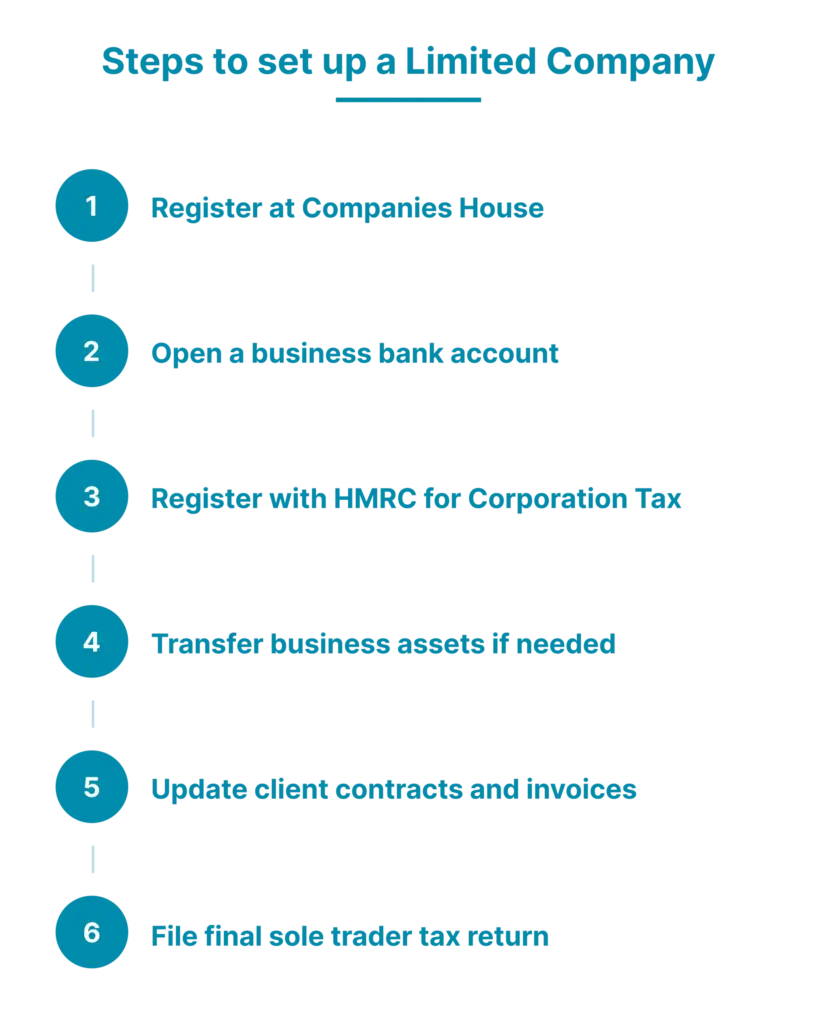
1. Register the limited company at Companies House: This can be done online and usually completes within 24 hours. You will need a company name, a registered address and at least one director.
2. Open a business bank account in the company’s name: The company is a separate legal entity, so personal and business finances must be kept apart from the date the company starts trading.
3. Notify HMRC: Register the company for Corporation Tax within three months of starting to trade. If relevant, register for PAYE if you are taking a salary and re-register for VAT if applicable.
4. Transfer any business assets: If you want to move equipment, intellectual property or other assets from your sole trader business into the company, this needs to be done carefully. There can be tax implications depending on the value involved.
5. Update your contracts and client relationships: Your clients will technically be contracting with a different legal entity. Inform existing clients and update invoicing details. New contracts should be signed in the company’s name.
6. File your final sole trader Self-Assessment: You will still need to report income earned up to the date of incorporation through your personal tax return.
Taking advice from an accountant before you begin will save time and help you avoid the most common mistakes, particularly around asset transfers and the mid-year tax position.
What changes after forming a Limited Company?
After forming a limited company, the business runs in a different way.
- The business becomes a separate legal entity and income belongs to the company first. You then take money through salary and dividends, each taxed differently.
- Reporting changes from Self-Assessment to a Corporation Tax return, along with payroll if a salary is paid and annual accounts plus a confirmation statement filed at Companies House, which are public records.
- The business name is protected once the company is formed, so no other company can register the same name.
- Pension contributions can be paid directly by the company as a business expense, with a £60,000 allowance for 2026/27.
- If you were a sole trader with income above £50,000, you would have been required to follow MTD for Income Tax rules. Once incorporated, the business operates under Corporation Tax rules instead and MTD for ITSA no longer applies.
Dividend Tax Rates: How you pay yourself as a Director?
Most directors take a small salary up to the National Insurance threshold and draw the remainder as dividends. The salary is deductible against Corporation Tax, while dividends are drawn from after-tax profit. In 2026/27, dividend tax rates are:
| Dividend Income | Tax Rate |
|---|---|
| Within Personal Allowance | 0% |
| First £500 (Dividend Allowance) | 0% |
| Basic rate (up to £50,270) | 10.75% |
| Higher rate (up to £125,140) | 35.75% |
| Additional rate (above £125,140) | 39.35% |
Dividends can only be paid from post-tax profits. The combined burden of Corporation Tax and dividend tax is still lower than sole trader Income Tax and National Insurance, as long as income stays within the basic rate band. Once dividends push total income into the higher rate band, the gap narrows and the overall saving reduces.
VAT Registration: What changes when you incorporate?
The £90,000 VAT threshold applies regardless of legal structure. If you are already VAT-registered as a sole trader, the registration does not carry over automatically the new company must register separately, though you can apply to transfer your existing VAT number.
If your turnover is below the threshold, registration is optional. It can be worthwhile if your clients are VAT-registered, as you can reclaim input VAT. If you use the Flat Rate Scheme, you will need to re-apply under the new company.
Conclusion
For many sole traders, the reason to switch comes when the tax cost of the current structure becomes too large to justify. For others, it is a contract they cannot win, an asset they need to protect or a partner they want to bring in.
In many cases, more than one of these factors appear together.
The right decision depends on clear numbers and real business needs. Moving too early adds extra cost and admin. Moving too late can mean paying more tax than needed over a long period.
The decision to choose between sole trader and limited company becomes clearer when you look at your income, level of risk and where you want the business to go next.
At DNS CloudCo, we work with sole traders across the UK who are at exactly this point. Visit dnscloudco.co.uk or get in touch today to book your consultation.
Frequently Asked Questions
When should I switch from sole trader to limited company?
For most sole traders with no other income, around £50,000 in annual profit is where the tax difference becomes meaningful. If you already have employment income, that point can come much earlier.
Should I go limited company as a sole trader?
It depends on your profit level, whether you have other income, what personal assets you hold and your business plans. These factors together give a far clearer answer than any single income threshold.
When should a sole trader form a limited company?
When the tax saving, personal liability protection or commercial requirement for one outweighs the cost and admin of running it. For tax reasons alone, most accountants point to £50,000 in profit as the starting point to seriously consider it.
How much should a sole trader earn before going limited?
There is no fixed figure. Around £50,000 in profit is a common starting point, but if you have a salary on top of your business income, it can make sense at £25,000 to £30,000 of business profit.
What profit level makes a limited company worthwhile?
Accountancy fees for a limited company typically run between £1,500 and £3,000 per year. Your tax saving needs to exceed that cost for incorporation to make financial sense. Above £50,000 in profit, it usually does.
When is it tax efficient to incorporate?
When your sole trader tax rates are consistently higher than what you would pay through a combination of Corporation Tax and dividend tax inside a limited company. For most sole traders, this starts to happen clearly above £50,000 in annual profit.
What are the financial thresholds for incorporating?
The key levels in 2026/27 are £50,270, where the higher rate Income Tax band begins and £100,000, where the Personal Allowance starts being withdrawn, creating an effective 60% rate up to £125,140.

Divyanshi is a subject matter expert in the UK accounting space, creating clear and easy-to-read content for accountants and businesses. She covers topics such as VAT returns, Self-assessment tax, bookkeeping, business planning and Year-end accounts. By understanding the common challenges faced by accountants and business owners, she focuses on writing content that answers real questions and simplifies complex topics. Her approach keeps information clear, relevant and useful for everyday business needs.