Cloud accounting and traditional accounting are often compared by UK SMEs when deciding which system is more cost-effective for managing business finances.
The real difference between cloud accounting solutions and traditional accounting setups is not just software, but the overall cost of running each system, including accounting software, while cloud-based accounting focuses on online access, automation and real-time financial reporting.
Understanding where the cost come from makes it easier to compare cloud accounting vs traditional accounting and decide which approach makes more financial sense for your business.
Key takeaways
- The average bookkeeper salary in the UK is £28,961 per year but the true employer cost is higher once National Insurance and pension contributions are included.
- Cloud accounting subscriptions usually range from £14 to £59 per month depending on platform and plan but the total cost can increase when add-ons and integrations are needed.
- Making Tax Digital is already mandatory for VAT-registered businesses and extends to Income Tax from April 2026. Some traditional desktop software may require a paid upgrade to stay compliant.
- Migrating from traditional to cloud accounting is a one-time cost the comparison shifts significantly from Year 2 onwards.
- Manual processing time, delayed financial data and accountant preparation time are real ongoing costs that rarely appear on any invoice but should be included in any real cost comparison.
The Full Cost of Traditional Accounting
Traditional accounting often cost more than the license fee or the bookkeeper salary. Employer obligations, IT maintenance and accountant preparation time all add to the overall spend, but these are rarely considered together when comparing accounting systems.
Bookkeeper or finance staff
According to Indeed, the average base salary for a bookkeeper in the UK is £28,961 per year, based on 3,800 reported salaries updated on 11 May 2026.
That salary is the starting point, not the total cost to your business. As an employer you are legally required to pay the following on top of it:
- Employer National Insurance is charged at 15% on earnings above £5,000 per year for the 2026/27 tax year. On a £28,961 salary, this applies to £23,961 of earnings, adding approximately £3,594 per year paid directly to HMRC on top of the salary itself.
- Under auto-enrolment rules, you are required to contribute a minimum of 3% into your employee’s workplace pension on qualifying earnings between £6,240 and £50,270 per year. On a £28,961 salary, qualifying earnings amount to £22,721, making the minimum employer pension contribution approximately £681 per year. This is a legal requirement for eligible staff, not a discretionary benefit.
- You are also obligated to provide 5.6 weeks minimum paid holiday per year, Statutory Sick Pay during absence and cover for their workload when they are away.
HMRC’s employment cost calculator gives you the precise employer cost for any salary. The total is consistently higher than the salary figure alone.
Software, licensing and IT
Desktop accounting software typically involves an upfront licence purchase or an annual renewal. If more than one person needs access, the price often increases.
The business is responsible for the systems that support the software. This includes the computer it runs on, technical support when problems arise and backup systems to keep financial records safe. If a device fails and there is no proper backup, recovering that data can be expensive.
MTD compliance updates may require a paid upgrade depending on the software version currently in use. Confirm this with your vendor in writing before assuming it is included in your existing license.
Accountant preparation time
When an accountant works from exported files, emailed spreadsheets or paper records extra time is often needed to organise and reconcile the information before they can begin reviewing the accounts. That time is included in what the business pays, even though some of it can be reduced with direct access to accounting software.
One useful question to ask is how much of your annual accounting fee covers preparation and reconciliation rather than advice. For many SMEs, this part of the fee is not always clear and the proportion can be higher than expected.
The Full Cost of Cloud Accounting
Cloud accounting has a more predictable cost structure, but the subscription price is the starting point, not the total.
The subscription cost
Cloud accounting subscription prices can vary depending on the provider and the features as per the needs of your business. The four main UK cloud accounting offer different plans, with some including payroll and others charging extra for add-ons. All figures below exclude VAT.
Confirm directly with each provider before subscribing as these figures are subject to change.
Xero offers four plans:
- Ignite: £16 per month up to 20 invoices and 5 bills, bank reconciliation, VAT returns
- Grow: £37 per month unlimited invoices and bills, multi-currency support
- Comprehensive: £50 per month includes payroll capability, bank payments
- Ultimate: £65 per month advanced analytics, expenses and project tracking
- Xero offers one month free on all plans for new customers. No credit card required.
Payroll is available as an add-on at £1.50 per additional employee per month on Grow and Comprehensive plans. Expenses tracking is charged at £2.50 per active user per month as an additional cost.
QuickBooks Online has five plans:
- Sole Trader: £10 per month for self-employed individuals, MTD Income Tax included
- Simple Start: £16 per month one business user, full bookkeeping, MTD VAT and MTD Income Tax
- Essentials: £38 per month up to three users, bill management, VAT submissions
- Plus: £56 per month up to five users, inventory tracking, project profitability
- Advanced: £123 per month for larger businesses, custom reporting, batch processing
- QuickBooks offers a 30-day free trial on its plans. Note: if you opt for an introductory discount instead, you will not be eligible for the free trial it is one or the other.
QuickBooks plans do not include payroll as standard, it is available as a paid add-on.
FreeAgent prices by business type, all excluding VAT:
- Limited companies: £33 per month or £330 per year
- Sole traders: £19 per month or £190 per year
- Partnerships or LLPs: £27 per month or £270 per year
- Landlords: £10 per month or £100 per year
- FreeAgent offers a 30-day free trial on all plans. No credit card required.
Payroll is included across all FreeAgent plans at no extra cost. FreeAgent is available free with qualifying NatWest, Royal Bank of Scotland and Ulster Bank business accounts. Verify this is still the case with your bank before relying on it.
Sage Accounting has three plans, all excluding VAT:
- Start: £18 per month for sole traders and micro-businesses, VAT submissions included
- Standard: £39 per month for small businesses, adds receipt capture and cash flow forecasting
- Plus: £59 per month adds inventory management and multi-currency support
- Sage Accounting offers a free 30-day trial on all plans. No credit card required.
Payroll is included across all Sage Accounting plans. Additional payroll users beyond plan limits are charged per employee per month.
Pricing and features are reviewed regularly by each provider. Always confirm the current rate before subscribing.
Add-ons and integrations
This is where cloud accounting can become more expensive than expected:
- Receipt capture tools such as Dext or AutoEntry carry their own separate monthly subscription
- Some platforms charge extra if more users need access
- Integrations for stock management, job management or CRM are all priced separately
Compare the total amount you are likely to pay based on what your business actually needs, not just the starting price of the software.
Migration
Moving from traditional to cloud accounting involves a one-time setup cost covering opening balances, chart of accounts, historical data and bank feed connections. Ask your accountant for a specific migration quote before making any cost comparison.
Year 1 always costs more than Year 2 onwards because migration is a one-time expense. Any meaningful comparison should be done over three years, not one.
Before making the switch, work through these five checks first.
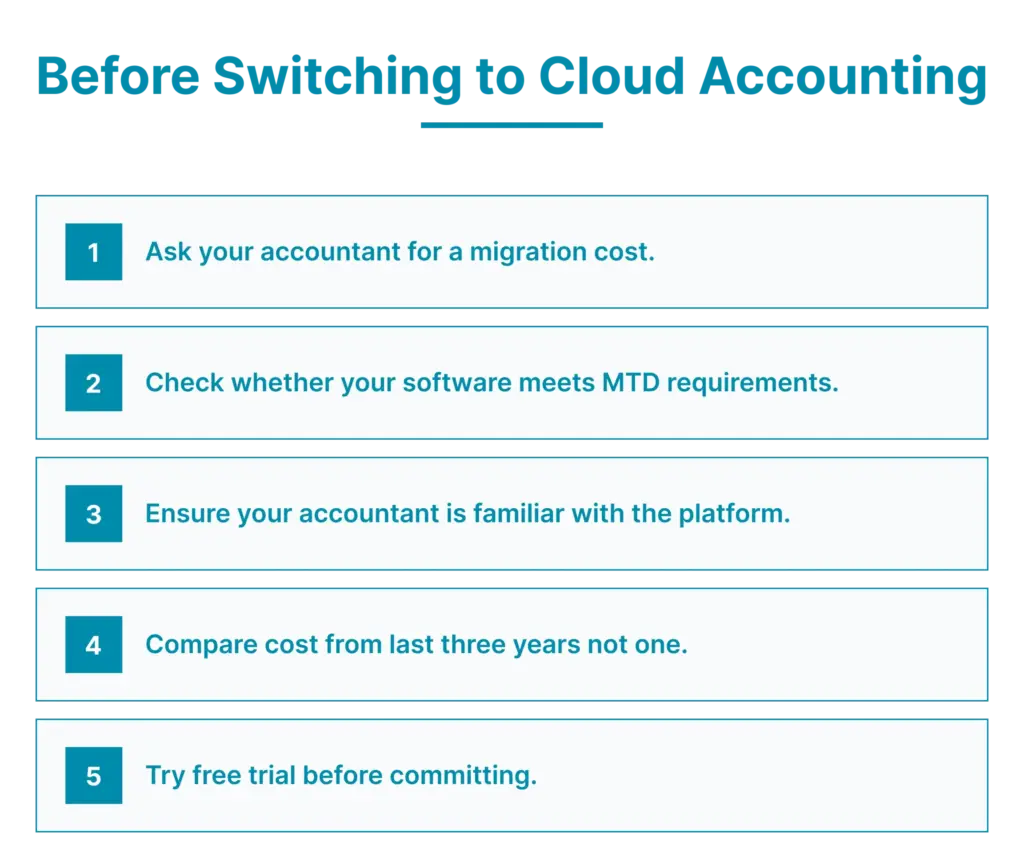
Once these are in place, the migration itself is simple.
Internet reliance
Cloud accounting requires an internet connection for most tasks. If your connection drops, access to live financial data may be temporarily limited.
Traditional desktop software can usually be accessed offline, which may suit businesses with unreliable connectivity.
For most UK SMEs, this is rarely a major issue, but it is worth checking what offline access or outage protection your chosen provider offers.
Does your current accountant support Cloud Accounting?
Moving to cloud accounting does not usually mean changing accountants, but it is worth checking whether your current adviser actively supports the platform you plan to use.
Most UK accountants now work with at least one major cloud platform such as Xero, QuickBooks, FreeAgent or Sage and can often assist with migration, setup and ongoing support.
If your accountant still relies mainly on spreadsheets or desktop software, cloud accounting may change how information is shared and how efficiently they can work with your records.
Before switching, ask whether your accountant supports your chosen platform and whether direct cloud access could reduce preparation time or annual accounting fees. Choosing software that works well for both your business and your accountant can make the transition much smoother.
Data Security: Cloud vs Traditional Accounting
Traditional accounting security depends entirely on your own systems, including backups, software updates and device protection. If records are lost or hardware fails, recovery can be costly and time-consuming.
Cloud accounting providers typically include encrypted data transfer, automatic backups and continuous security updates as standard, reducing the risk of data loss and outdated software vulnerabilities.
No system is completely risk-free, but for most UK SMEs, cloud accounting offers a more secure and reliable way to protect financial data without the burden of managing security internally.
What the invoice does not show?
Beyond the direct monthly or annual costs, several significant expenses sit outside any invoice.
The time cost of manual processing:
How many hours each week does someone in your business spend on data entry, bank reconciliation or chasing receipts? When that time is added up over the year, it can represent a significant expense that should be included in any accounting comparison.
Cloud accounting can reduce much of this manual work through features such as automated bank feeds and faster transaction matching.
Decisions made on delayed data:
In traditional setups, financial data is often weeks behind by the time it has been entered and reconciled. Pricing decisions, cash flow planning and hiring decisions made without a current picture carry a genuine business cost, even if it cannot be precisely measured.
Accountant collaboration time:
Traditional setups require file exports or manual handover before an accountant can begin work.
Cloud accounting allows accountants to access records directly at no additional cost on most platforms, reducing preparation time and in many cases lowering the annual fee. Ask your accountant whether this would apply to your arrangement.
MTD: The compliance cost most businesses have not planned for
Making Tax Digital has changed the cost calculation for a significant number of UK SMEs and its scope is widening.
MTD for VAT was first introduced in April 2019 for businesses above the £85,000 VAT threshold and extended to all VAT-registered businesses in April 2022.
MTD for Income Tax Self-Assessment is being introduced in stages:
- April 2026: sole traders and landlords earning over £50,000 are now required to comply
- April 2027: threshold drops to £30,000
- April 2028: £20,000 threshold proposed but not yet legislated at time of writing
Some traditional desktop software requires a paid upgrade to meet MTD requirements. All four cloud platforms covered above include MTD compliance within their standard subscriptions at no extra charge.
If your current software needs a paid upgrade to stay compliant, that cost belongs in your traditional accounting total. HMRC operates a points-based penalty system for late or missed submissions, with points accumulating towards financial penalties. The structure applies per tax obligation, so businesses with both VAT and Income Tax MTD requirements face exposure on both.
How the two options compare?
| Cost Category | Traditional | Cloud |
|---|---|---|
| Software cost | Upfront licence or annual renewal | Monthly subscription depending on platform and plan |
| Bookkeeping & staff costs | Salary plus employer NI plus pension plus statutory costs | Less manual input can reduce bookkeeping time |
| IT and infrastructure | Hardware, backup and support managed by the business | Managed by the software provider and included in the subscription |
| Payroll | Separate software or manual process | Included in Sage and FreeAgent; add-on in Xero and QuickBooks |
| MTD compliance | May require a paid upgrade confirm with vendor | Included as standard across all four major platforms |
| Accountant access | File export or manual handover required | Direct access through shared login on most platforms |
| Add-on tools | Separate purchases where required | Extra subscriptions may apply for integrations or advanced features |
| Migration cost | Already established if staying on the same system | One-time cost to switch |
| Data backup | Managed by business | Managed by the software provider |
| Real-time reporting | Delayed on how often records are updated manually | Available as standard |
| Internet required | Not always | Yes |
This table reflects cost structures. Verify all current pricing directly with each vendor and your accountant.
Conclusion
When the full cost of traditional accounting is calculated properly salary, employer National Insurance, pension, IT, compliance upgrades and accountant preparation time, the total is often much higher than the licence fee or bookkeeper salary alone.
Cloud accounting can bring many of these into one simpler setup. Add-ons and migration still need to be considered, but day-to-day management is often easier and there are fewer hidden expenses to manage.
For most UK SMEs running the full numbers, cloud accounting works out cheaper from Year 2 onwards. The question isn’t whether to switch, it’s how to time it and what migration will cost your business
Need help with cloud accounting? DNS CloudCo can help you choose the right setup for your business and support you through the switch. Call : 01908886755, email info@dnscloudco.co.uk or visit DNS CloudCo for expert support.
FAQs
Is cloud accounting cheaper than traditional accounting for UK small businesses?
For most SMEs yes, when the full cost is calculated properly. The monthly subscription replaces software licences, IT infrastructure and a portion of accountant preparation time. The comparison only looks close when employment costs and IT expenses on the traditional side are left out of the calculation.
What are the costs of traditional accounting that businesses often miss?
Employer National Insurance and pension contributions on top of bookkeeper salaries, IT hardware and support, data backup systems and accountant time spent reconciling manually exported data. None of these appear on a single invoice but all are real ongoing costs that accumulate over time.
Does cloud accounting software include Making Tax Digital compliance?
Yes, all four major platforms covered above Xero, QuickBooks, FreeAgent and Sage Accounting include MTD compliance within their standard subscriptions. Traditional desktop software may require a separate paid upgrade depending on the version currently in use. Confirm this with your vendor in writing.
How much does it cost to migrate from traditional to cloud accounting?
Migration is a one-time cost covering opening balances, chart of accounts setup and bank feed connections. The total varies depending on your current setup and the accountant handling the migration. Get a specific quote before making any comparison. Year 1 costs more. Year 2 onwards is where the financial case typically becomes clear.
Should UK SMEs switch to cloud accounting?
For many SMEs, cloud accounting offers lower long-term costs, better visibility and easier compliance. The right timing depends on your current setup and readiness to migrate.
What is the easiest cloud accounting software for a small UK business?
The easiest platform depends on your business needs. FreeAgent is often chosen for simplicity, Xero for usability, QuickBooks for reporting and Sage for familiarity. Free trials can help you decide.
Can I switch cloud accounting platforms later if I change my mind?
Yes, but switching may involve data migration costs and temporary disruption. Choosing the right platform early can help avoid unnecessary changes later.

Divyanshi is a subject matter expert in the UK accounting space, creating clear and easy-to-read content for accountants and businesses. She covers topics such as VAT returns, Self-assessment tax, bookkeeping, business planning and Year-end accounts. By understanding the common challenges faced by accountants and business owners, she focuses on writing content that answers real questions and simplifies complex topics. Her approach keeps information clear, relevant and useful for everyday business needs.