For many businesses in the UK, AI has made bookkeeping incredibly easy. Earlier sorting receipts, matching bank transactions used to consume so much time, but platforms like Xero, QuickBooks and Sage handle these tasks automatically.
But one important thing in bookkeeping tasks is that being fast does not guarantee accuracy. AI can handle day-to-day bookkeeping tasks well, but when a transaction requires even a little judgement, such as a transaction that may not follow a clear pattern. These errors are difficult to detect because the records look clean and complete on the surface.
With Making Tax Digital expanding in 2026, accurate records matter more than ever. This guide explains where AI bookkeeping can genuinely help, where it can go wrong and what businesses should keep in mind when relying on automation.
Key takeaways
AI works best with regular and predictable transactions. The more complex the bookkeeping, the more important manual checks become.
Some of the most common mistakes happen with VAT, large purchases and loan repayments, where small errors can affect your financial records.
These errors often go unnoticed because the records can still look correct in the software.
Accurate bookkeeping is essential for Making Tax Digital, especially with more frequent digital reporting.
AI works best when businesses use automation carefully and review their records regularly.
What AI Bookkeeping actually does?
First, it is important to understand what AI does for your accounting software. Only then you can decide how much trust you should place in it.
In short, AI bookkeeping is simply a pattern-recognising system. It analyses your past transactions, understands which expenses belong in which category and then repeats the pattern for future transactions.
The more your transactions follow a similar pattern, the more accurate the software will be.
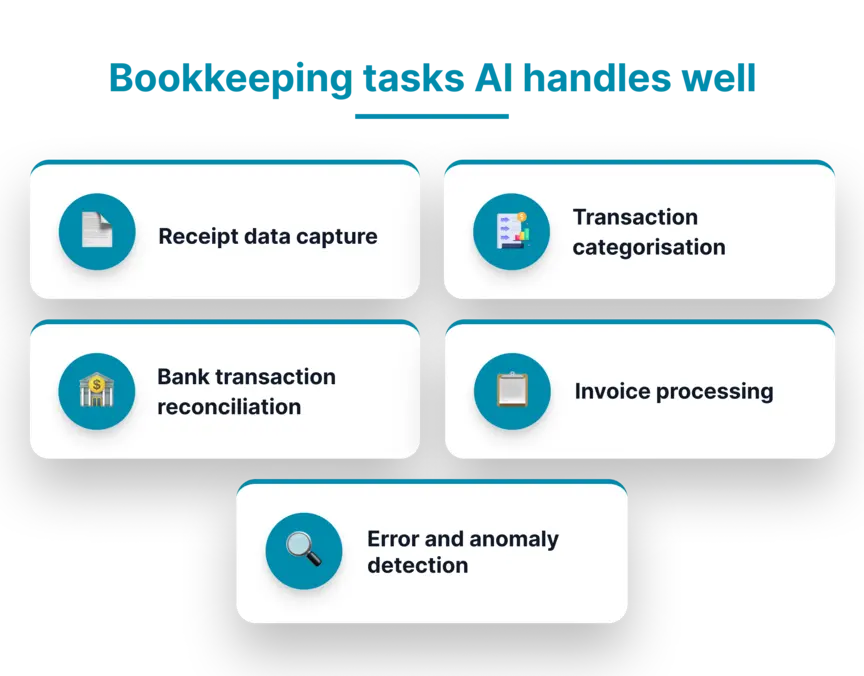
The tasks it handles well:
- Receipt data capture: Tools like Dext and Hubdoc scan receipts and extract supplier name, amount, date and VAT without manual entry
- Transaction categorisation: Recurring costs like subscriptions, utilities and regular supplier invoices are sorted into the right accounts once the pattern is established
- Bank transaction reconciliation: Transactions are matched to invoices and records automatically. Where Open Banking feeds are available, this happens in near real time.
- Invoice processing: Standard supplier bills and recurring client invoices are processed and matched with minimal manual input
- Error and anomaly detection: Duplicate charges, unusual vendors and out-of-pattern amounts are flagged faster than any manual review
For a UK SME spending hours each month on basic bookkeeping admin, these features alone can make a meaningful difference. That is the genuine value of AI bookkeeping and it is worth using.
Where AI Bookkeeping gets it wrong?
This is where it gets important. AI works with patterns and rules. Bookkeeping often requires context and judgement. Those two things are not the same and the gap between them is where expensive errors happen.
To understand the problem, consider a simple example.
A tradesperson buys materials from the same builder’s merchant twice in one week. Monday’s purchase was for a client job. Friday’s was consumables for the workshop. To the AI, both transactions look identical. Same supplier, similar amount, same payment method. It categorises both the same way. One should be a job cost. One should be an overhead. The AI cannot tell the difference.
That kind of error does not look like an error in the software. It looks like a clean set of books. Until someone reviews it.
The most common AI Bookkeeping errors:
- Capital asset misclassification: Equipment purchases recorded as day-to-day expenses rather than capital assets, which affects Corporation Tax treatment under HMRC rules
- VAT treatment errors: Mixed invoices with items at different VAT rates processed incorrectly, with no flag to alert you
- Loan repayments: Recorded as a single outgoing rather than split between principal and interest, making both the balance sheet and profit and loss inaccurate
- Job and project costing: Costs linked to the wrong job or not linked at all, making profitability figures unreliable
- Director and owner transactions: Drawings, director loans and dividends regularly categorised as ordinary business expenses.
How can UK SMEs set up a review process for AI Bookkeeping?
AI works best when it is supported by a simple review system rather than full automation.
A practical approach includes:
- Regular review of bank reconciliation to catch mismatches early
- Monthly checks of expense categories, especially VAT and large costs
- Separate review of capital assets and loan entries before closing accounts
- Final check before Making Tax Digital submissions to confirm accuracy
This approach helps businesses benefit from automation while keeping control over financial accuracy.
The tasks AI should never handle alone
Some bookkeeping tasks carry direct HMRC compliance risk if they go wrong. These are the ones that always need a qualified human involved, regardless of how capable the software is.
| Bookkeeping Task | Safe to Automate Fully? | Why It Needs Human Review |
|---|---|---|
| Routine transaction categorisation | Mostly | Context errors need regular spot checks |
| Bank reconciliation on clean data | Yes | Standard matching, low risk |
| Receipt capture | Yes | Reliable on consistent formats |
| VAT return preparation | No | Supply type treatment must be verified |
| Payroll accounting | No | NI, pension and journals require accuracy |
| Capital asset recording | No | Classification and depreciation under UK rules |
| Director and owner transactions | No | Frequently miscategorised |
| Multi-line invoices | No | AI defaults to one line rather than splitting |
| HMRC allowability judgements | No | AI cannot determine what qualifies |
The pattern is consistent. Routine, predictable tasks are safe to automate. Anything requiring context, compliance knowledge or judgement is not.
What Making Tax Digital means for your books?
Making Tax Digital is the biggest structural change to UK bookkeeping compliance in a generation. Here is where things stand in 2026:
- MTD for VAT has been mandatory for all VAT-registered businesses since April 2022
- MTD for Income Tax begins in April 2026 for self-employed individuals and landlords earning above £50,000
- MTD for Income Tax extends to those earning above £30,000 from April 2027
MTD for VAT is now the standard for VAT-registered businesses, with automatic enrolment for new VAT registrations by HMRC.
AI helps by:
- Maintains digital records in an MTD-compatible format
- Connects to HMRC-recognised software for quarterly submissions
- Reduces the admin burden of preparing data for each submission
However, AI cannot:
- Verify that the records it has created are actually correct
- Determine whether VAT has been applied to the right rate
- Ensure capital assets have been classified properly before submission
- Make any of the compliance judgements that sit underneath the numbers
MTD does not reduce the need for accurate bookkeeping. It makes accurate bookkeeping a legal submission requirement four times a year rather than once. Every quarterly submission reflects the accuracy of what is underneath it.
GDPR and Data Security in AI Bookkeeping
AI bookkeeping tools operate through cloud-based systems, meaning financial data is stored and processed digitally.
For UK SMEs, this introduces GDPR responsibilities. Businesses must ensure:
- Software providers follow UK data protection standards
- Data is encrypted and securely stored
- Access is restricted to authorised users only
- Sensitive financial information is properly controlled internally
Platforms like Xero, QuickBooks and Sage already meet strong security standards, but businesses still need to maintain safe internal practices.
Conclusion
AI is changing how bookkeeping gets done but has not changed what good bookkeeping requires. Speed and automation can improve efficiency, but they cannot replace accuracy, judgement and regular review.
The benefits of AI for UK businesses come from using it wisely. This means knowing which tasks are suitable for automation and which still require closer attention. As the demands for digital reporting increase, accurate record keeping has become more important than ever.
If you are unsure whether your AI bookkeeping setup is working correctly, a review with a qualified bookkeeper or accountant is a sensible next step.
Frequently Asked Questions
What bookkeeping tasks can be automated safely?
Routine tasks like receipt capture, invoice processing, bank matching and basic categorisation can be automated safely. As they follow clear patterns. But tasks involving VAT, judgement or complex entries still need manual review.
What is the best AI accounting software for UK small businesses?
Common tools include Xero, QuickBooks and Sage. All offer AI features like bank feeds, automation and receipt scanning. The best option depends on business size, transaction volume and reporting needs.
How does AI help with bank reconciliation?
AI matches bank transactions with invoices using bank feeds and past patterns. It suggests matches automatically, reducing manual work and making reconciliation faster, especially for regular transactions.
What are the benefits of AI in accounting for UK SMEs?
AI reduces manual entry, saves time and improves record accuracy. It supports faster reporting, easier expense tracking and quicker reconciliation, helping SMEs focus more on operations.
Which AI bookkeeping software is best for my type of business?
Xero suits service businesses, QuickBooks fits high-volume transactions and Sage works well for structured accounting needs. The right choice depends on complexity, size and reporting requirements.
How do I know if my current AI setup has made errors?
Errors are found through regular review of bank reconciliation, VAT entries and reports against bank statements. Monthly checks help catch mistakes that AI may not flag automatically.
What should I ask a bookkeeper to check?
Ask them to review VAT accuracy, capital assets, payroll entries, loan splits and director transactions. These areas are most likely to contain AI-related errors.
Does AI bookkeeping work for VAT-registered businesses specifically?
Yes, it supports VAT record keeping and reporting. However, VAT treatment still needs review as incorrect categorisation or mixed-rate invoices can create errors before submission.

Divyanshi is a subject matter expert in the UK accounting space, creating clear and easy-to-read content for accountants and businesses. She covers topics such as VAT returns, Self-assessment tax, bookkeeping, business planning and Year-end accounts. By understanding the common challenges faced by accountants and business owners, she focuses on writing content that answers real questions and simplifies complex topics. Her approach keeps information clear, relevant and useful for everyday business needs.