VAT-registered UK businesses can reclaim VAT on electric car mileage, but the answer depends on ownership, charging location and recordkeeping. The rules around business mileage claims are more specific than most businesses expect. If the details are wrong, a business may lose the reclaim completely or recover less VAT than it should.
From September 2025, HMRC introduced two separate Advisory Electricity Rates for the first time, distinguishing between home and public charging. From 1 March 2026, the home charging rate remains at 7p per mile while the public charging rate increased to 15p per mile. Where a business records charging location directly affects how much VAT it recovers each quarter.
This blog covers what can be reclaimed, how ownership type affects the calculation, what different charging locations mean for the reclaim and what records HMRC needs.
Key takeaways
- VAT recovery depends on whether the car is available for private use, not whether private use actually occurs
- Public and home charging follow different VAT recovery rules with significantly different return amounts
- Purchased cars block VAT entirely, leased cars allow 50% recovery if available for private use
- HMRC requires clear evidence of restricted private use before allowing a full VAT reclaim
- Employers cannot recover VAT on electricity used by employees to charge company cars at home
The VAT Rules for Electric Car Mileage in 2026
Electric cars follow the same VAT rules as petrol and diesel vehicles under VAT Notice 700/64. There is no separate or more generous treatment for EVs.
Claiming VAT on mileage for electric cars is available in three situations. The first is the electricity used to charge a company electric car for business travel. The second is the VAT on mileage allowance payments made to employees driving company EVs. The third is repairs and maintenance costs the business has paid for directly.
The VAT treatment differs by cost type. Exclusive business use is crucial when reclaiming VAT on a purchased car, while repairs, maintenance and mileage-related claims follow different rules. The vehicle must not be available for private use by anyone, including employees and directors.
What Exclusive Business Use means in practice?
The reclaim does not fail because someone used the car privately. It fails because nothing prevented them from doing so.
HMRC looks for a written restriction in the employment contract or a formal vehicle policy that actively prevents private use. If that document does not exist, HMRC blocks the reclaim, regardless of whether the car was used privately or not.
Commuting does not count as business mileage. A director or employee driving a company electric car between home and a regular workplace is making a personal journey under HMRC rules.
Business mileage covers travel to a client site, a temporary workplace, or any location outside the usual place of work.
How the VAT on Business Mileage is calculated?
Reclaiming VAT on business mileage is based on HMRC’s Advisory Electricity Rate. From March 2026, the rates are:
| Charging Location | Advisory Electricity Rate |
|---|---|
| Home charger | 7 pence per mile |
| Public charger | 15 pence per mile |
HMRC separated the Advisory Electricity Rate by charging location from September 2025. The March 2026 update increased the public charging rate from 14p to 15p.
The VAT fraction also differs by charging location. Home electricity carries VAT at 5%, so the fraction is 5/105. Public charging carries VAT at 20%, so the fraction is 20/120.
For 100 business miles charged at home: £7.00 x 5/105 gives 33 pence reclaimable.
For 100 business miles charged at a public point: £15.00 x 20/120 gives £2.50 reclaimable.
That creates a much higher VAT reclaim for public charging than for home charging. For a business running multiple EVs on high monthly mileage, the difference in the VAT reclaim between home and public charging is material. Recording charging location accurately is what determines the correct reclaim amount.
Pool cars
A car shared across employees for business trips, kept at business premises, not allocated to any individual and not taken home qualifies as a pool car. VAT on pool cars is reclaimable in full. The exclusive use condition that applies to standard company cars does not apply here.
How the Reclaim differs if you Own or Lease the Car?
Whether a business owns or leases its electric cars changes the VAT reclaim available. The two are calculated differently and the outcomes can be very different.
Purchased car
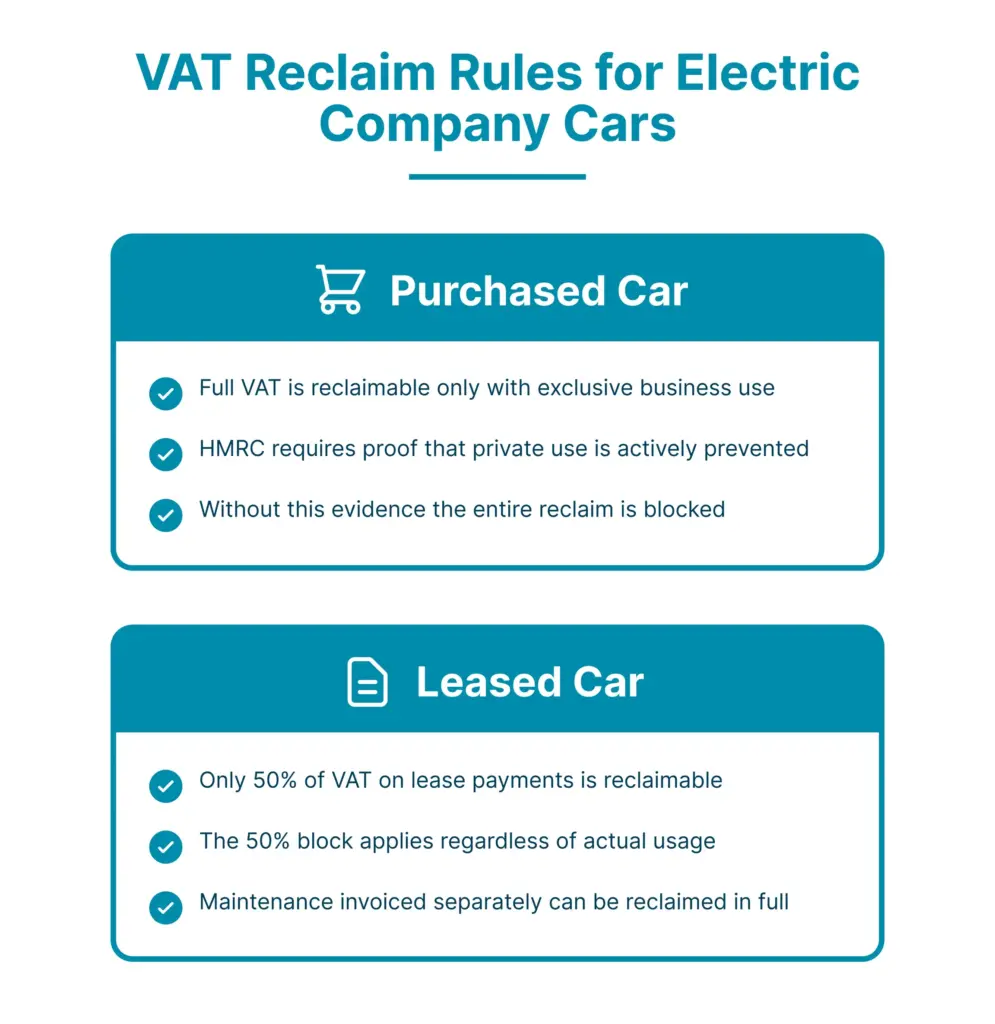
For a purchased car, the full VAT is reclaimable only where the car is used exclusively for business and no private use is available to anyone. Where exclusive use cannot be shown, the VAT on the purchase is blocked in full. There is no partial reclaim.
A business that spends £60,000 on a company EV without the correct documentation in place recovers nothing on that purchase. Not a proportion, not 50%, nothing.
Leased car
For a leased electric car, HMRC applies a 50% VAT block. Only 50% of the VAT on the lease rental charges is reclaimable, regardless of how the car is used in practice. HMRC treats a leased car as available for private use by default. This restriction applies to electric, hybrid, petrol and diesel vehicles equally.
The 50% block applies to rental charges only. VAT on maintenance is fully reclaimable if listed separately on the invoice. Many leasing companies bundle maintenance into the monthly charge, requesting a separate line item increases the VAT recoverable each quarter.
Repairs and maintenance
VAT on repairs and maintenance is fully reclaimable where the business has paid for the work directly. Private use of the car does not block this. The restriction applies to the purchase or lease, not to ongoing expenses.
How Charging Location affects your VAT Reclaim?
The location where a company electric car is charged determines how much VAT a business can recover, at what rate and under what conditions. The rules differ for each location and in one case the reclaim is not available at all.
Charging at the Workplace
Businesses can usually reclaim VAT on electricity used to charge a company’s electric car at the workplace, provided the business-use portion can be supported. Mileage records must separate business and private use. Normal input tax rules under VAT Notice 700 apply.
Charging at a Public Charging Point
HMRC treats the electricity at a public charging point as a supply made to the employer. The business can recover the VAT, subject to mileage records confirming the business proportion. Public charging carries VAT at 20%.
In March 2026, the First Tier Tribunal ruled in Charge My Street Ltd v HMRC that certain public EV charging supplies could qualify for the reduced 5% VAT rate. However, HMRC has not updated its published guidance and continues to treat public charging as subject to 20% VAT. Until HMRC updates its guidance, businesses should continue using 20% rate when calculating their reclaim.
Charging at Home: Sole Traders and Partners
A sole trader or partner can recover VAT on the business portion of home charging costs. Domestic electricity carries VAT at 5%. Mileage records must separate business and private use.
Charging at Home: Employees
Where an employee charges a company electric car at home, the electricity supply is made to the employee, not the employer. The employer cannot reclaim that VAT, even where the full cost is reimbursed.
This gap affects businesses where employees charge company EVs at home overnight. HMRC acknowledged this in VAT Notice 700/64 section 8.4 and confirmed a review is ongoing. As of May 2026, HMRC has not published updated guidance changing this position.
How to Reclaim VAT on Electric Car Mileage?
Reclaiming VAT on electric car mileage is based on a few key steps. Following a consistent process helps ensure the correct amount is claimed and reduces the risk of issues during an HMRC review.
- Step 1: Track business mileage: Maintain mileage records showing the date, purpose of the journey and business miles travelled. Only qualifying business journeys can be included in the calculation.
- Step 2: Identify the charging location: Record whether the vehicle was charged at home, at the workplace or at a public charging point. The charging location determines the rate used in the VAT calculation.
- Step 3: Apply HMRC’s Advisory Electricity Rate: Calculate the mileage cost using the appropriate Advisory Electricity Rate for the charging location. HMRC publishes these rates and updates them periodically.
- Step 4: Calculate the recoverable VAT: Apply the relevant VAT fraction to determine the VAT element of the mileage cost. The amount recoverable differs depending on where the vehicle was charged.
- Step 5: Include the claim in the VAT Return: Record the recoverable amount as input tax on the VAT return and retain supporting mileage logs and charging records as evidence.
What records HMRC requires for VAT Reclaim?
A VAT reclaim is only as strong as the records supporting it. HMRC requires specific documentation across mileage, charging and vehicle use. Missing records can lead HMRC to reduce or reject the claim.
The core requirements are:
- Mileage logs showing the date, journey purpose, start and end points and total miles travelled
- Charging location records confirming whether each charge took place at home, at the workplace, or at a public point
- Charging receipts for all costs paid directly by the business
- Apportionment calculations where a car is used for both business and private purposes
- Written private use restrictions, where a business is claiming a full VAT reclaim on a purchased car
For mileage allowance payments, HMRC also requires confirmation that each journey was a business journey, the rate paid and the input tax claimed.
Maintaining these records consistently through the year is considerably less work than reconstructing them before a compliance check.
BIK Rates for Electric Company Cars in 2026/27
Once VAT reclaim requirements are understood, it is equally important to consider how company cars are treated for Benefit in Kind (BIK) purposes, since both areas rely on similar underlying usage data.
Where a company car is available for private use, including commuting, it may create a Benefit in Kind (BIK) charge. This is calculated separately from VAT but is influenced by how the vehicle is used and recorded.
Fully electric cars have an appropriate percentage of 4% in 2026/27, rising to 5% in 2027/28. For petrol, diesel and hybrid vehicles, the appropriate percentage varies according to CO2 emissions and can be as high as 37%.
The mileage records maintained for VAT purposes can also help support BIK reporting by distinguishing business journeys from private travel. However, businesses may still need separate payroll, P11D and company car records to meet their reporting obligations.
Conclusion
Claiming VAT on electric car mileage depends on charging location, vehicle ownership and accurate recordkeeping. Businesses using separate home and public charging rates should ensure their calculations reflect HMRC’s latest guidance.
The position on employee home charging remains unchanged, making charging records and mileage logs essential for supporting any reclaim.
Reviewing EV VAT claims regularly can help ensure the correct amount is being recovered and that supporting records meet HMRC requirements. For support, contact DNS CloudCo on 01908886755.
FAQs
Which accounting software supports VAT tracking for electric car mileage?
Most accounting software platforms, including Xero, QuickBooks and Sage, allow businesses to record mileage, store receipts and track vehicle-related expenses. However, businesses may still need separate records showing charging location and business mileage to calculate VAT recovery correctly.
Should a business change how it pays for EV charging to improve VAT recovery?
Possibly, charging arrangements can affect VAT recovery. Businesses that reimburse employee home charging may benefit from reviewing how EV charging expenses are managed.
Is it worth reviewing existing lease agreements for electric company cars?
Yes, lease agreements that separately itemise maintenance cost may allow more VAT to be recovered than agreements where maintenance is included within rental charges.
Can HMRC challenge an electric car VAT reclaim after it has already been submitted?
Yes, HMRC can review previous VAT returns during a compliance check and request supporting records. If the business cannot provide sufficient evidence, some or all of the VAT previously claimed may need to be repaid.
Can a director reclaim VAT on charging a company electric car at home?
Usually not, where the electricity supply is in the director’s name, the company generally cannot reclaim the VAT even if the charging costs are reimbursed.
Do public charging receipts need to show VAT separately?
Yes, retaining VAT receipts or invoices helps support the reclaim and provides evidence if HMRC requests documentation during a compliance review.
Can VAT be reclaimed if a company electric car is used for both business and private journeys?
Yes, VAT on qualifying running cost may still be recoverable for the business-use portion of those costs. However, private use can affect the VAT treatment of the vehicle itself, particularly where a business is seeking to reclaim VAT on the purchase of a company car.
What happens if charging location records are missing?
Missing charging location records can make it difficult to support a VAT reclaim, as different charging locations use different VAT calculations.

Divyanshi is a subject matter expert in the UK accounting space, creating clear and easy-to-read content for accountants and businesses. She covers topics such as VAT returns, Self-assessment tax, bookkeeping, business planning and Year-end accounts. By understanding the common challenges faced by accountants and business owners, she focuses on writing content that answers real questions and simplifies complex topics. Her approach keeps information clear, relevant and useful for everyday business needs.