Can I buy a watch through my limited company? A washing machine? A TV? These are questions most limited company directors ask at some point.
The answer is not a simple yes or no. HMRC draws a firm line between a genuine business expense and a personal benefit and the consequences of getting it wrong can be costly.
This guide covers everything directors need to know about buying personal items through a limited company what you can legitimately claim, what triggers a tax liability and where the real risks sit.
Key takeaways
- HMRC distinguishes between business expenses and personal benefits purpose is everything
- Personal use of company-purchased items is usually treated as a benefit in kind, which is taxable
- Some items are clearly allowable; others such as a Rolex or a washing machine will almost certainly not be
- Understanding director expenses and what qualifies keeps you compliant and tax-efficient
Note : This article was updated and republished on 25-Mar-2026 to reflect the latest HMRC guidance on allowable business expenses, benefits in kind, director’s loan account rules and compliance requirements for UK limited company directors using company funds for personal or mixed-use purchases.
Why Business Purpose is the only rule that matters?
Before asking whether you can buy something through your company, ask a different question: is this genuinely for the business?
The Wholly and Exclusively Test:
HMRC applies the wholly and exclusively test when assessing business expenses. An item is only allowable if purchased wholly and exclusively for business purposes. If the dominant purpose is personal, or if the expense is inherently personal, HMRC is likely to treat the element of personal use as a benefit in kind., triggering income tax and National Insurance contributions.
Before putting anything through your company, HMRC applies one test.
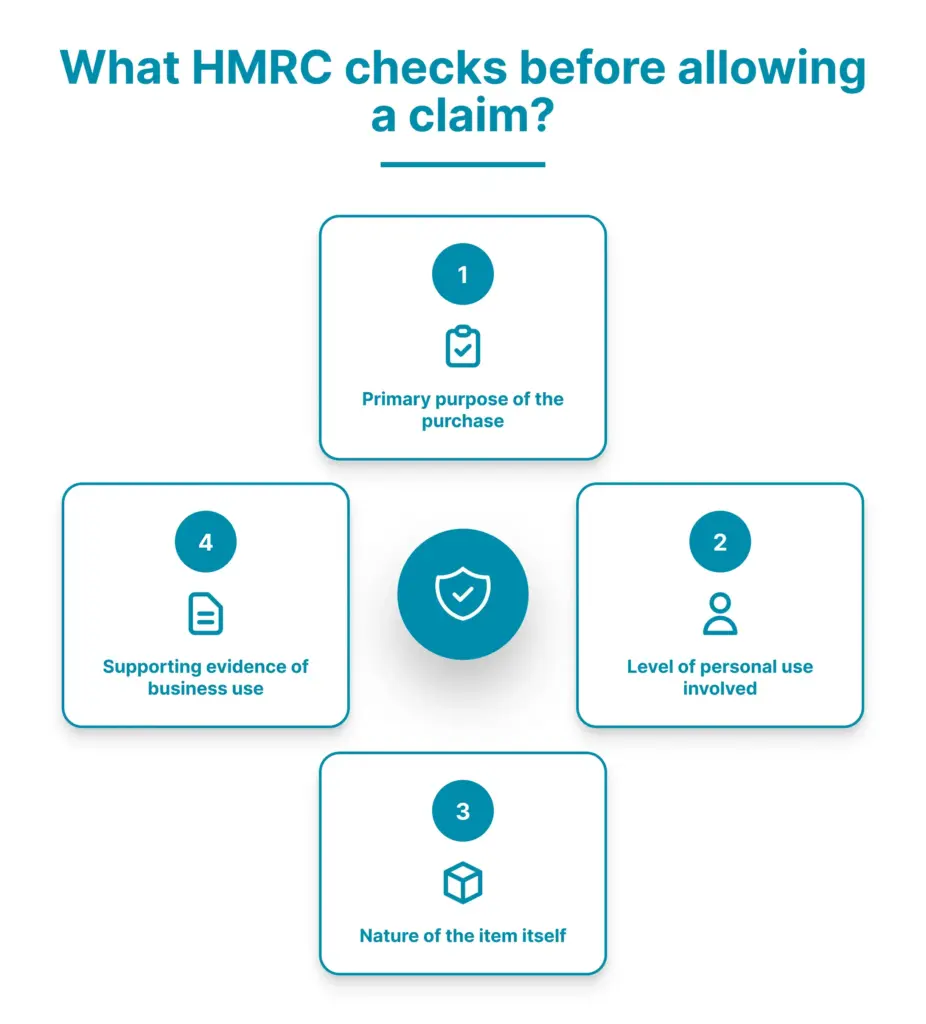
If any one of these four points cannot be answered clearly, the purchase is likely to be treated as a personal benefit.
The items you can and cannot put through your company
Some purchases are clearly allowable. Some will never pass HMRC scrutiny regardless of how they are recorded. Many depend entirely on whether you can prove a genuine business purpose.
How is each item treated?
| Item | Allowable? | Key Condition |
|---|---|---|
| Laptop or computer | Yes | Must be primarily for business use |
| Mobile phone (one per director) | Yes | One handset, primarily business use |
| Office furniture | Yes | Home office or business premises |
| Professional subscriptions | Yes | Must be on HMRC’s approved list |
| Business travel and accommodation | Yes | Must be wholly for business purposes |
| Work clothing or uniform | Yes, if uniform or PPE only | Regular clothing is not allowable |
| Training and CPD courses | Yes | Relevant to the director’s role |
| Watch (standard) | Depends on business purpose | Luxury watches face highest scrutiny |
| Watch (Rolex or luxury) | Unlikely | Benefit in kind applies in most cases |
| Television | Generally no | No clear business purpose |
| Washing machine | No | Treated as a personal benefit |
| Gym membership | No, unless justified | Normally a taxable benefit in kind |
| Client entertainment | Partially | Not fully deductible |
Items with a clear business purpose are generally treated as allowable expenses. Lifestyle, luxury, or domestic items draw immediate scrutiny and the burden of proof is always on the director.
Lifestyle, luxury, or domestic items draw immediate scrutiny and the burden of proof is always on the director.
Benefits in Kind: What they are and what they cost you?
If your company buys something with personal value to you, HMRC treats that as a benefit in kind additional taxable income provided outside your salary.
How is the tax charge calculated?
- A benefit in kind is any non-cash benefit provided to a director or employee that carries personal value
- HMRC treats the personal-use element as additional taxable income for the director
- The company reports benefits in kind on a P11D form, submitted annually to HMRC
- The director pays income tax on the benefit value; the company pays Class 1A NI at 15%
For example:
| Scenario | Detail |
|---|---|
| Item purchased | Laptop: £3,000 |
| Personal use | 50% |
| Taxable benefit value | £1,500 |
| Director pays | Income tax on £1,500 at marginal rate |
| Company pays | Class 1A NI at 15% on £1,500 |
P11D reporting is an area where errors are common and penalties are real. Working with a specialist accountant who will ensure that your benefits are reported correctly and your company remains fully compliant with HMRC.
What Happens when you use your Business Account Personally?
A limited company is a separate legal entity. Company money is not simply your money to spend as you choose.
How HMRC treats Personal Withdrawals:
If you take money from your company for personal use without processing it through payroll or dividends, HMRC treats it as a director loan.
- The amount must be recorded in a director loan account (DLA)
- If unrepaid within 9 months of the accounting year-end, the company faces a Section 455 tax charge of 35.75%
- If the loan exceeds £10,000 with no interest charged, HMRC treats the interest-free element as a benefit in kind
- Unrecorded personal drawings signal poor record-keeping and increase audit risk
The correct ways to pay yourself:
| Method | HMRC Treatment |
|---|---|
| Salary through payroll | Allowable subject to income tax and NI |
| Dividends | Allowable subject to dividend tax |
| Director loan (repaid within 9 months) | Allowable must be formally recorded |
| Director loan (unrepaid after 9 months) | Section 455 tax at 35.75% applies |
| Unrecorded personal drawings | Significant compliance and audit risk |
Common errors that lead to Tax Penalties
1. Assuming everything is allowable if it goes through the books: HMRC cares why you bought something, not whether it appears in your accounts. Purpose, not process, determines allowability.
2. Mixing business and personal expenses: Without clean records, HMRC scrutiny becomes much harder to defend against.
3. Forgetting to submit P11D forms: Late or missing filings attract automatic penalties. P11D compliance is not optional.
4. Treating director loans as informal drawings: Unrecorded or unrepaid loans trigger Section 455 tax. Every personal withdrawal outside payroll or dividends must be formally recorded.
Conclusion
Getting company expenses wrong rarely happens because a director ignored the rules. It happens because the line between a business expense and a personal benefit is not always obvious and HMRC does not give the benefit of the doubt.
Understanding that line and keeping the records to support it, is what keeps a limited company director on the right side of a compliance query.
DNS CloudCo’s chartered accountants work with limited company directors on exactly this. To get in touch, call 01908 886755, email info@dnscloudco.co.uk.
Frequently Asked Questions
Can I buy a watch, television or washing machine through my limited company?
A watch may be allowable if there is a clear business purpose, but luxury watches are almost always treated as a benefit in kind. A television and washing machine have no business purpose for most companies and HMRC will treat both as personal benefits, creating a tax liability.
Which items are most commonly flagged by HMRC?
Luxury watches, domestic appliances, gym memberships and personal clothing draw the most scrutiny. These items have no clear business purpose for most companies and are almost always treated as a benefit in kind.
What is a benefit in kind and how is it taxed?
A benefit in kind is any non-cash item with personal value provided to a director outside of salary. The director pays income tax on the value of the benefit and the company pays Class 1A National Insurance at 15%, both reported through a P11D.
What happens if personal purchases are made through the company without being declared?
Undeclared personal purchases are treated as director loans. If unrepaid within nine months of the accounting year-end, the company faces a Section 455 tax charge of 35.75% on the outstanding amount.
Does a director loan always trigger a tax charge?
Not automatically, but if the loan exceeds £10,000 and no interest is charged, HMRC treats the interest-free element as a benefit in kind. Loans repaid within nine months of year-end avoid the Section 455 charge entirely.
What records does a director need to keep for mixed-use purchases?
Every purchase with any element of personal use must have supporting evidence showing the business proportion. Without clear records, HMRC will default to treating the full cost as a personal benefit.

Divyanshi is a subject matter expert in the UK accounting space, creating clear and easy-to-read content for accountants and businesses. She covers topics such as VAT returns, Self-assessment tax, bookkeeping, business planning and Year-end accounts. By understanding the common challenges faced by accountants and business owners, she focuses on writing content that answers real questions and simplifies complex topics. Her approach keeps information clear, relevant and useful for everyday business needs.