Most people usually assume there’s only one kind of limited company, but there isn’t. The UK law actually recognises several different structures and which one you go with has real consequences for ownership, tax and how much personal financial risk you’re carrying
When people ask what the two types of limited companies are, they are referring to the Companies Act 2006 distinction between limited by shares and limited by guarantee but there are further structures beyond these two.
Understanding all the different types of limited companies in the UK is the first step to making the right decision for your situation.
Key Takeaways
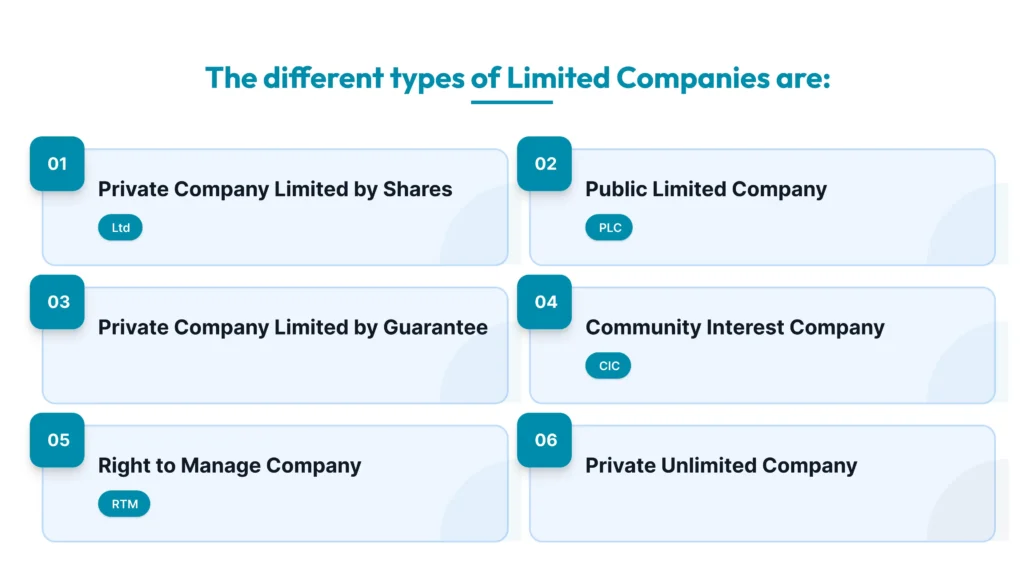
UK law recognises several types of limited companies, including private companies limited by shares, public limited companies, companies limited by guarantee, Community Interest Companies, Right to Manage Companies and private unlimited companies.
The private company limited by shares is the most widely used structure, favoured by contractors, freelancers and small businesses registered at Companies House.
Limited by guarantee companies have no shareholders and are typically used by charities, clubs and non-profit organisations.
Choosing the wrong limited company structure can have lasting legal and tax consequences that are costly to reverse.
Note : This article was updated and republished on 29-April-2026 to reflect the latest UK company law guidance, including updates from the Companies Act 2006, Companies House requirements and current rules covering the structure, ownership and compliance obligations of different types of limited companies in the UK.
The Main Types of Limited Companies in the UK
Companies House officially recognises two foundational categories of limited company: limited by shares and limited by guarantee. Within these, there are distinct limited company structures available to UK businesses and organisations.
This is what most people mean when they say “limited company.” Contractors, freelancers, small business owners, this is the one they’re almost always using.
Ownership works through shares. Your personal liability as a shareholder stops at whatever value of shares you haven’t paid up. Many companies start with just £1 of share capital and that’s completely fine.
- You can be the only director and the only shareholder at the same time, which is very common among contractors
- There’s no minimum share capital requirement
- Profits can be distributed as dividends, making this a tax-efficient structure for owner-directors
- Must register with Companies House and file annual accounts and a confirmation statement each year
2. Public Limited Company (PLC)
A PLC can offer shares to the general public and is typically listed on a stock exchange such as the London Stock Exchange. It is a significantly more regulated structure than a private limited company.
- Must have a minimum share capital of £50,000, with at least 25% paid up before trading begins
- Requires at least two directors and a qualified company secretary
- Subject to greater public disclosure requirements than a private limited company
- Most PLCs begin as private limited companies and re-register as a PLC when seeking public investment
- Not a practical structure for most small businesses or individual contractors
3. Private Company Limited by Guarantee
This structure has no share capital and no shareholders. Instead, it has members known as guarantors, making it the standard structure for organisations that are not formed to generate profit for owners.
- Each guarantor agrees to contribute a fixed sum typically £1 if the company is ever wound up
- Used by charities, non-profit organisations, sports clubs, trade associations and residents’ management companies
- The company can still generate income and pay staff but profits cannot be distributed to members
- Must register with Companies House in the same way as a limited by shares company
- Provides formal legal status and liability protection without a share ownership structure
4. Community Interest Company (CIC)
A Community Interest Company is a specific limited company structure created for social enterprises that exist to benefit the community rather than private shareholders.
- Can be formed as limited by shares or limited by guarantee the choice is made at formation
- Subject to an asset lock assets and profits must be directed towards the community purpose and cannot be freely distributed
- Must pass a community interest test when applying to Companies House, approved by the CIC Regulator
- Popular with social entrepreneurs, community groups and organisations delivering public benefit
- Provides a recognised legal structure for accessing grants and public contracts
5. Right to Manage Company (RTM)
A Right to Manage Company is a specialist structure used exclusively by leaseholders in residential blocks of flats. It gives leaseholders the legal right to take over management of their building.
- Formed as a private company limited by guarantee under the Commonhold and Leasehold Reform Act 2002
- Allows leaseholders to take over building management from the freeholder without needing to prove mismanagement
- At least 50% of qualifying leaseholders in the building must participate for the RTM company to be eligible
- Operates under its own statutory framework and is managed by the leaseholders themselves
- Not a general business structure it exists solely for this specific purpose
6. Private Unlimited Company
This is a private company where there is no limit on members’ personal liability. If the company cannot pay its debts, members can be held personally liable for the full amount owed.
- Rarely used in practice the absence of liability protection is a significant drawback for most situations
- The main advantage is financial privacy: unlimited companies are not required to file accounts at Companies House
- This makes them attractive in specific situations where confidentiality of financial information is a priority
- Mainly used by certain professional partnerships and holding companies where privacy outweighs the risk of unlimited liability
- Still required to register with Companies House, despite the reduced filing obligations
Choosing the Right Structure
The right choice depends on what your organisation does, whether it’s meant to make a profit and who will own it. Here’s a simple breakdown:
- If you’re running a small business, contracting or freelancing, a private company limited by shares is almost always the right choice. It’s the most straightforward structure and works well for the majority of business owners.
- If you’re setting up a charity, club or non-profit, a company limited by guarantee makes more sense. There’s no share capital involved and profits stay within the organisation rather than going to members.
- If you’re building a social enterprise, a CIC is worth looking at. It gives you a formal legal structure that’s recognised when applying for grants or public sector contracts.
- If you’re a leaseholder wanting to take over management of your building, the RTM company is the specific route for that situation and has its own formation process under the 2002 Act.
For most people the answer ends up being a private limited company, but the other structures are there for a reason. Talking to a chartered accountant before you register is a good idea.
Conclusion
Different types of limited companies exist because different organisations have different needs. What works for a contractor will not work for a charity and what works for a social enterprise will not work for a leaseholder group.
Going through each structure before registering helps you pick the one that fits your situation. If you are still not sure, speaking to an accountant before you register is the right move.
Not sure which type of limited company fits your situation? DNS CloudCo’s chartered accountants help founders, contractors and small business owners choose the right structure and manage the company formation process from start to finish. Book a consultation today.
FAQs
What are the two types of limited companies?
The Companies Act 2006 has two main categories, limited by shares and limited by guarantee. There are also other structures like CICs, RTM companies, PLCs and unlimited companies that exist beyond these two.
Which type of limited company is the most common?
The private company limited by shares is the most common. Contractors, freelancers and small business owners use it and millions are registered at Companies House.
What is the difference between a private and public limited company?
A private limited company cannot offer shares to the public, but a PLC can. A PLC also requires at least £50,000 in share capital and has stricter reporting and regulatory requirements.
Who uses a company limited by guarantee?
Charities, non-profits, sports clubs and trade associations use it. They need a legal structure but do not have shareholders and do not distribute profits to owners.
Can one person set up and run a limited company?
Yes, a single person can be the director and the only shareholder at the same time. This is actually a very common setup, particularly among contractors and freelancers.
Why would anyone use an unlimited company?
Unlimited companies do not need to file accounts at Companies House so the finances remain private. Some organisations prefer this over having liability protection.

Divyanshi is a subject matter expert in the UK accounting space, creating clear and easy-to-read content for accountants and businesses. She covers topics such as VAT returns, Self-assessment tax, bookkeeping, business planning and Year-end accounts. By understanding the common challenges faced by accountants and business owners, she focuses on writing content that answers real questions and simplifies complex topics. Her approach keeps information clear, relevant and useful for everyday business needs.