Messy books, unexpected tax charges and HMRC questions rarely come from one big mistake. They come from small habits repeated over time. Reaching for the wrong card at the wrong moment, month after month, is one of the most common ones.
Using a personal credit card for business expenses or putting company spend on a personal card looks harmless in the moment. But it creates real consequences: transactions that need untangling, director’s loan accounts that grow without anyone noticing and expense records that do not hold up under scrutiny.
Key Takeaways
Using a dedicated company card for business expenses keeps finances clean and creates an automatic audit trail
Using a personal credit card for business expenses is allowed but must be handled correctly
Personal expenses put through the company can trigger benefit in kind charges
A director’s loan account records money owed between you and the company and mismanaging it has direct tax consequences
For most limited company directors, a dedicated company card is the simplest and safest approach
Note : This article was updated and republished on 03-May-2026 to reflect the latest HMRC guidance on director expenses, including the correct use of company and personal cards, director’s loan account rules, benefit in kind implications and best practices for maintaining accurate and compliant financial records for limited company directors in the UK.
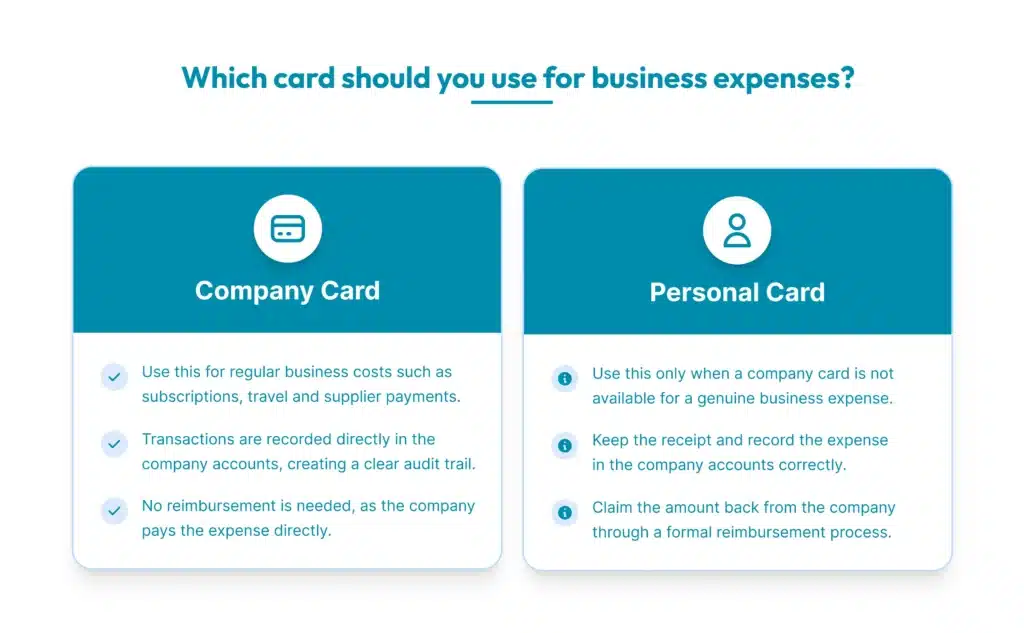
Company Card vs Personal Card: The Core Difference
The card you use directly affects how your company’s finances are recorded and how much admin sits behind them.
These are the main differences:
| Expense Factor | Company Card | Personal Card |
|---|---|---|
| Audit trail | Automatic | Manual reconciliation required |
| Reimbursement needed | No | Yes, formally processed |
| HMRC risk | Lower | Higher if not documented correctly |
| Admin involved | Minimal | Receipt, record, reimbursement |
| Best for | All routine business expenses | Occasional, unavoidable spend |
HMRC expects clear separation between personal and business finances. Using a credit card for business expenses through a dedicated company account makes that straightforward from day one.
Can UK Business Owners Use a Personal Credit Card for Business Expenses?
Using a personal credit card for business expenses in the UK is permitted. But permitted and straightforward are not the same thing.
The Wholly and Exclusively Test
Every personal card transaction used for business must meet HMRC’s “wholly and exclusively” test. The expense must have been incurred entirely for business purposes to qualify as an allowable deduction against company profits. Part-personal, part-business purchases require careful splitting and documentation.
The Correct Reimbursement Process
When you use a personal credit card for business expenses, getting reimbursed informally is not enough. The process must be documented correctly at every step.
- Keep the original receipt for every transaction
- Record the expense in your accounting software
- Categorise it correctly as a business expense
- Raise a formal reimbursement claim
- Ensure the company pays you back and the payment is logged in the accounts
A chartered accountant, such as the team at DNS CloudCo, can ensure these reimbursements are processed correctly and your records are clean well before any HMRC review.
The Risks of Mixing Personal and Business Expenses
Most directors who run into difficulty with expenses do not do anything deliberately wrong. Small habits accumulate. Here is what goes wrong when personal expenses appear on a business credit card or company funds are used for personal purchases.
Director’s Loan Account
When personal spending goes through the company card or money leaves the company outside of salary or dividends, it is recorded as a loan from the company to you. This is your director’s loan account (DLA).
| DLA Scenario | Tax Consequence |
|---|---|
| Balance repaid before 9 months + 1 day after APE | No Section 455 charge |
| Balance outstanding 9 months + 1 day after APE | Section 455 tax at 33.75% on full outstanding balance (paid by company, reclaimable on later repayment) |
| Balance written off by company | Treated as dividend distribution; director liable for income tax; company can reclaim prior s455 tax |
The Section 455 charge is temporary and repayable once the loan is cleared, but it creates a cash flow problem that catches many directors off guard.
Benefit in Kind
If a director uses a company credit card for personal use and does not repay the amount, HMRC may treat the value as a benefit in kind (BiK). This means:
- You pay income tax on the value of the personal spending
- The company pays employer’s National Insurance on the same amount
- Both charges must be reported on a P11D form
It is a cost most directors do not see coming until the P11D deadline arrives.
HMRC Scrutiny
Mixed transactions, missing receipts and personal spending in company accounts are common triggers for HMRC enquiries. The three things HMRC looks for most are:
- Inconsistent or missing expense records
- Personal transactions appearing in business accounts
- Director’s loan accounts that are not reconciled or disclosed
Clean, separated records are the most practical way to reduce that exposure.
Insolvency Risk
If a company enters financial difficulty, a liquidator examines the director’s loan account closely. Unexplained personal expenses through the company can be treated as misuse of company funds. Clear separation protects you personally if the business ever faces creditor pressure.
Keeping Director Expenses Clean: A Practical Approach
Good expense management does not require complicated systems. A few consistent habits make a significant difference when it comes to using a credit card for company expenses correctly.
Day-to-Day Habits
- Use a dedicated company card for all business expenses wherever possible
- If you use a personal credit card for business expenses, raise the reimbursement the same day and document everything immediately
- If the company card is used accidentally for something personal, record it as a director’s loan entry straight away
Monthly Discipline
- Review your director’s loan account monthly, not just at year-end
- Reconcile all business expenses in your accounting software regularly
- Use Xero or QuickBooks to categorise transactions in real time and flag anything unclear
At Year-End
- Ensure all reimbursements have been formally processed and logged
- Confirm your director’s loan account balance and repay any outstanding amounts before the nine-month deadline
- Check that receipts are in place for every expense claimed
Conclusion
For most UK limited company directors, a dedicated company card for business expenses is the right approach. It keeps finances clean, removes unnecessary admin and means your records are in good shape if HMRC ever asks questions.
Using a personal credit card for business expenses is sometimes unavoidable. When it happens, process the reimbursement correctly and promptly. Leaving expense records to sort out at year-end almost always creates more work than it saves.
The risks of getting this wrong are avoidable: director’s loan account charges, benefit in kind liabilities and the kind of mixed records that attract scrutiny. None of them are difficult to prevent with the right habits in place from the start.
Need help keeping your director expenses HMRC-compliant? The team at DNS CloudCo works with UK limited company directors to ensure their accounts are clean, correct and ready for any HMRC review. Get in touch for a consultation.
FAQs
Can I use my personal credit card for limited company business expenses?
Yes, but each transaction must be receipted, recorded in the company’s accounts and reimbursed formally. Using a personal credit card for business expenses in the UK is permitted, but informal transfers do not meet HMRC’s requirements.
What happens if I accidentally use the company card for a personal purchase?
Record it as a director’s loan account entry immediately. If repaid within nine months of the company’s year-end, no Section 455 tax charge applies.
What is a director’s loan account?
It records money owed between you and the company. If the balance exceeds £10,000 and remains unpaid nine months after year-end, HMRC applies a Section 455 tax charge.
Can a director put personal expenses through the company?
No, personal expenses are not allowable deductions and may be treated as a benefit in kind, resulting in income tax for the director and employer’s National Insurance for the company.
Is it illegal to use a business credit card for personal use?
Not automatically but using a company credit card for personal use creates tax and accounting complications. Personal spending must be recorded as a director’s loan and repaid. Repeated misuse can have serious legal consequences.
What is a benefit in kind?
A benefit in kind arises when a director receives personal value through the company. Unrepaid personal purchases on a company card may be treated as taxable, attracting income tax and National Insurance.
How do I record a business expense on a personal credit card?
Keep the receipt, log it in your accounting software, categorise it as a business expense, raise a reimbursement claim and ensure the company pays you back with the payment recorded.
What does HMRC look for when reviewing director expenses?
Clear receipts, consistent records and a clean audit trail. Mixed transactions, missing receipts and informal transfers between personal and company accounts are common triggers for enquiry.
Do I need receipts for business expenses paid on a personal card?
Yes, HMRC requires receipts for all business expenses regardless of which card was used. Without them, the expense may not be accepted as an allowable deduction.
How can I keep my director expenses HMRC-compliant?
Use a company card wherever possible, process reimbursements promptly, keep all receipts and review your director’s loan account regularly. The team at DNS CloudCo can keep your records accurate and audit-ready.

Divyanshi is a subject matter expert in the UK accounting space, creating clear and easy-to-read content for accountants and businesses. She covers topics such as VAT returns, Self-assessment tax, bookkeeping, business planning and Year-end accounts. By understanding the common challenges faced by accountants and business owners, she focuses on writing content that answers real questions and simplifies complex topics. Her approach keeps information clear, relevant and useful for everyday business needs.