Business rates are a significant expense for small businesses in the UK and understanding how they are calculated is essential. The amount you pay depends on your property’s rateable value and the multiplier set by the government.
Without understanding which multiplier applies and which reliefs are available, businesses may pay more business rates than necessary.
This guide explains how business rates work, how to calculate them and what relief schemes you may qualify for, helping small business owners make informed decisions and manage costs effectively.
Key Takeaways
UK now has five business rate multipliers from April 2026.
Bill = Rateable Value × Multiplier – simple calculation.
Small business rate: 43.2p | Standard: 48.0p | RHL: 38.2p.
Under the lower threshold? You pay zero business rates.
Bill increases are capped – 5%, 15%, or 30% via transitional relief.
Empty properties? Landlord pays rates after initial exemption expires.
Think your rateable value is wrong? Appeal via VOA.
What is a Business Rates Multiplier?
A business rates multiplier is the figure set by the UK Government that is used to calculate the amount of business rates payable on a commercial property. It is multiplied by your property’s rateable value, which is assessed by the Valuation Office Agency (VOA), to determine your annual business rates bill before any reliefs or exemptions are applied.
From 1 April 2026, England introduced a new five-multiplier system to better reflect different property types and support smaller businesses. The multiplier that applies to your property depends on factors such as its rateable value and whether it qualifies as a retail, hospitality or leisure (RHL) property. Understanding which multiplier applies can help you estimate your costs more accurately and identify any reliefs you may be entitled to.
Current Multiplier Business Rates 2026/27
From April 2026, the UK Government has introduced five new business rates multipliers, replacing the previous two-multiplier system. These changes are part of wider reforms to create a fairer, more modern system that supports investment and protects the high street.
As confirmed by GOV.UK’s official notification of non-domestic rating multipliers for 2026/27, the standard non-domestic rating multiplier is 48.0p and the small business multiplier is 43.2p.
The full business rates multiplier 2026/27 breakdown is as follows:
| Property Type | Rateable Value | Multiplier Rate 2026/27 | Example Calculation |
|---|---|---|---|
| Small Business (Non-RHL) | Below £51,000 | 43.2p | £30,000 × 0.432 = £12,960 |
| Standard Business (Non-RHL) | £51,000 and above | 48.0p | £60,000 × 0.48 = £28,800 |
| Small RHL Business | Below £51,000 | 38.2p | £40,000 × 0.382 = £15,280 |
| Standard RHL Business | £51,000 to £499,999 | 43.0p | £100,000 × 0.43 = £43,000 |
| High Value Properties | £500,000 and above | 50.8p | £600,000 × 0.508 = £304,800 |
For full confirmation of the budget package and multiplier rates, refer to the GOV.UK budget package and multipliers confirmation for 2026/27.
How are Business Rates Calculated in the UK?
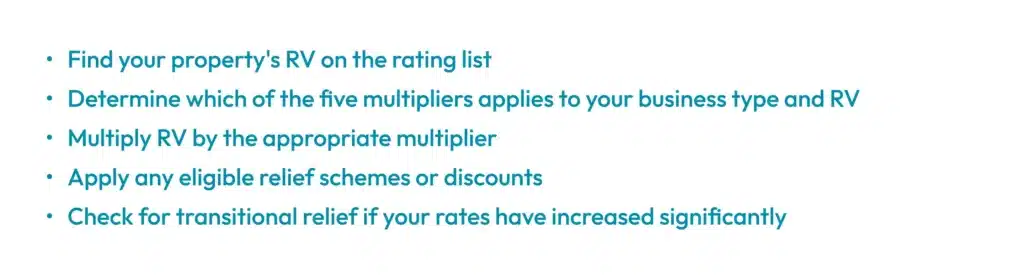
The calculation process involves multiplying your rateable value by the appropriate business rates multiplier.
Your local council calculates your bill by multiplying your rateable value by the relevant multiplier set by the UK Government. They then determine whether to apply any reliefs you are eligible for.
Your local council’s Valuation Office Agency determines your property’s rateable value. This represents the annual rental value your property could achieve.
Multiply your rateable value by your multiplier. This gives you your gross business rates liability before any reliefs are applied.
How to Calculate Your Business Rates: Step by Step Process
Do Business Rates Include VAT?
No, business rates are completely outside the scope of VAT. They are a property tax collected by local councils and do not appear on your VAT return.
However, business rates are deductible as an allowable business expense for corporation tax purposes. This is confirmed by HMRC’s official guidance on business expenses.
Small Business Rates Relief UK Schemes (2026-27)
Multiple relief schemes help reduce small business rates for qualifying businesses. These schemes significantly lower the financial burden on smaller enterprises.
Properties below the current lower threshold (set annually by government order) receive complete exemption. This means thousands of small businesses pay no business rates at all.
For properties with rateable values between the lower and upper thresholds, relief tapers gradually from 100% to 0%.
Supporting Small Business Relief also caps bill increases for properties losing eligibility due to 2026 revaluation:
| Rateable Value | Relief/Cap | Annual Saving (Example) |
|---|---|---|
| Below lower threshold | 100% | Up to £5,184 |
| Between thresholds | Tapered | Up to £3,243 |
| Up to £20,000 (£28k London) | 5% or £800 bill cap | Protects from sharp rises |
| £20,001-£100,000 | 15% or £800 bill cap | Protects from sharp rises |
| Over £100,000 | 30% or £800 bill cap | Protects from sharp rises |
Note: Exact lower/upper thresholds are set annually by government order – confirm with your local authority for 2026-27 figures.
New Business Rates System 2026/27 Changes
The next revaluations of non-domestic properties in England, Scotland, Wales and Northern Ireland took effect on 1 April 2026. New rateable values can be found at the Find a Business Rates Valuation service for England and Wales.
At a revaluation, the national multipliers are adjusted to reflect changes in the overall value of the tax base. If the total value of rateable properties increases, the tax rate will generally fall. This means that even if a specific property’s rateable value goes up, its bill could still decrease if the reduction in the tax rate is big enough to offset the increase in value.
The temporary 40% RHL relief (2025-26) has ended, permanently replaced by RHL-specific lower multipliers.
| Date | Change | Impact |
|---|---|---|
| April 2025 | RHL 40% relief applies | Immediate 40% discount for qualifying businesses |
| April 2026 | Five new multipliers introduced | Permanent lower rates for RHL, higher rates for large properties |
| April 2026 | Full revaluation takes effect | All rateable values updated across England and Wales |
| 2026 to 2029 | Transitional relief in place | Bills capped at set percentages annually |
Business Rates Explained for Different Property Types
Business rates in England affect all commercial properties differently. The system varies based on property type, size and usage.
Commercial property rates apply to offices, shops, warehouses and factories. Each category faces different challenges under the current system.
Local shops and hospitality businesses now benefit from the new permanently lower RHL multipliers. You can check whether your business qualifies on the GOV.UK guidance for qualifying retail, hospitality or leisure businesses.
| Property Type | Typical RV Range | Common Relief | Multiplier Used (2026/27) |
|---|---|---|---|
| Small Retail Shop | £5,000 to £25,000 | RHL+ Small Business Relief | 38.2p (RHL) |
| Office Space | £20,000 to £100,000 | Limited relief | 43.2p or 48.0p |
| Industrial Unit | £15,000 to £80,000 | Various schemes | 43.2p or 48.0p |
| Restaurant | £10,000 to £50,000 | RHL Multiplier | 38.2p |
Landlord’s Responsibilities for Business Rates
Landlords’ obligations for business rates depend on the occupancy status of their properties and the terms of lease agreements. Empty properties are usually the landlord’s responsibility once the initial exemption period ends.
Most lease agreements transfer business rates liability to tenants. However, landlords must understand their potential obligations during void periods.
Do landlords pay business rates on empty properties?
Yes, typically after initial exemption periods expire. Different property types have varying empty property relief periods.
| Period | Empty Property Status | Rates Liability |
|---|---|---|
| First 1 month | Industrial property | No rates payable |
| First 3 months | Other properties | No rates payable |
| After exemption | All empty properties | Full rates apply |
| Long-term empty | 2 years or more | Possible premium rates |
Business Rates Reform UK Progress
Business rates reform UK continues evolving to support economic growth. The government recognises current system limitations affecting business investment. Reform proposals aim to create fairer, growth-supporting taxation.
The move from two to five multipliers from April 2026 represents the most significant structural reform to business rates in England in decades. The government will continue to define eligibility for RHL properties through secondary legislation.
Transitional Relief Business Rates Support
Transitional relief business rates help businesses manage significant rate increases following the 2026 revaluation. As detailed in the briefing on the 2026 revaluation, the upwards caps for transitional relief are:
- 5% for small properties with rateable value up to £20,000
- 15% for medium properties with rateable value between £20,001 and £100,000
- 30% for large properties with rateable value greater than £100,000
Bills can only rise by a set percentage or £800 per year, whichever is higher. Businesses still receiving Supporting Small Business Relief from the 2023 revaluation will have it extended for 12 months, with increases capped at £800 or the relevant transitional relief limit.
| Business Type | Annual Increase Cap | Maximum Protection |
|---|---|---|
| Small Business (RV up to £20,000) | 5% per year | Minimum £800 |
| Medium Business (RV £20,001 to £100,000) | 15% per year | Percentage based |
| Large Business (RV above £100,000) | 30% per year | Limited protection |
Council Tax vs Business Rates Differences
Council tax vs business rates serve different purposes in local taxation. Council tax applies to residential properties, while business rates cover commercial premises.
Council tax uses property bands A to H based on 1991 values. Business rates now use updated rateable values from the April 2026 revaluation.
Both taxes fund local council services, but business rates also support national government spending. The collection and distribution methods differ significantly between systems.
| Aspect | Council Tax | Business Rates |
|---|---|---|
| Property Type | Residential | Commercial |
| Valuation Base | 1991 values | Current rental values |
| Payment Responsibility | Residents | Occupiers or owners |
| Relief Schemes | Limited options | Multiple schemes available |
| VAT | Outside scope of VAT | Outside scope of VAT |
Business Rate Calculator UK Tools
Business rate calculator UK tools help estimate annual costs. These calculators use rateable values and current multipliers for accurate estimates.
Government websites provide official calculation tools. Local councils also offer calculators specific to their areas.
To calculate your business rates in the UK first find your property’s rateable value then identify which of the five multipliers applies to your business type, multiply the two figures together and then deduct any reliefs you qualify for.
Business Rates Differences Across the UK
Business rates work differently depending on where you are:
England
- Uses the five-multiplier system introduced in April 2026.
- Revaluation happened in April 2026 with the next one due in April 2029.
- Various reliefs available including small business rate relief and the new RHL multipliers.
Scotland
- Called “Non-Domestic Rates”
- Has its own multiplier system (known as the “poundage”)
- Small business bonus scheme available
- Different relief thresholds than England
Wales
- Similar system to England but with different multipliers
- Small business rates relief scheme with different qualifying criteria
- Retail, leisure and hospitality rates relief available
Northern Ireland
- Called “rates” or “non-domestic rates”
- Calculated using the regional rate and district rate
- Industrial derating offers relief for manufacturing properties
- Different relief schemes available
Important: Always check with your local council or valuation office for the exact rates and reliefs that apply to your location.
Relief Eligibility for Multiple Properties
Many business owners have multiple properties and wonder how this affects their relief eligibility.
Small Business Rate Relief (England)
Eligibility:
Your main property must be below the current lower threshold (set annually by government order).
How much relief:
- 100% relief if rateable value is at/below current lower threshold
- Relief on a sliding scale between current lower and upper thresholds
- Example: A property with RV below current threshold gets full relief
Multiple Properties Scenario:
You own three shops:
- Shop A: £10,000 rateable value (your main property)
- Shop B: £8,000 rateable value
- Shop C: £7,000 rateable value
- Total: £25,000 (under current aggregate limit)
Shop A would qualify for small business rate relief. The other properties would pay standard rates.
Confirm 2026-27 thresholds with your local authority, fixed £12k/£15k/£20k/£28k figures no longer apply post-revaluation.
How Much are Business Rates?
It depends on your property type, rateable value and which multiplier applies. Under the new 2026/27 system:
| Business Size | Rateable Value | Annual Cost (Before Relief) | After Small Business Relief |
|---|---|---|---|
| Micro Business | £8,000 | £3,456 | £0 |
| Small Shop (Non-RHL) | £20,000 | £8,640 | £6,480 |
| Small RHL Shop | £20,000 | £7,640 | £5,730 |
| Medium Office | £40,000 | £17,280 | £17,280 |
| Large Warehouse | £70,000 | £33,600 | £33,600 |
How to Appeal Your Rateable Value?
If you think your rateable value is too high, you can challenge it. Here’s how:
Step 1: Check Your Rateable Value
Find your property’s rateable value on the Valuation Office Agency (VOA) website or your rates bill. Compare it to similar properties in your area.
Step 2: Gather Evidence
You’ll need proof that your rateable value is wrong. This could include:
- Details of similar properties with lower rateable values
- Evidence of property issues (damp, structural problems, access difficulties)
- Changes in the local area affecting your business
- Rent you’re actually paying versus the assessed value
- Photos and documentation
Step 3: Check Your Reasons for Appeal
Valid reasons include:
- The property description is wrong (size, features, location)
- Similar properties have lower rateable values
- Physical changes to the property or area
- Your property is affected by roadworks, construction or other disruptions
Invalid reasons (that won’t succeed):
- You simply think it’s too expensive
- You can’t afford to pay
- You disagree with how business rates work in general
Step 4: Submit Your Challenge
For properties in England:
- Go to the VOA website
- Create an account or log in
- Submit your “Check” (reviewing the information held)
- If needed, submit a “Challenge” with your evidence
- If still not satisfied, submit an “Appeal”
Timeline: You have clear deadlines, so don’t delay. Generally, you must start a Check within certain time periods after a revaluation.
For Scotland, Wales or Northern Ireland: Contact your local assessor or valuation office for their specific process.
Step 5: What Happens Next
- The VOA or local assessor reviews your case (can take several months)
- They may contact you for more information
- They’ll either accept your challenge and reduce your rateable value or reject it
- If rejected and you still disagree, you can appeal to an independent tribunal
Important Tips:
- You still must pay your business rates while appealing
- If successful, you may get a refund for overpayments
- Consider using a rating surveyor for complex cases
- Keep paying on time to avoid penalties
Important: You must continue paying your business rates while appealing. If successful, you may receive a refund for overpayments. Consider using a rating surveyor for complex cases.
Value Multiplier and Property Assessments
Value multiplier calculations connect property values to tax obligations. The rateable value business rates multiplier system ensures consistent application across England.
Professional valuers assessed all commercial properties as part of the April 2026 revaluation. These updated rateable values now reflect current market conditions based on April 2024 rental values.
Understanding your property’s valuation helps predict future rate changes. Businesses can appeal assessments they consider unfair or inaccurate.
Uniform Business Rate Multiplier System
The uniform business rate multiplier creates consistency across England. All councils use identical multipliers set by central government.
This uniformity prevents regional variations that could distort business location decisions. However, local relief schemes can create practical differences between areas.
The system balances national consistency with local flexibility. Councils can provide additional support through discretionary relief schemes.
Multiplier Business Rates: What Differences for Wales, Scotland, Northern Ireland?
Business rates, known as non-domestic rates, are taxes on properties used for business purposes. The business rates multiplier is the rate used to calculate how much you pay. While the system is similar across the UK, each nation sets its own multiplier and has different rules.
England
- Standard multiplier 2026/27: 48.0p per £1 of RV
- Small business multiplier: 43.2p per £1 of RV
- RHL small business multiplier: 38.2p per £1 of RV
- Set annually by the UK Government
- Properties with RV under £51,000 may qualify for small business rate relief
- Revaluation took effect April 2026, next due April 2029
Wales
- Welsh Government introduced three multipliers from 2026/27
- Small business rates relief scheme with different qualifying criteria
- Retail, leisure and hospitality rates relief available
- Revaluation cycle follows its own schedule
Scotland
- Single poundage rate (not multiple multipliers)
- Small business bonus scheme
- Different relief schemes than England
Northern Ireland
- Regional rate set separately by Department of Finance
- District rate set by each local council and varies by area
- Your total bill combines both rates
- Industrial derating offers significant relief for manufacturing properties
- Separate revaluation schedule and different appeals process
Future Business Rates Changes 2026 and Beyond
The government is providing a support package worth £4.3 billion over the next three years, including a £3.2 billion transitional relief scheme, for those seeing bill increases following the 2026 revaluation.
| Year | Planned Changes | Expected Impact |
|---|---|---|
| April 2026 | Five new multipliers and full revaluation | New rates for all properties |
| 2026 to 2029 | Transitional relief in place | Capped increases across all size bands |
| April 2029 | Next scheduled revaluation | Updated rateable values again |
Conclusion
Understanding how business rates and multipliers work is important for small businesses to manage costs. By knowing your property’s rateable value, the correct multiplier and the reliefs available, you can ensure you are not overpaying.
Check your rateable value regularly and explore any reliefs or caps that apply to your business. If you believe your assessment is incorrect, you can challenge it through the proper channels.
Staying informed about current rates and upcoming changes will help you plan expenses and maintain better control over your business finances.
FAQs
What is the business rates multiplier UK?
The business rates multiplier is the rate per pound used to calculate your annual business rates bill. From April 2026, there are five multipliers ranging from 38.2p for small RHL businesses to 50.8p for high value properties.
How to work out rates payable from rateable value?
Multiply your property’s rateable value by the appropriate multiplier rate for your business type and rateable value band. Then subtract any applicable reliefs or discounts to get your final bill.
What is the difference between small business rates multiplier and standard multiplier?
From April 2026, the small business multiplier is 43.2p while the standard multiplier is 48.0p, a difference of 4.8p per pound. RHL businesses benefit from even lower multipliers of 38.2p or 43.0p depending on their rateable value.
Do landlords pay business rates on empty properties?
Yes, landlords typically pay business rates on empty properties after initial exemption periods. Industrial properties get 3 months exemption while other properties get 6 months before rates become payable.
How are business rates calculated for 2026/27?
Business rates are calculated by multiplying your rateable value by the relevant multiplier from the new five-multiplier system, then applying any eligible relief schemes.
Do business rates include VAT?
No, business rates are completely outside the scope of VAT. They are a property tax collected by local councils and do not appear on your VAT return.
What relief schemes are available for small business rates?
Relief schemes for small business rates include 100% relief for properties under £12,000 rateable value, tapered relief up to £15,000, the new permanently lower RHL multipliers and transitional relief capping annual increases.
When do business rates multipliers change?
Business rates multipliers change annually on 1st April. The major structural change from two to five multipliers took effect on 1 April 2026 alongside the full property revaluation.
Can I appeal my business rates assessment?
Yes, you can appeal your business rates assessment if you believe your rateable value is incorrect. Appeals must be made through the Valuation Office Agency with supporting evidence.
What happens if I don’t pay business rates?
If you don’t pay business rates, councils can take enforcement action including bailiff visits, charging orders on property or bankruptcy proceedings. Interest and costs are added to unpaid amounts.
How do business rates affect cash flow for small businesses?
Business rates affect cash flow through regular monthly or annual payments. Many small businesses benefit from relief schemes that reduce or eliminate these costs, improving their cash flow position significantly.

Divyanshi is a subject matter expert in the UK accounting space, creating clear and easy-to-read content for accountants and businesses. She covers topics such as VAT returns, Self-assessment tax, bookkeeping, business planning and Year-end accounts. By understanding the common challenges faced by accountants and business owners, she focuses on writing content that answers real questions and simplifies complex topics. Her approach keeps information clear, relevant and useful for everyday business needs.