
Selling a home in 2026 requires careful planning, especially when it comes to estate agent fees for UK sellers must budget for. Commission structures, contract terms, and service levels have continued to evolve, with increased competition from online and hybrid agents alongside traditional high street firms.
Understanding estate agent selling fees, how estate agents commission in UK rates are structured, and what is included in the service will help you protect your sale proceeds and avoid unnecessary costs.
Key takeaways
- Most estate agent fees UK are still charged as a percentage of the final sale price, typically between 1% and 3% plus VAT in 2026.
- Fixed-fee online agents remain widely available, often starting from several hundred pounds.
- The seller is usually responsible for paying estate agent commission.
- VAT at 20% applies to most estate agent fees.
- Commission rates are negotiable in many areas, particularly where competition is strong.
Note : This article was updated and republished on 03-Mar-2026 to include the latest information on estate agent fees in the UK, including revised commission rate ranges, updated fixed-fee and hybrid agent pricing, current VAT guidance, and 2026 market trends relevant to home sellers and property professionals.
What are Estate Agent Fees?
Estate agent fees are the charges paid to a property professional for marketing and managing the sale of your home. These fees cover services from valuation through to completion.
In 2026, estate agents commission UK structures remain largely performance based. Most traditional agents charge a percentage of the achieved sale price, while online agents commonly offer fixed packages.
For example:
If a property sells for £450,000 at a 1.5% commission rate, the fee would be £6,750 plus VAT.
When calculating fees when selling a house, always confirm whether VAT is included in the quoted rate.
Who Pays Estate Agent Fees in the UK?
In standard residential sales, the seller pays the estate agent fees. The commission is deducted from the sale proceeds at completion by the solicitor.
Buyers do not usually pay estate agent selling fees in the UK property market.
Typical Estate Agent Fees Average in 2026
As of 2026, the estate agent fees average across the UK remains:
- Sole agency (traditional high street agent): 1-2% + VAT (avg. 1.42% including VAT). The average across all sales is 1.42% including VAT.
- Multi-agency: 2.5-3.5% + VAT.
- Online/fixed fee agents: Flat rates starting at £495 and capping around £2,000, depending on the service tier
These broad ranges reflect 2026 market trends actual rates vary by location, negotiation, and agent. Always get written quotes.
How are Estate Agent Fees structured?
Estate agent fees are typically charged as a percentage of the final sale price as a fixed fee, depending on the service model.
Understanding how these structures work makes it easier to compare quotes and choose the right option for your sale. Below are the most common ways estate agent fees are structured in the market.
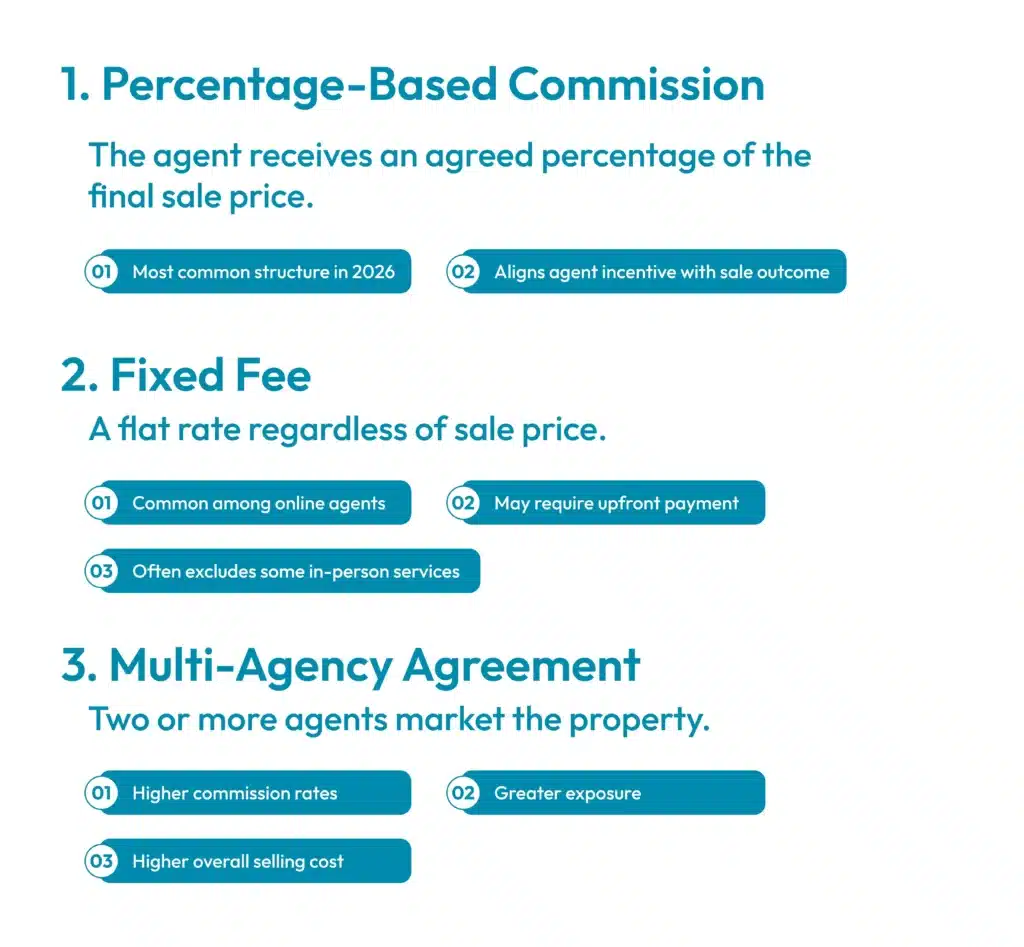
After reviewing the options, it becomes clear that each model affects cost, control, and overall selling approach. Checking these differences carefully before signing an agreement helps in choosing the most suitable arrangement.
What is Included in Estate Agent Selling Fees?
Estate agent fees UK generally cover the following services:
Property valuation
Assessment of your home’s market value using local sales data and current demand.
Marketing
- Professional photography
- Online portal listings
- Floor plans
- For sale boards
- Digital advertising
Viewings
Arranging and conducting property viewings.
Negotiation
Managing offers and securing the best possible price.
Sales Progression
Coordinating communication between buyer, seller, mortgage lender, and solicitors until completion.
Premium marketing services such as enhanced portal listings or staging may incur additional costs.
Factors That Affect Estate Agents Commission in the UK
Several elements influence how much agents charge in 2026:
- Location: Urban areas with high agent competition often see lower commission rates.
- Property Value: Higher-value properties may attract lower percentage rates due to larger total commissions.
- Market Conditions: In slower markets, agents may be more open to negotiating fees.
- Agent Experience: Established agents with strong local reputations may charge higher estate agents commission rates in the UK.
How to compare Estate Agent fees in 2026?
Choosing the right agent involves more than selecting the lowest percentage.
Request detailed quotes
Ask for written confirmation of:
- Commission rate
- VAT inclusion
- Marketing coverage
- Contract length
Use an estate agent fee calculator
Online calculators can estimate total fees based on property value and commission percentage.
Review terms carefully
Pay close attention to:
- Sole agency clauses
- Dual fee risk
- Withdrawal or cancellation charges
- Minimum commission clauses
Check reviews and performance
Look at recent sales history and customer feedback to assess effectiveness.
How to Reduce Estate Agency Costs?
Reducing estate agent fees average costs is possible with preparation.
- Negotiate: Commission rates are often flexible, especially if your property is in high demand.
- Compare online and hybrid agents: Fixed-fee options may reduce costs but ensure service levels meet your expectations.
- Choose sole agency: Sole agency agreements are usually cheaper than multi-agency contracts.
- Balance cost with sale price: A slightly higher commission may be justified if the agent achieves a stronger final sale price.
Common Hidden Cost to watch in 2026
Before signing an agreement, check for:
- Upfront marketing fees
- Premium portal listing upgrades
- Dual commission clauses
- Withdrawal penalties
- Minimum fee guarantees
Understanding these terms protects you from unexpected deductions at completion.
Conclusion
Estate agent fees UK sellers face in 2026 remain competitive but varied. Understanding estate agents commission UK structures, reviewing contracts carefully, and comparing service levels ensures you retain maximum value from your sale.
Clear knowledge of fees when selling a house allows you to plan accurately, negotiate confidently, and move forward with greater certainty.
FAQs
How much do estate agents charge in 2026?
Estate agent fees UK typically range from 1% to 3% plus VAT for traditional agents, with fixed-fee options available through online agents.
Are estate agent fees negotiable?
Yes, estate agents commission UK rates are often negotiable depending on location and market conditions.
Who pays the real estate agent fees in the UK?
Sellers pay the real estate agent fees in the UK their solicitor deducts it from sale proceeds at completion, buyers pay nothing.
What are estate agent costs?
Estate agent costs encompass commissions plus potential add-ons like photography or withdrawal fees always clarify upfront.
How much do estate agents charge to sell a house?
Around £3,600-£5,400 on a £300k sale at 1.2-1.8% estate agent commission rates including VAT.
How much do estate agents earn?
Estate agent wages UK vary widely depending on commission structure, sales volume, and employer model.
Are estate agent rates negotiable?
Estate agent rates are negotiable shop around to drop from 2% to 1% in competitive markets by comparing estate agent fees.
What is included in estate agent selling fees?
Most fees include valuation, marketing, negotiation, and sales progression through to completion.
How to compare estate agent fees?
Compare estate agent fees via quotes, reviews, and tools online £999 fixed beats high street 1.5% on £400k sales (£7,200).

Divyanshi is a subject matter expert in the UK accounting space, creating clear and easy-to-read content for accountants and businesses. She covers topics such as VAT returns, Self-assessment tax, bookkeeping, business planning and Year-end accounts. By understanding the common challenges faced by accountants and business owners, she focuses on writing content that answers real questions and simplifies complex topics. Her approach keeps information clear, relevant and useful for everyday business needs.