If you run your own business in the UK, you might be wondering whether you can employ your wife or civil partner. The short answer is yes, but there are important rules you need to follow.
Spouse employment in small business can offer real tax advantages for your household when done correctly. However, HMRC employing your spouse arrangements are closely scrutinised, so everything must be above board.
In this guide we will explain everything you need to know about employing your spouse, from the legal requirements to the tax benefits you could enjoy.
Key Takeaways
- Employing your spouse is legal if they do real work and receive a fair salary.
- Pay up to £12,570 tax-free using your spouse’s Personal Allowance for 2026-27.
- The Secondary Threshold remains at £5,000 per year and employer NIC stays at 15% for 2026-27, frozen until 2028.
- The Lower Earnings Limit increases to £6,708 for 2026-27, meaning your spouse must earn at least this amount to qualify for State Pension credit.
- Register as an employer with HMRC before making any payment to your spouse. Employer NIC becomes payable on earnings above the Secondary Threshold of £5,000
- Maintain proper payroll with PAYE, keep clear records, and have Employer’s Liability Insurance if you run a limited company.
- Paying your spouse a salary reduces taxable profits and can lower your overall tax bill.
- The Employment Allowance remains at £10,500 for 2026-27, which eligible employers can use to reduce their annual NIC liability.
Note: This article was originally published on 8 May 2019 and last updated on 30 March 2026 to reflect the latest 2026-27 rates and thresholds, including the updated Lower Earnings Limit of £6,708, confirmed NIC figures, and Employment Allowance.
Can you legally employ your spouse?
Yes, it is perfectly legal to employ your wife or civil partner in your business. Many small business owners do this, particularly when they need help with administration, bookkeeping, customer service or other essential tasks.
However, HMRC has strict rules to prevent people from using these arrangements purely to avoid tax. Your spouse must be a genuine employee doing real work, and you must pay them a fair salary for what they do.
What are the requirements?
When you employ your wife or spouse, you need to treat them exactly like any other employee. Here is what you must do:
1. Give them a real job
Your spouse must perform actual, necessary work for the business. This could include:
- Managing the books and invoicing
- Answering phone calls and emails
- Handling social media and marketing
- Processing orders and dealing with suppliers
- General administrative tasks
HMRC can investigate if they suspect your spouse is not really working or if the role seems created purely for tax purposes.
2. Pay a reasonable salary
The salary you pay must match the work your spouse does. Look at what you would pay someone else to do the same job as that is a good benchmark.
HMRC will challenge any payments they consider excessive or unrealistic for the duties involved.
3. Set up PAYE
If your spouse earns above certain thresholds, you must operate a PAYE scheme. This means deducting income tax and National Insurance contributions from their wages and paying these to HMRC.
For the 2026-27 tax year, the Personal Allowance remains at £12,570. If your spouse earns less than this and has no other income, they will not pay income tax. However, you still need to run payroll properly and report their earnings to HMRC.
4. Register as an Employer
You must register as an employer with HMRC before paying your spouse anything. The Secondary Threshold is £5,000 above this, employer NIC at 15% applies. Your spouse’s earnings above the Lower Earnings Limit of £6,708 also build State Pension entitlement.
5. Pay the salary
You must actually pay the salary to your spouse. The money should go into their own bank account, not a joint account.
This creates a clear audit trail and proves the payments are genuine. Record these payments properly in your business accounts.
6. Keep proper records
You should maintain clear employment records including a written job description, records of hours worked, payslips, payment records, and any employment contract. These documents will be essential if HMRC ever questions the arrangement.
7. Get Employer’s Liability Insurance
If you run a limited company, you are legally required to have Employer’s Liability insurance, even if your only employee is your spouse.
Sole traders are not legally required to have this insurance, but it is worth considering.
What are the Tax benefits of employing your spouse?
Employing your spouse is not just a practical arrangement it can be a genuinely effective way to reduce your household tax burden.
When structured correctly, it allows you to make use of your spouse’s unused Personal Allowance and lower tax bands.
Understanding each benefit clearly will help you make the most tax-efficient decision for your business in 2026-27.
Using the Personal Allowance
If your spouse has no other income, you can pay them up to £12,570 (for 2025/26) without them paying any income tax. This is their tax-free Personal Allowance.
For example, if you’re a higher-rate taxpayer earning £60,000 and your spouse doesn’t work, paying them £12,570 means:
- They pay no income tax on this amount
- You reduce your own taxable income (if you’re a sole trader)
- Your limited company reduces its taxable profit by £12,570
Lowering your household tax bill
If you pay 40% tax on part of your income but your spouse pays 20% or nothing, shifting some income to them reduces the total tax your household pays.
For example, if you earn £55,000 and pay your spouse £10,000, you save 40% tax on that £10,000 while your spouse pays 0% or 20% on it.
Reducing Corporation Tax
If you are paying your wife through your limited company, her salary is a business expense.
As a sole trader, you reduce your own taxable income. As a limited company, you reduce your taxable profit by the same amount.
This reduces your company’s taxable profit and therefore your Corporation Tax liability, currently 19% to 25% depending on your profits.
National Insurance Considerations for 2026-27
As confirmed by GOV.UK’s rates and thresholds for employers 2026 to 2027, the key figures are:
| Threshold | 2026-27 Figure |
|---|---|
| Personal Allowance | £12,570 |
| Lower Earnings Limit | £6,708 per year |
| Secondary Threshold (Employer NIC starts) | £5,000 per year |
| Employer NIC Rate | 15% |
| Employee NIC Rate (£12,570 to £50,270) | 8% |
| Employment Allowance | £10,500 |
Paying your spouse between the Lower Earnings Limit of £6,708 and £12,570 means they pay no income tax and no employee NIC, while still building State Pension entitlement.
On a £12,570 salary, your company pays 15% employer NIC on earnings above £5,000, costing approximately £1,136 per year in employer NIC.
If your business is eligible for the Employment Allowance, this cost can be fully offset.
Note that single-director companies with no other employees cannot claim the Employment Allowance.
If your spouse is your only other employee added to a single-director company, the Employment Allowance becomes available and will cover this cost entirely.
Pension Contributions
You can make tax-deductible pension contributions for your spouse. If your business pays into a pension scheme for them, this reduces your company’s taxable profit and helps build their retirement savings without creating a tax charge.
Can I pay my wife a salary as a Sole Trader?
Yes, if you are self-employed and want to pay your wife a wage, register as an employer with HMRC and operate PAYE. The salary reduces your self-employment profit for tax purposes.
As a sole trader employing your spouse, you still need to run payroll and pay employer NIC if the salary exceeds the Secondary Threshold of £5,000. The core rules remain the same regardless of business structure: the work must be genuine, the salary reasonable, and all payments properly recorded.
Partnership vs Employment: Which is better?
If you’re a sole trader, you have another option: making your spouse a business partner rather than an employee.
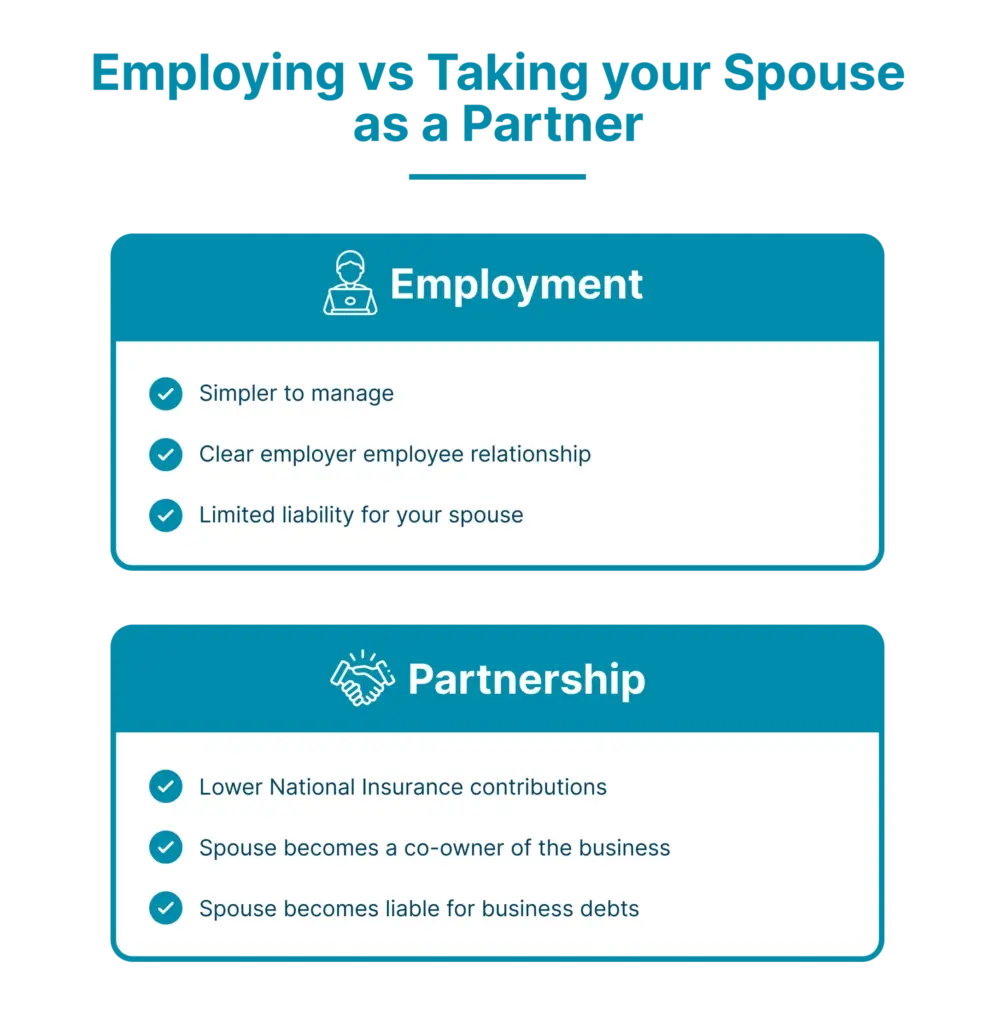
Partnership Advantages:
- Much lower National Insurance contributions
- Your spouse becomes a co-owner of the business
- Profits are split between partners
Partnership Disadvantages:
- Your spouse becomes liable for business debts
- More complex to set up and run
- Requires genuine partnership involvement
Employment Advantages:
- Simpler to manage
- Clear employer-employee relationship
- Limited liability for your spouse
Employment Disadvantages:
- Higher National Insurance costs on larger salaries
- More payroll administration
The right choice depends on your situation. Speaking to an accountant can help you decide which structure saves you the most tax.
Statutory Sick Pay: What Spouse Employers need to know for 2026-27?
The weekly rate of Statutory Sick Pay for 2026-27 is £123.25, or 80% of the employee’s average weekly earnings, whichever is lower.
This applies from the first day of illness and covers all employees, including a spouse you employ. Ensure your payroll is set up to handle SSP correctly from day one of any absence.
Common mistakes to avoid
- Paying too much: Don’t pay your spouse £40,000 for basic admin work. HMRC will spot this and could disallow the expense.
- No real work: Your spouse must actually work for the business. Paying them for doing nothing is tax evasion.
- Poor record keeping: Keep detailed records of what your spouse does and when they’re paid.
- Using Joint Accounts: Always pay your spouse’s salary into their individual bank account.
- Ignoring PAYE: Even if your spouse earns below the tax threshold, you still need proper payroll records.
- Missing the LEL: For 2026-27, ensure your spouse earns at least £6,708 per year to maintain their State Pension entitlement.
Conclusion
For many small business owners, employing a spouse makes perfect sense. Whether you are paying your wife through a limited company or operating as a sole trader employing your spouse, the tax savings can be substantial when the arrangement is set up correctly.
However, it must be a legitimate arrangement. HMRC’s rules on employing your spouse are clear: the work must be real, the salary must be fair, and you must follow proper PAYE and record-keeping procedures. Falling short of these requirements can lead to HMRC disallowing the expense and, in serious cases, treating the arrangement as tax evasion.
Before making any decisions, speak to a qualified accountant. They can look at your specific circumstances and advise on the most tax-efficient way to structure your household income for 2026-27 and beyond.
Disclaimer: Tax rules and thresholds are subject to change. Always refer to HMRC’s official guidance or consult a qualified tax adviser for advice specific to your circumstances.
Frequently Asked Questions
Can I employ my spouse if they have another job?
Yes, but ensure their tax code is correct for 2026/27. Use BR or D0 if their main job exceeds the £12,570 Personal Allowance; they’ll pay tax on all second job earnings.
How much should I pay my spouse?
Pay a fair wage for work done. For 2026/27, up to £12,570 is tax-efficient with Employment Allowance; no spouse tax or NI, allowance covers employer NI. Without it, add 15% employer NI above £5,000.
Do I need a written employment contract?
Not legally required but highly recommended. A contract, job description and hours records prove genuine work to HMRC.
What if HMRC investigates?
Show evidence of real work, reasonable salary, duties, hours and payments. Legitimate arrangements face no issues.
Can my spouse be a director instead of an employee?
Yes, in limited companies. They can take small salary plus dividends for tax efficiency, but must perform genuine director duties.
Will employing my spouse affect their benefits?
Yes, earnings may reduce means-tested benefits like Universal Credit. Check impacts first.
What happens if we separate or divorce?
Your spouse keeps full employee rights. Add contract terms for relationship changes.
Can I backdate my spouse’s employment for tax purposes?
No, claim relief only for genuine work periods paid. Backdating is fraud; HMRC acts firmly.
Does employing my spouse trigger employer National Insurance?
Yes, 15% on earnings above £5,000 from April 2026. On £12,570 it costs about £1,136 yearly. Employment Allowance of £10,500 covers it if eligible; single-director firms cannot claim.
What is the most tax-efficient salary to pay my spouse in 2026/27?
Up to £12,570 if claiming Employment Allowance; no spouse tax or NI, allowance offsets employer NI. Without it, balance tax savings against 15% NI over £5,000. Consult your accountant.

Divyanshi is a subject matter expert in the UK accounting space, creating clear and easy-to-read content for accountants and businesses. She covers topics such as VAT returns, Self-assessment tax, bookkeeping, business planning and Year-end accounts. By understanding the common challenges faced by accountants and business owners, she focuses on writing content that answers real questions and simplifies complex topics. Her approach keeps information clear, relevant and useful for everyday business needs.