
Revenue rises, workloads increase and teams operate at full capacity, yet year-end profit often changes very little. Many business owners respond by chasing more sales, but the underlying issue is usually elsewhere.
Profitability often declines gradually through prices that were never reviewed, customers whose demands outgrew the fee structure and cost that increased unnoticed alongside revenue.
This guide explains where profit erosion commonly occurs, what the profit and loss account reveals when analysed properly and which changes are most likely to improve profitability rather than simply increase activity.
Key takeaways
- Businesses with similar turnover can have very different profit margins. Revenue alone does not reflect financial health.
- Profitability often declines gradually through underpricing, an unprofitable customer mix and rising overheads.
- Metrics such as gross profit margin, contribution, debtor days and interest cover help identify where profit is being lost.
- The UK corporation tax marginal relief band applies to taxable profits between £50,000 and £250,000.
- Profit improvement measures work best when guided by financial analysis rather than assumptions.
Why does Higher Turnover not guarantee Higher Profit?
A business can issue more invoices, accept additional work and report higher turnover while keeping almost nothing additional at year-end.
This happens when new work involves a lower margin than existing work, when pricing has not kept pace with rising costs or when more resource is being consumed per client than the fee structure accounts for.
Two businesses with similar turnover can generate very different profits. For example, a business with £700,000 in sales and a 15% net margin can outperform one with £850,000 in sales and an 8% net margin.
Profitability depends on the relationship between revenue, direct costs, overheads, customer mix and financing decisions. When any one of those changes without being reviewed, the effect accumulates gradually until it becomes visible in the final accounts.
What the Profit and Loss Account shows that Turnover does not?
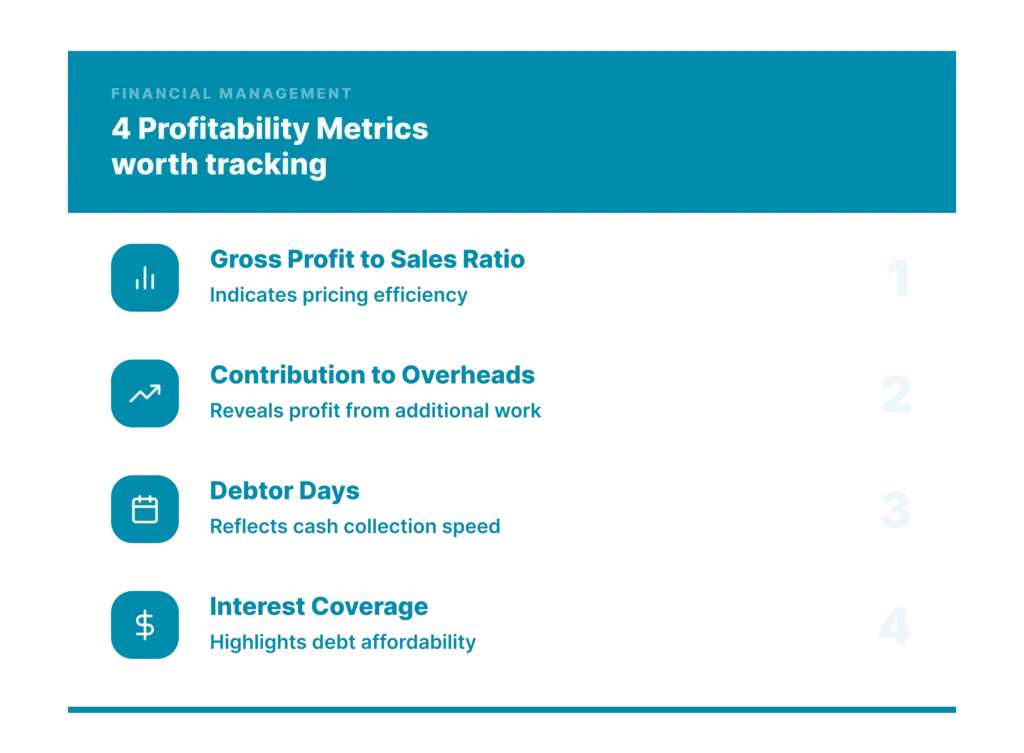
A profit and loss account answers the profitability question far more accurately than a bank balance, provided the right questions are asked of it rather than just the totals being read. Four ratios, each tied to a specific question, are usually enough to identify where margin is being lost.
Gross Profit to Sales Ratio
If sales increased but profit remained largely unchanged, gross profit as a percentage of sales is the figure that explains the gap.
A ratio declining over several periods, even while turnover rises, indicates that pricing or direct costs are absorbing additional revenue before it reaches the bottom line.
For service businesses, gross margin shows how efficiently billable work is converted into revenue, while net margin shows what remains after overheads, financing costs and taxes have been paid.
Contribution to overheads
Where a business is increasing work volume but generating very little additional profit, contribution against overheads identifies the problem.
Where the contribution each piece of work generates after direct costs barely covers the fixed cost base, additional volume produces activity rather than profit.
Debtor days
Debtor days measures the average number of days customers take to pay. Rising payment times alongside increasing turnover can indicate that a business is financing its own growth rather than collecting the profit it has already earned.
Credit control also influences profitability. Prompt invoicing, clear payment terms and regular follow-ups help reduce debtor days and bring cash into the business more quickly.
Interest coverage
A business carrying more debt than its operating profit can comfortably support may struggle to improve margins through pricing or cost reductions alone.
Interest coverage shows how easily operating profit covers interest payments. A declining ratio limits the benefit of other profit improvement measures.
These ratios rarely point to a single issue. Falling gross margins combined with rising debtor days often indicate pricing pressure alongside an unprofitable customer mix, helping businesses focus on the areas that need attention.
Eight ways to increase Profitability
Each of the following addresses a specific diagnostic finding. They are not a general checklist to be applied uniformly. The value of each depends on which of the four diagnostics above identified it as the relevant problem.
1. Reprice work where margin has declined
A sale priced at £100 with £70 in direct costs produces a 30% gross margin. Raising that price to £105 with no change in costs lifts profit from £30 to £35, a 16.7% improvement from a 5% price change, with no additional cost incurred.
Pricing often becomes outdated as costs rise or the scope of work expands. The impact may not be obvious on individual jobs but usually appears over time in a declining gross margin ratio.
The most defensible place to begin repricing is work that already generates friction: jobs that consistently overrun, clients who negotiate hardest at renewal and services priced before the last significant cost increase.
2. Review profitability at customer level
Customer profitability measures the actual margin a client generates after accounting for discounts applied, time spent on unpaid revisions and any non-standard commercial terms not just the revenue they produce.
A customer producing £50,000 in annual revenue but requiring constant rework, multiple approval rounds and discounted rates can contribute less actual profit than a customer generating £20,000 with none of those demands.
Ranking customers by revenue alone obscures this entirely. The result of measuring at customer level usually changes the ranking significantly.
3. Track and bill follow-up time
Most service businesses price the initial brief or engagement, then absorb every subsequent call, revision request and clarification email as an unmarked cost of doing business. That time represents real margin leaving the business without appearing anywhere as a line item.
The effect is a calendar that becomes progressively busier without a corresponding increase in revenue.
Tracking how much follow-up time is used per client each month and whether that volume justifies a separate charge or a restructured fee, is one of the least visible and most recoverable sources of margin in a service business.
4. Compare P&L profitability against staff time allocation
A client who pays on time and at full price can still represent a net cost if their account consumes a disproportionate share of senior staff time relative to clients of similar or greater revenue. The profit and loss account records what was billed and what was spent. It does not record which clients those costs were concentrated in.
Reviewing staff time allocation against client contribution, rather than against revenue alone, identifies relationships where the P&L records profitability that the actual resource allocation does not support.
5. Review owner remuneration and dividends
The split between salary and dividends affects both personal tax and the company’s taxable profit. A salary set too high increases employer National Insurance and reduces retained profit unnecessarily. A salary set too low may miss the personal allowance or National Insurance thresholds that make a modest salary tax-efficient.
Reviewing the remuneration structure annually, particularly when profit levels shift, ensures the split between salary and dividends reflects the current position rather than a decision made in a different tax year.
6. Align the accounting year-end with the income pattern
A business that completes most large projects or recognises most significant revenue in the weeks immediately before its year-end has very little time to plan the tax position before the period closes.
Shifting the accounting reference date to a point that naturally follows the busiest income period creates time to consider capital expenditure, director remuneration and other decisions before the year closes rather than after.
7. Plan profit timing against Corporation Tax thresholds
Taxable profits below £50,000 are taxed at 19% under the small profits rate. Profits above £250,000 are taxed at 25% under the main rate.
Profits between £50,000 and £250,000 qualify for Marginal Relief, which gradually increases the effective rate between the two.
For example: A company forecasting profit of £95,000 that moves planned capital expenditure of £20,000 into the same accounting period reduces taxable profit to £75,000.
The expenditure was already committed before the timing decision was made. The timing determines whether part of the profit is taxed within the Marginal Relief band or at the 19% small profits rate.
8. Improve operational efficiency before funding growth
Where the analysis shows that increasing work volume produces very little additional profit, the instinct is often to increase volume further. The more effective response is to reduce the cost of delivering the work already being done.
Removing a manual step or resolving a recurring bottleneck reduces cost across every job the business currently does. A business that improves delivery efficiency first enters any growth phase with a stronger margin on every additional customer it wins.
How to confirm that a change has improved Profitability?
Improving profitability means checking whether the figures that highlighted the issue have also improved.
- After a pricing change, review gross profit as a percentage of sales. If it has not increased within one or two billing cycles, discounts or unpriced scope changes may be offsetting the benefit.
- After reviewing customer relationships or recovering unbilled time, assess contribution to overheads and customer profitability to confirm that resources are being used more effectively.
- After operational improvements, monitor net profit margin over the following quarter to determine whether cost savings are reflected in the overall result.
Using the same measures to identify and review profitability issues helps businesses track whether changes are producing the intended outcome.
Conclusion
Profitability does not usually decline because of one decision. Revenue, costs, customer demands and tax timing become misaligned gradually and nothing forces a business to identify that until the accounts confirm what the level of activity was concealing.
DNS CloudCo works with UK businesses and accounting practices on profitability diagnostics, pricing reviews and corporation tax planning, identifying where margin is being lost before it becomes visible in a year-end result that is harder to act on.
Call 01908 886755 or email info@dnscloudco.co.uk to speak with the team.
FAQs
How can a business improve profit without increasing sales?
Yes, businesses can improve profitability by repricing work, reducing inefficiencies, recovering unbilled time and reviewing customer profitability before pursuing additional sales.
What is the first profitability metric to check?
Gross profit as a percentage of sales is usually the best starting point. A declining ratio often highlights pricing pressure or rising direct costs before the impact becomes visible in net profit.
Can slow payments reduce profitability?
Yes, slow payments can tie up cash within the business and increase financing costs. Effective credit control helps convert profit into cash more quickly.
What is the difference between gross and net profit?
Gross profit shows what remains after direct costs are deducted from revenue. Net profit shows what remains after overheads, financing costs, taxes and other expenses have been accounted for.
Does changing the year-end increase profit?
No, changing the accounting year-end does not create additional profit. It can, however, provide more time to plan expenditure, remuneration and other decisions before the accounting period closes.
How long before a profitability change produces measurable results?
Pricing changes often affect gross margin within one or two billing cycles, while operational improvements may take a full quarter to be reflected in net profit.
What is the clearest sign that a client relationship has become unprofitable?
Repeated revisions, unbilled follow-up work, frequent discounts and disproportionate use of staff time can indicate that a customer relationship is reducing overall profitability.
Should profitability measures be reviewed only when profit has declined?
No, reviewing key profitability measures regularly helps identify pricing pressure, rising costs and inefficient resource allocation before they become visible in year-end results.

Divyanshi is a subject matter expert in the UK accounting space, creating clear and easy-to-read content for accountants and businesses. She covers topics such as VAT returns, Self-assessment tax, bookkeeping, business planning and Year-end accounts. By understanding the common challenges faced by accountants and business owners, she focuses on writing content that answers real questions and simplifies complex topics. Her approach keeps information clear, relevant and useful for everyday business needs.