
Audit season puts pressure on UK firms. Your team is overworked, deadlines are approaching, and the workload keeps growing. You can’t miss filing deadlines or deliver poor work, but hiring full-time senior staff just for busy periods is too expensive.
This is where specialist audit services help. Experienced qualified auditors work with you when needed handling your audits properly and on time without the cost of permanent employees.
This guide covers:
Why CAA-qualified auditors matter for specialist work
Cost structures and pricing models for outsourced audit services
How firms manage deadlines effectively with external support
What to look for when choosing audit partners
Why CAA-Qualified Auditors Matter for UK Firms?
CAA (Chartered Accountant in Audit) qualification represents a specific level of technical knowledge that’s essential when handling complex audit work. According to ICAEW, these professionals understand International Standards on Auditing (UK) inside out and know exactly what the Financial Reporting Council (FRC) expects in terms of documentation and quality control.
Deep Technical Knowledge for Complex Sectors
Certain sectors demand more than basic audit skills. Here’s where CAA-qualified auditors make a real difference:
- CASS audits for financial services firms require understanding of Client Assets Sourcebook rules per the FCA Handbook and specific regulatory reporting
- Charity audits involve fund accounting requirements and Charity Commission reporting frameworks
- SRA audits need knowledge of Solicitors Regulation Authority compliance and trust account testing
Many audit firms offering specialist services employ teams with Big 4 backgrounds. These auditors have worked on large, complex jobs and understand how to handle:
- Difficult accounting treatments and technical standards
- Consolidated financial statements with multiple entities
- Industry-specific reporting requirements
- Unusual transactions that need specialist knowledge
Need help with a complex audit? Talk to our team about your specific requirements.
Scalability During Peak Periods
UK audit firms typically face capacity problems between January and April when most year-end clients need work completed. Here’s why outsourced audit services solve this problem:
- You can scale up quickly without long recruitment processes
- Experienced professionals can start working on files within days
- No problems during quieter months when you don’t need extra capacity
- You take on more clients during busy periods without overwhelming your team
- Once the peak passes, you scale back down without redundancy costs
Quality Control and FRC Compliance
The FRC has clear expectations for audit file quality. Experienced CAA-qualified auditors deliver working papers that meet these standards because they:
- Understand exactly what regulators look for during reviews
- Know how to document professional skepticism properly
- Produce thorough testing documentation that supports conclusions
- Create files that tell a clear story about the audit work performed
Firms that use specialist audit support often report better outcomes in quality reviews. The documentation is complete, the testing is appropriate and regulators find fewer issues during inspections.
Cost Structures: What UK Firms Actually Pay?
Understanding pricing for specialist audit services helps you budget accurately and compare options. Here’s what the market looks like in 2026.
Working Paper Preparation Costs
| Service Type | Typical Price Range | What’s Included |
|---|---|---|
| Basic working paper support | £800 – £1,500 per file | Lead schedules, basic substantive testing, formatting |
| Standard audit file preparation | £1,500 – £2,500 per file | Full working papers, testing documentation, review notes |
| Complex audit support (CASS, group audits) | £2,500 – £3,500 per file | Specialist testing, complex accounting areas, detailed documentation |
These figures represent market rates for outsourcing working paper preparation to specialist teams. The actual cost depends on:
- Client complexity and size
- Audit scope and areas requiring testing
- Level of support needed from your team
- Timescales and deadline pressures
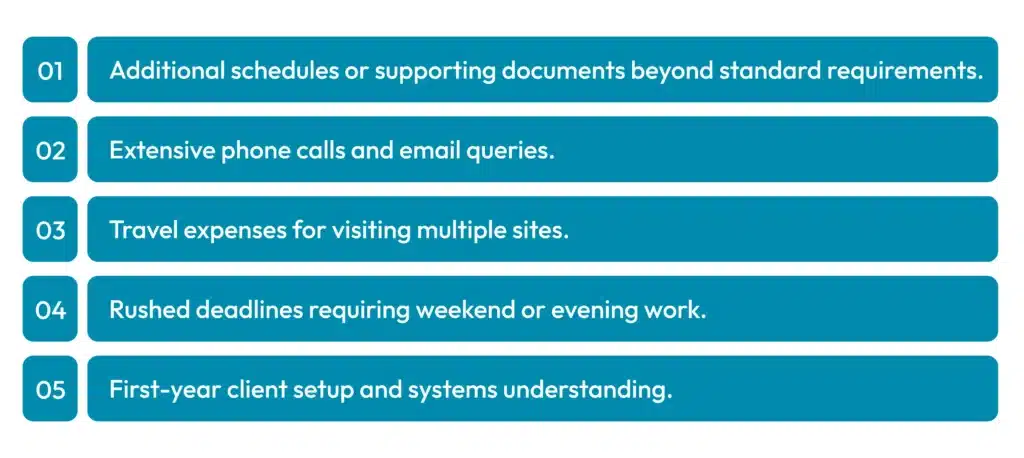
Common factors that increase UK audit fees beyond standard pricing
Cost Saving Compared to In-House work
Many firms find significant cost advantages when outsourcing working paper preparation. The savings come from several factors:
- Senior staff often spend a substantial portion of their time on documentation rather than review the work
- Specialist teams typically work more efficiently on documentation tasks due to their focused expertise
- You avoid employment costs like National Insurance, pension contributions and benefits
- No recruitment or training expenses for documentation work
- Senior staff freed up for higher-value activities like client relationships and technical consultations
Practical example: Consider a senior auditor costing £50,000 annually. If a significant portion of their time goes to working paper documentation, outsourcing that work at £2,000 per file for 15 files (£30,000 total) could prove more cost-effective while freeing your senior person for client work, risk assessment and business development.
The actual savings vary by firm depending on your current cost structure, staff utilisation rates and the complexity of files you outsource. We recommend calculating your own costs by tracking how your team currently spends their time during audit season.
Integrated Team Models
Some audit companies offer integrated team arrangements where their auditors work as an extension of your firm. These models typically involve:
- Monthly retainers for guaranteed capacity during busy periods
- Per-file pricing for variable workloads when you need flexibility
- Hybrid structures combining both approaches based on your needs
Pricing varies based on:
- Volume of work you commit to
- Level of responsibility the external team takes on
- Whether they handle full audits or just working paper preparation
- Support for fieldwork coordination and client communication
How Deadline Management Actually Works?
Meeting Companies House filing deadlines requires planning and execution. Here’s how specialist audit firms ensure timely completion.
Hybrid and Offshore Working Models
Many audit companies in the UK now use hybrid models that combine onshore and offshore teams. The typical process works in three stages:
Stage 1: Planning and risk assessment
- UK-based team handles initial planning meetings
- Understands the client and their business
- Identifies audit risks and key areas
- Sets scope and testing approach
Stage 2: Working paper preparation
- Offshore team (often in India or Philippines) prepares detailed working papers
- Work continues during UK night hours for faster turnaround
- Detailed testing documentation and lead schedules completed
- Queries flagged for UK team to resolve
Stage 3: Review and finalisation
- UK team reviews all work produced
- Resolves outstanding queries with clients
- Completes partner review and sign-off
- Files submitted to Companies House
This model significantly speeds up completion. In many cases, hybrid models can reduce completion timelines from around 3–5 weeks to closer to 2–3 weeks, depending on client responsiveness and audit complexity.
Progress Tracking and Communication
Professional audit support firms use project management systems to track progress. You get regular updates on:
- Which sections are complete and ready for review
- Outstanding queries requiring client information
- Expected completion dates based on current progress
- Any delays or issues that need attention
This visibility helps you manage client expectations and plan your own review time effectively. You’re not waiting until week four to discover problems that should have been addressed in week one.
Buffer Time for Quality Review
Good deadline management includes buffer time for thorough review. The best approach involves:
- Completing working papers 1-2 weeks before the filing deadline
- Allowing proper time for partner review and sign-off
- Building in contingency for unexpected issues or additional procedures
- Not rushing sign-off just to meet a deadline
Well-established outsourced audit providers typically build these buffers into their timelines. They understand that rushing creates quality risks that outweigh the speed benefits.
In-House vs Outsourced Audit Support: Quick Comparison
| Factor | In-House Team | Outsourced Support |
|---|---|---|
| Cost Structure | Fixed salaries, NI, pensions, benefits | Variable cost per file |
| Scalability | Limited by headcount | Flexible capacity |
| Peak Period Capacity | Team stretched, overtime needed | Scale up without hiring |
| Technical Expertise | Depends on team skills | Access to specialists |
| Quality Control | Internal processes | Provider processes + your review |
| Staff Wellbeing | Risk of burnout during busy periods | More balanced workload |
| Control | Direct oversight | Requires coordination |
| Recruitment Risk | Hiring/retention challenges | Provider’s responsibility |
Data Security & Confidentiality
When outsourcing audit work, data security is non-negotiable. UK firms must ensure their partners maintain robust protections for client information.
Look for providers who demonstrate:
- ISO 27001 certification or equivalent information security standards
- Secure file transfer protocols with encryption for all data transmission
- Confidentiality agreements signed by all team members
- GDPR compliance with clear data processing agreements
- Access controls limiting who can view client information
- Regular security audits and penetration testing
- Data retention policies that align with UK requirements
Ask potential partners specific questions about their security measures. Where are files stored? Who has access? How is data destroyed after engagement completion? What happens in case of a breach?
Reputable firms will have clear, documented answers to these questions. If a provider is vague about security, that’s a red flag. Your clients trust you with their financial data, and that trust extends to anyone you work with.
Questions about our security measures? Ask us anything about how we protect your data.
Conclusion
The demands on UK audit firms continue to grow. Clients want competitive fees and fast turnaround, regulators expect high-quality documentation and your team can only work so many hours.
Specialist audit and assurance services offer a practical solution. Working with experienced CAA-qualified auditors gives you the capacity to handle peak periods, the expertise to manage complex sectors and the flexibility to grow without hiring permanent staff.
Start small with a pilot project, set clear expectations and monitor quality carefully. When you find the right fit, you’ll free up your senior team to focus on client relationships and business growth.
For firms ready to scale or simply survive the next audit season without burnout, specialist audit support is becoming a necessary part of running a modern UK audit practice.
Ready to explore how specialist audit support could work for your firm?
Speak to a specialist audit support team to discuss your specific needs and see if outsourcing makes sense for your practice.
Frequently Asked Questions
What qualifications should a specialist auditor in the UK have?
Look for CAA, ACA, or ACCA members with audit practice certificates who are registered auditors understanding ISA (UK) standards and FRC requirements.
How much does an audit cost in the UK?
Outsourced working paper support typically costs £800-£3,500 per file depending on complexity, with fees increasing for group audits, specialist sectors, or tight deadlines.
How do you manage audit deadlines for UK companies?
Professional firms use hybrid working models combining UK and offshore teams to reduce completion timelines to 2-3 weeks, with daily progress tracking and buffer time built in.
What is included in your audit scope for UK firms?
Most outsourced services include working paper preparation and substantive testing but exclude planning and client communication, though some providers offer full-service audits.
What post-audit support do you provide?
Reputable firms provide 12 months of post-audit support for queries related to their work, including explaining working papers to regulators and providing additional documentation.

Divyanshi is a subject matter expert in the UK accounting space, creating clear and easy-to-read content for accountants and businesses. She covers topics such as VAT returns, Self-assessment tax, bookkeeping, business planning and Year-end accounts. By understanding the common challenges faced by accountants and business owners, she focuses on writing content that answers real questions and simplifies complex topics. Her approach keeps information clear, relevant and useful for everyday business needs.