A business can close the year in profit and still spend January chasing a supplier payment it can’t yet cover. The timing gap between a sale and the cash actually landing in the account is where most cash problems start, even in a business that’s otherwise doing well.
This gap matters more this year. In the UK, GDP will grow by only 0.7% in 2026. Consumer spending will also grow by 0.7%, says KPMG’s latest outlook. This is slower than the 1% growth seen in 2025. With growth weak on both sides, an unplanned bill is harder to cover.
This is written for the people managing that timing gap directly: business owners running their own forecasts and finance leads keeping cash flow mapped against fixed payment dates.
Key takeaways
- A forecast tracks money by the date it actually moves, which is what separates it from a budget checked once a year.
- UK tax bills come as large, one-off payments on fixed dates, not spread evenly through the year.
- Lumpy costs, the ones that appear once a year rather than monthly, cause more forecasting misses than day-to-day expenses.
- A forecast is only useful if it is updated with actual results regularly. Otherwise, it quickly loses accuracy.
- Use realistic sales estimates. Overestimating revenue is one of the most common forecasting mistakes.
Benefits of Financial Forecasting for UK Businesses
Financial forecasting brings more than one benefit to a UK business. Its impact reaches cash flow, cost control and credibility with lenders. Some of the main ones are explained below.
It shows a cash gap before it becomes serious
UK company insolvencies ran at 50.9 per 10,000 companies in the year to May 2026. Most closed through a creditor’s voluntary liquidation, the route a company takes once it can no longer keep trading. A forecast shows this risk months ahead, in the gap between an invoice raised and cash received.
It keeps rising expenses in view
Inflation is expected to peak near 3.6% in September, according to KPMG. A forecast places that pressure in a specific month, rather than leaving it to show up in the bank balance.
It’s what lenders, investors and HMRC ask to see
A lender wants proof a loan can be repaid. An investor wants evidence of a plan behind the numbers. HMRC asks for one when a business applies for a Time to Pay arrangement. A forecast can answer that request directly. A budget checked once a year cannot.
Growth is weaker this year, so SME financial management depends more on a live forecast than an annual budget. What a forecast needs to track next depends on its type.
What a Forecast needs to track and how often?
No single forecast answers every financial question. Most businesses use several types of forecasts, each focusing on a different area such as cash flow, sales, costs, or growth. The update frequency depends on how quickly that area changes.
The table below shows the key forecasts businesses rely on, what each one predicts, and how often it should be reviewed.
| Type | What It Predicts | Update Frequency |
|---|---|---|
| Cash flow forecasting | When money actually moves in and out of the account | Weekly to monthly |
| Sales forecasting | Expected revenue from products or services | Monthly |
| Cost forecasting | Fixed and variable expenses ahead | Monthly to quarterly |
| Growth forecasting | Revenue and profit direction over a longer period | Quarterly |
- Cash flow forecasting tracks money by the date it actually moves. A £5,000 invoice raised in June but not paid until August shows up as a gap in July, not as an average smoothed across the quarter.
- Sales forecasting produces the revenue projections that cost and cash flow forecasts build from first, using past trading where it exists and reasonable assumptions about demand where it doesn’t.
- Cost forecasting separates fixed costs, such as rent and salaries, from variable ones, such as materials and delivery, so each responds correctly when assumptions change.
- Growth forecasting, sometimes called profit forecasting, tracks revenue and profit direction over a longer period and feeds directly into decisions about reinvestment and expansion.
The UK tax dates a forecast can’t miss
A forecast built for a UK business need each of these mapped to the exact month it falls due not left as a rough estimate for later in the year:
- VAT is due one calendar month and seven days after the end of the VAT accounting period.
- Corporation Tax is due nine months and one day after the end of the accounting period, which puts it well outside the month most businesses associate with tax.
- PAYE is due by the 22nd of the following month if paid electronically, or the 19th by post.
- Self-Assessment balancing payments and first payments on account are due by 31 January, with a second payment on account due by 31 July.
Corporation Tax causes the most forecasting misses of the four. It isn’t that businesses forget it exists; it’s that nine months is long enough to lose track of exactly when it lands against a normal monthly view. Building the date into the forecast directly removes one of the more avoidable causes of a cash gap.
The cost a Forecast usually misses
Rent and payroll are predictable, so most businesses budget for them without trouble. The cost that get missed are the ones that only appear once a year:
- The insurance renewal that comes as one lump sum instead of twelve smaller ones.
- The van or laptop that needs replacing months before it was due.
- The software subscription that renews automatically, at a price nobody checked.
- The tax bill that has been building all year and lands as a single number.
The tax bill is the most predictable of the four, since the dates never move.
How do you build a Financial Forecast step by step?
Before starting, a business needs its last twelve months of sales and bank statements, confirmed tax dates for the year ahead, any loan or lease repayment schedule and known lumpy costs such as an insurance renewal or equipment due for replacement.
- Start with a sales forecast: Getting this number right matters more than any other step, since cost and cash flow forecasts build directly from it. A cautious figure, based on past trading where it exists, holds up better than an optimistic one.
- Build an expenses budget: Listing fixed costs such as rent and salaries apart from variable costs such as materials and delivery keeps each one responding correctly when assumptions change later.
- Develop a cash flow statement: Expected receipts mapped against expected payments by month catch a cash gap before it happens. Averaged across the year, the same gap disappears into a number that looks fine. A £10,000 sale in June that isn’t paid until August needs that gap built into the statement directly.
- Calculate income projections: Combining sales, cost and cash flow show gross margin and, after tax and interest, net profit.
- Account for assets and liabilities: Including what the business owns and owes, including loan repayments due later in the year, keeps the forecast complete rather than showing only the trading side.
- Run a breakeven check: Identifying the point where cost and revenue meet gives the forecast a reference point for every month that follows.
What turns a working Forecast into Forecast Drift?
A forecast usually stops working for one of a handful of reasons. None of them are forecasting failures in the technical sense; they’re habits that quietly separate the forecast from what’s actually in the bank:
- Using the invoice date instead of the payment date, which makes the account look healthier than it is.
- Writing the forecast once and never returning to it, so it stops reflecting what is actually happening.
- Leaving out irregular annual costs that don’t appear in a normal monthly average.
- Treating profit and available cash as the same figure, when they rarely move together.
- Building the forecast from a hoped-for sales number instead of a cautious one.
A forecast checked against real figures each month catches drift while it’s still a small correction. One left untouched for a quarter usually needs rebuilding from the sales line up.
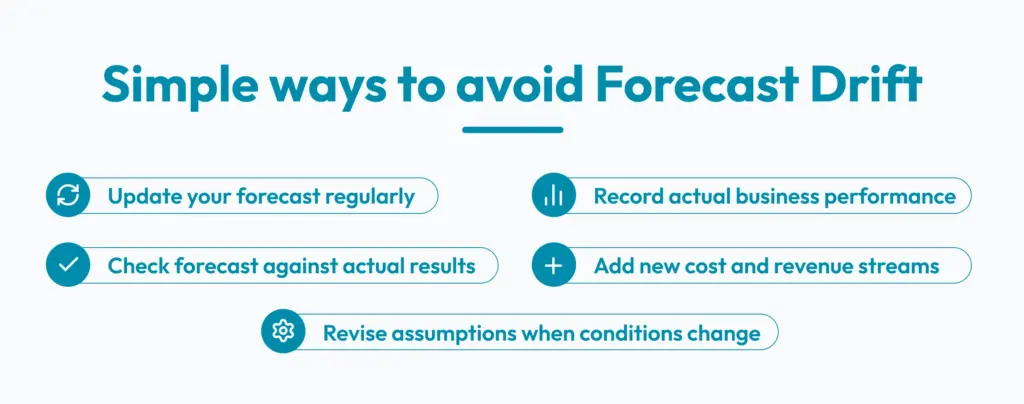
The process of keeping a forecast accurate matters more than the software used to create it. Businesses can use simple spreadsheets or dedicated forecasting tools, depending on how detailed their planning needs to be.
Tools that support a Forecast
Businesses use different tools to prepare and maintain financial forecasts, from basic spreadsheets to dedicated forecasting software. Each option is suited to a different level of financial planning and reporting.
The table below compares some of the most commonly used forecasting tools and the situations they are best suited for.
| Tool | Best for |
|---|---|
| Spreadsheet (Excel or Google Sheets) | Simple trading, provided someone updates it regularly |
| Xero or QuickBooks | Everyday bookkeeping with live bank data feeding in |
| Float or Fathom | Rolling cash flow forecasts built directly from accounting data |
| Pulse or Spotlight Reporting | Scenario modelling to compare best and worst cases |
| Brixx | Longer-term financial planning beyond day-to-day bookkeeping |
The tool matters less than the habit of returning to it. A simple spreadsheet, kept current, holds up better than an advanced tool nobody updates.
Conclusion
A financial forecast will not remove the uncertainty of running a business, but it does mean fewer surprises. Knowing a tax bill is coming in October or that August is usually tight, changes what a business does about it in June rather than in October.
Getting the assumptions right matters more than the tool used to build them and that’s often where professional guidance helps most, spotting a sales number that’s too optimistic or a cost that’s been missed before it becomes a problem.
DNS CloudCo’s business planning support covers exactly this kind of forward planning. Call 01908 886755, email info@dnscloudco.co.uk or visit our website to find out more.
FAQs
What information does a business need to have ready before building a forecast?
Twelve months of sales and bank statements confirmed tax dates for the year ahead, any loan or lease repayments and known lumpy costs such as an insurance renewal or equipment replacement. Gathering these first makes the forecast usable from day one.
How quickly can a usable forecast be put together if a business doesn’t already have one?
A basic twelve-month forecast can usually be built within a week once the figures above are gathered. Checking it against real numbers each month afterwards is what keeps it accurate; a forecast left untouched stops being one.
Does a forecast need rebuilding every time a quarter comes in worse than expected?
No, a forecast should be adjusted against the new figures rather than rebuilt from scratch. A full rebuild is usually only needed once it’s been left unchecked for months and drifted too far from what’s actually happening.
Does a sole trader need a financial forecast or is it only useful for larger businesses?
Sole traders benefit from forecasting as much as larger businesses, particularly around Self-Assessment payments on account and irregular income. A forecast doesn’t need to be complex to be useful.
Should VAT be included in a forecast if the business isn’t VAT registered yet?
No, VAT only needs mapping into a forecast once a business is VAT registered, whether voluntarily or because it passed the registration threshold. Below that, VAT isn’t a cash flow concern yet.